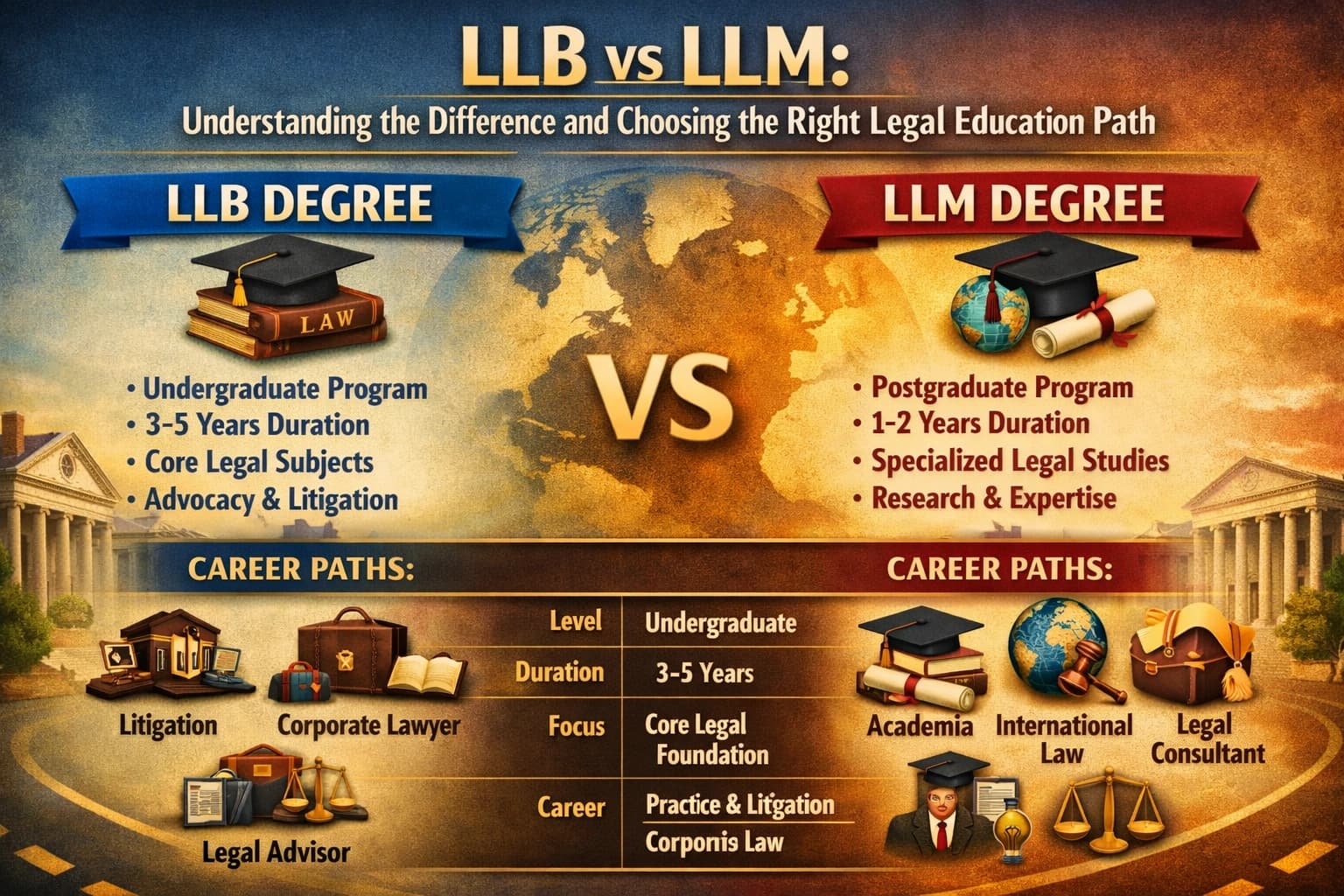
Students interested in legal education often come across two important academic programmes—LLB (Bachelor of Laws) and LLM (Master of Laws). While both are respected law degrees, they serve different academic purposes and are designed for different stages of a student's educational journey.
Understanding the difference between these two programmes can help students make informed decisions about their future. Whether you are beginning your legal studies or considering postgraduate education, knowing what each programme offers is essential for planning your academic and professional growth.
What is an LLB?
An LLB (Bachelor of Laws) is an undergraduate or graduate-level law degree that introduces students to the fundamentals of legal education.
The programme focuses on developing knowledge of:
- Constitutional Law
- Criminal Law
- Contract Law
- Family Law
- Administrative Law
- Company Law
- Property Law
- Environmental Law
An LLB provides the academic foundation required to understand the legal system and legal principles.
What is an LLM?
An LLM (Master of Laws) is a postgraduate law degree pursued after completing an eligible law qualification.
Unlike an LLB, an LLM focuses on advanced legal studies and specialised knowledge.
Students usually explore:
- Advanced legal theories
- Research methodology
- Comparative legal studies
- Specialized legal subjects
- Academic writing
- Dissertation or research projects (depending on the university)
The programme is intended for students who wish to deepen their expertise in law.
Key Differences Between LLB and LLM
| Feature | LLB | LLM |
| Level | Undergraduate / Professional | Postgraduate |
| Purpose | Learn legal fundamentals | Develop specialised legal expertise |
| Focus | Broad legal education | Advanced legal studies |
| Learning Style | Foundation-based | Research-oriented |
| Suitable For | Students beginning legal education | Law graduates seeking higher studies |
Who Should Choose an LLB?
An LLB is suitable for students who:
- Want to begin legal education
- Are interested in understanding the legal system
- Wish to build a strong academic foundation
- Plan to pursue careers in law or related fields
- Want to develop legal reasoning and analytical thinking
It serves as the first major step toward a professional legal career.
Who Should Consider an LLM?
An LLM may be suitable for students who:
- Have completed an eligible law degree
- Enjoy advanced legal research
- Want to specialise in a particular branch of law
- Plan to pursue academic or research-oriented studies
- Wish to deepen their legal expertise
The programme allows students to explore legal subjects in greater depth.
Skills Developed During an LLB
An LLB helps students develop:
- Legal Reasoning
- Analytical Thinking
- Communication Skills
- Legal Writing
- Problem Solving
- Research Skills
- Professional Ethics
These skills create a strong academic and professional foundation.
Skills Developed During an LLM
An LLM focuses on strengthening:
- Advanced Legal Research
- Critical Analysis
- Academic Writing
- Legal Interpretation
- Independent Learning
- Specialized Knowledge
- Policy Evaluation
These abilities support postgraduate learning and specialised professional growth.
How to Decide Which Programme is Right for You
Ask yourself the following questions:
Are you beginning your legal education?
An LLB is generally the starting point for students entering the legal field.
Do you already have a law degree?
If yes, an LLM may help you pursue advanced academic knowledge.
Do you enjoy research?
Students interested in legal research often benefit from postgraduate legal education.
What are your long-term goals?
Choose a programme that aligns with your academic interests and professional aspirations.
Choosing the Right University
Whether you pursue an LLB or LLM, selecting the right university is an important decision.
Compare universities based on:
- Recognition and Approvals
- Faculty Expertise
- Academic Curriculum
- Research Opportunities
- Library Resources
- Student Support
- Learning Environment
- Career Guidance
A well-informed choice contributes to a stronger educational experience.
Why Professional Admission Guidance Matters
Many students find it difficult to compare universities, understand eligibility requirements, or complete admission formalities.
Professional guidance can help with:
- Course Selection
- University Comparison
- Eligibility Assessment
- Documentation Support
- Admission Planning
- Career Counselling
Seeking expert advice helps students make confident decisions.
Why Choose Vidyapun?
At Vidyapun, we help aspiring law students navigate every stage of their educational journey.
Our services include:
- LLB Admission Guidance
- LLM Admission Counselling
- University Comparison
- Eligibility Assessment
- Documentation Assistance
- Career Counselling
- Personalised Admission Support
Our experienced education counsellors help students choose recognised universities that match their academic interests and future career goals.
Frequently Asked Questions
What is the main difference between an LLB and an LLM?
An LLB provides foundational legal education, while an LLM focuses on advanced study and legal specialisation.
Can I pursue an LLM without completing an LLB?
Admission requirements vary by university. Students should check the eligibility criteria specified by their preferred institution.
Is an LLM compulsory after an LLB?
No. Pursuing an LLM is an optional academic pathway based on personal interests and career goals.
Which programme is better for beginners?
Students beginning legal education generally start with an undergraduate or eligible professional law programme such as an LLB, depending on the applicable admission pathway.
How can Vidyapun help with law admissions?
Vidyapun provides expert counselling, university comparison, admission guidance, eligibility assessment, and documentation support for both LLB and LLM aspirants.
Author's Note
Reviewed by the Vidyapun Education Team
This article is intended for educational purposes only. Admission requirements, programme structures, and university policies may vary. Students should always verify the latest information through official university sources before applying.
Conclusion
Both LLB and LLM play important roles in legal education, but they serve different academic objectives. An LLB helps students establish a strong legal foundation, while an LLM allows graduates to deepen their knowledge through advanced study and specialisation. Understanding the differences between these programmes enables students to choose the educational path that best supports their aspirations and long-term professional growth.
Build Your Legal Future with Vidyapun
Whether you are planning to start your legal education with an LLB or advance your expertise through an LLM, Vidyapun is here to guide you every step of the way.
🌐 Website: www.vidyapun.com
📞 Call / WhatsApp: +91 96438 02216
Contact Vidyapun today for expert admission guidance, university comparison, and personalised counselling to make the right choice for your legal education journey.