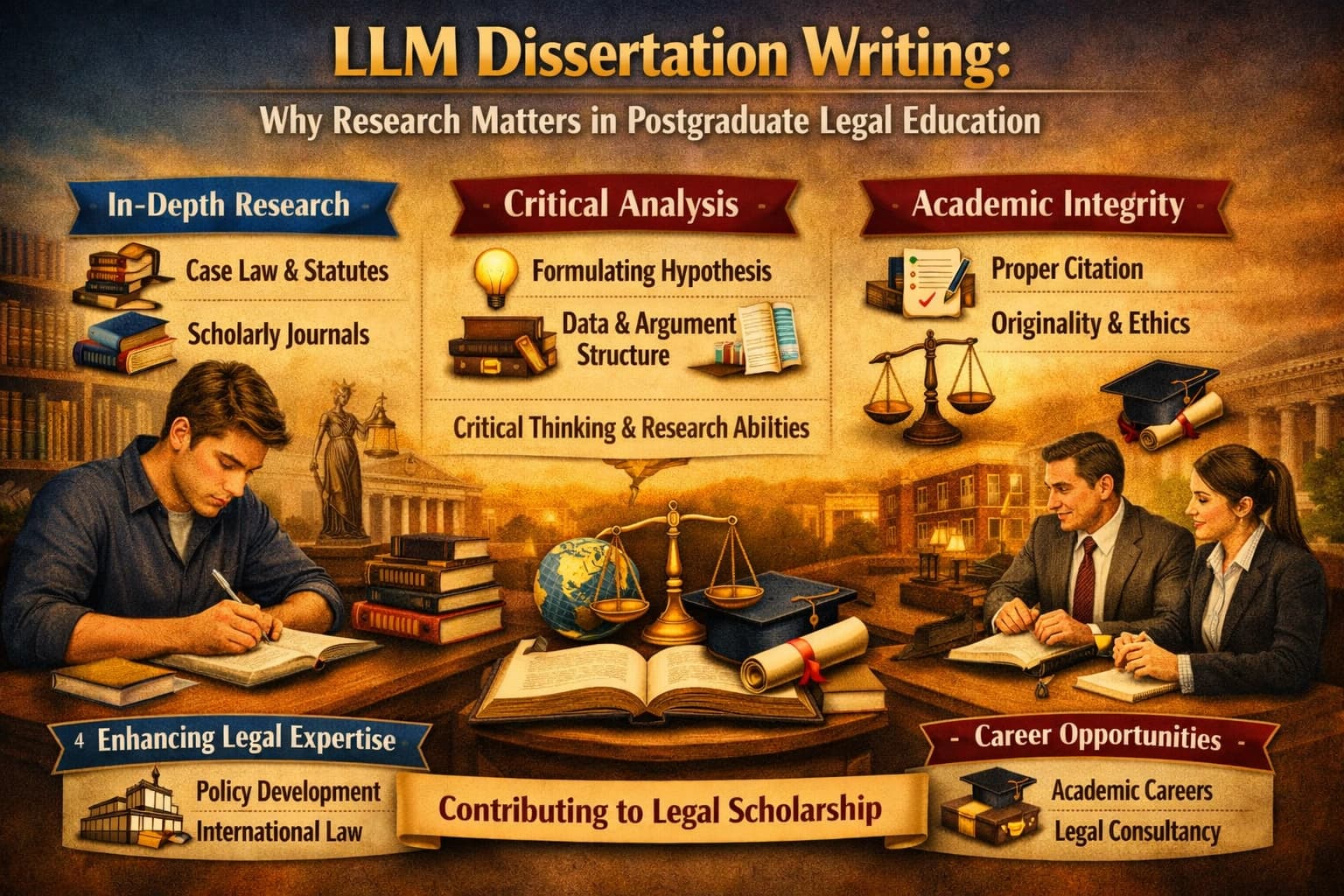
One of the defining features of an LLM programme is the opportunity to conduct advanced legal research through a dissertation or research project, depending on the university's curriculum. Unlike undergraduate legal education, postgraduate studies encourage students to investigate complex legal issues, evaluate existing legal frameworks, and contribute original academic insights.
An LLM dissertation is more than a graduation requirement. It develops independent thinking, advanced research skills, legal writing abilities, and subject-specific expertise that benefit students throughout their academic and professional careers.
What is an LLM Dissertation?
An LLM dissertation is an academic research project that focuses on a specific legal topic. Students select a research area, review legal literature, analyse statutes and judicial decisions, and present their findings in a structured academic format.
The objective is to demonstrate the ability to conduct independent legal research using recognised academic methods.
Why Dissertation Writing is Important
Dissertation writing strengthens several essential professional skills.
Students learn to:
- Conduct independent research
- Analyse legal issues critically
- Interpret legislation and judgments
- Present logical legal arguments
- Write academically
- Organise complex information effectively
These abilities are valuable in legal practice, higher education, policy research, and legal consultancy.
Choosing the Right Research Topic
Selecting an appropriate topic is one of the most important steps.
A good dissertation topic should be:
- Relevant to your area of interest
- Researchable using available resources
- Academically significant
- Clearly defined
- Practical within the available timeline
Students should choose topics that genuinely interest them, as they will spend considerable time researching and writing.
Sources Used in Legal Research
A quality dissertation is based on credible legal sources.
Students generally refer to:
- Statutes
- Constitutional Provisions
- Judicial Decisions
- Government Reports
- Academic Journals
- Law Commission Publications
- International Legal Materials
- University Library Resources
Using authentic sources improves the credibility of academic work.
Steps in Writing an LLM Dissertation
Although universities may follow different formats, dissertation writing usually includes the following stages.
Identifying the Research Problem
Clearly defining the legal issue that will be studied.
Literature Review
Reviewing previous research, legal articles, and academic publications related to the chosen topic.
Research Methodology
Selecting appropriate research methods for analysing legal issues.
Data Analysis
Examining statutes, judgments, comparative legal systems, or other relevant legal materials.
Conclusion
Presenting research findings and summarising key observations based on the study.
Skills Developed Through Dissertation Writing
Completing an LLM dissertation helps students strengthen:
- Legal Research
- Academic Writing
- Time Management
- Critical Thinking
- Legal Analysis
- Independent Learning
- Problem Solving
- Professional Presentation
These skills remain valuable throughout a legal career.
Common Challenges Students Face
Many postgraduate students experience challenges such as:
- Selecting a suitable topic
- Managing research timelines
- Reviewing large amounts of literature
- Organising references
- Maintaining academic writing standards
- Avoiding plagiarism
Careful planning and consistent effort can help students manage these challenges effectively.
Tips for Writing a Strong Dissertation
Students can improve their research experience by following these best practices:
- Start research early
- Create a realistic writing schedule
- Read academic journals regularly
- Maintain organised research notes
- Use reliable legal sources
- Review university guidelines carefully
- Seek feedback from academic supervisors
Consistency is often the key to successful dissertation writing.
How an LLM Dissertation Supports Career Growth
The knowledge gained during dissertation writing can support various professional paths.
It demonstrates the ability to:
- Conduct detailed legal research
- Analyse complex legal questions
- Produce academic publications
- Solve legal problems systematically
- Develop specialised legal expertise
These capabilities are valued in legal practice, academia, think tanks, public policy institutions, and corporate legal departments.
Why Choose Vidyapun?
Choosing the right university is essential for quality postgraduate legal education.
Vidyapun provides:
- LLM Admission Guidance
- University Comparison
- Specialisation Counselling
- Eligibility Assessment
- Documentation Assistance
- Career Counselling
- Higher Education Planning
Our experienced education counsellors help students identify recognised universities that offer research-oriented LLM programmes aligned with their academic goals.
Frequently Asked Questions
Is a dissertation compulsory in every LLM programme?
The requirement varies depending on the university and curriculum. Students should refer to the official programme structure of their chosen institution.
Why is legal research important during an LLM?
Legal research helps students develop analytical thinking, academic writing, legal interpretation, and subject-specific expertise.
How do I select a dissertation topic?
Choose a topic that matches your academic interests, has sufficient research material available, and is manageable within the programme timeline.
Can dissertation writing improve career opportunities?
Yes. Research experience demonstrates advanced analytical abilities, legal writing skills, and subject expertise that are valuable in several professional settings.
How can Vidyapun help with LLM admission?
Vidyapun offers expert guidance on LLM admissions, recognised universities, programme comparison, documentation support, and personalised career counselling.
Author's Note
Reviewed by the Vidyapun Education Team
This article is intended for educational purposes only. Dissertation requirements, research guidelines, and academic regulations may differ across universities. Students should always follow the official guidelines issued by their respective institutions.
Conclusion
An LLM dissertation is one of the most valuable components of postgraduate legal education. It allows students to explore specialised legal topics, strengthen research capabilities, and develop advanced academic skills that extend far beyond the classroom. By approaching dissertation writing with careful planning, curiosity, and discipline, students can gain knowledge and experience that supports both academic excellence and long-term professional growth.
Advance Your Legal Education with Vidyapun
If you're planning to pursue an LLM, Vidyapun is here to guide you in choosing the right university, understanding programme requirements, and planning your postgraduate legal education.
🌐 Website: www.vidyapun.com
📞 Call / WhatsApp: +91 96438 02216
Connect with Vidyapun today for expert LLM admission guidance, university comparison, and personalised counselling to take the next step in your legal education journey.