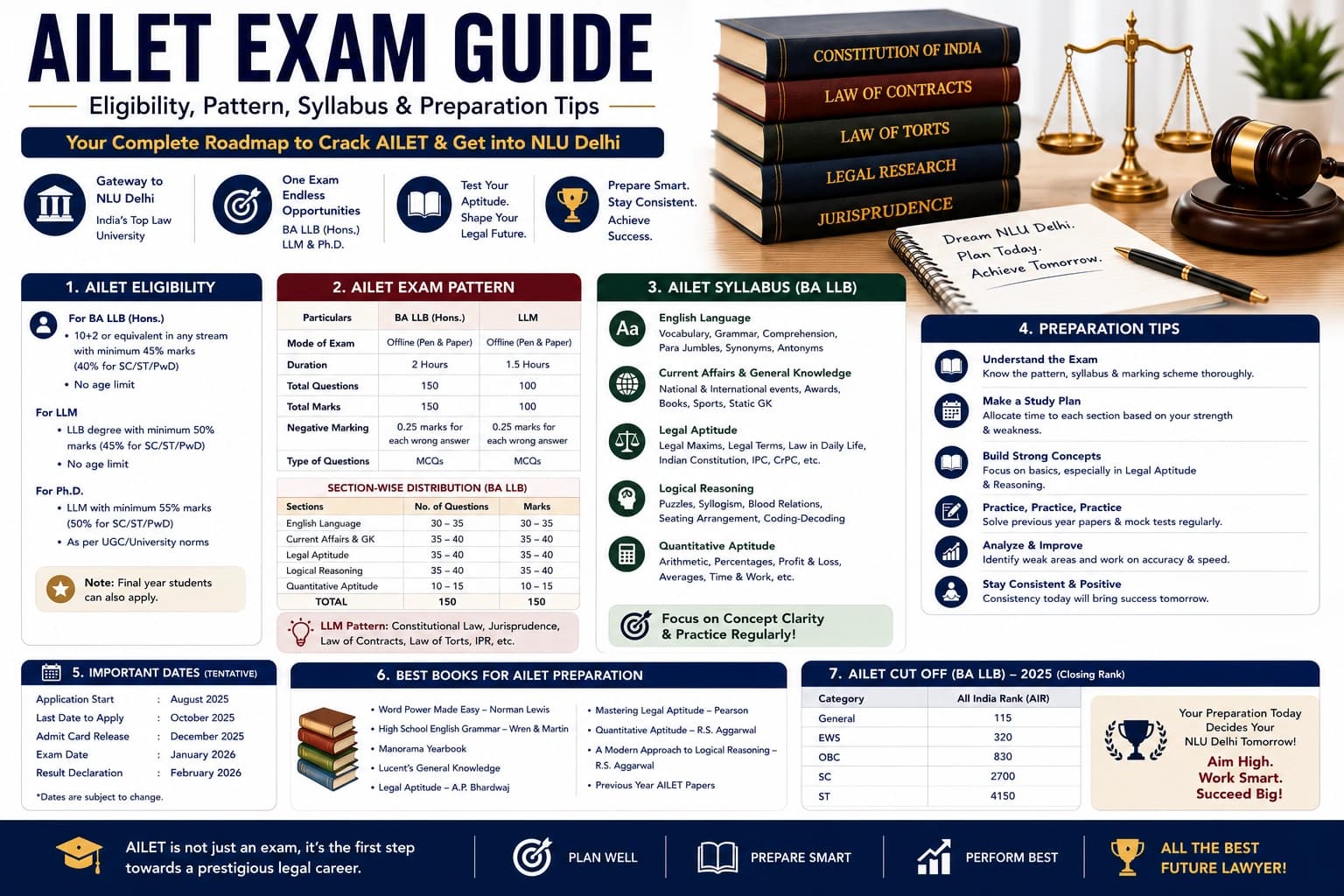
AILET (All India Law Entrance Test) is the single entry point into National Law University, Delhi — one of India's top three law schools, despite offering far fewer seats than the CLAT-linked NLU network. AILET 2026 was conducted on December 14, 2025, with results and counseling following into early 2026. This guide covers eligibility, pattern, syllabus, and preparation strategy in depth — useful whether you're reviewing the 2026 cycle or preparing for a future AILET attempt, since the exam's structure has stayed largely consistent year over year.
What Is AILET, and Why It's Different From CLAT
AILET is conducted entirely by NLU Delhi, not the Consortium of NLUs. Clearing it gets you access to exactly one institution — but that institution is NLU Delhi, which consistently ranks among India's top law schools for placements, moot court culture, and faculty reputation.
AILET Eligibility Criteria
- For BA LLB (Hons.): Candidates must have passed or be appearing in Class 12 (or equivalent), with a minimum of around 45% marks for general category candidates, relaxed to around 40% for SC/ST/PwD candidates
- No upper age limit currently applies to undergraduate AILET candidates
- For LLM: An LLB degree with a minimum of around 50% marks (45% for reserved categories) is generally required
Always verify the exact current-year percentage and category-relaxation figures against NLU Delhi's official notification, since these are set by the university and can be revised.
AILET Exam Pattern
- Total questions: 150 multiple choice questions
- Duration: 2 hours (120 minutes)
- Mode: Offline, pen-and-paper
- Marking: +1 for each correct answer, -0.25 for each incorrect one
- Sections: 3 — English Language, Current Affairs & General Knowledge, and Logical Reasoning
What's Missing Compared to CLAT
AILET has no standalone Quantitative Aptitude section, and no separately-weighted Legal Reasoning section — legal awareness is folded into the Current Affairs and General Knowledge section instead. Logical Reasoning, by contrast, carries a much heavier share of the paper than in CLAT.
AILET Syllabus: Section by Section
English Language
- Reading comprehension passages
- Grammar and vocabulary in context
- Vocabulary-based questions embedded in passages
Current Affairs & General Knowledge
- National and international current events
- History, geography, and basic economics
- General legal awareness and legal current affairs, woven into this section rather than tested separately
Logical Reasoning
- Critical reasoning, arguments, and assumptions
- Analytical and pattern-based questions
- Statement-conclusion and syllogism-style questions
This section alone typically carries the largest share of questions in the AILET paper, and also functions as a tie-breaker: if two candidates end up with the same overall score, the one with the higher Logical Reasoning score is generally given preference.
AILET Cut-Off: What to Expect
Because NLU Delhi has a small number of seats compared to the wider CLAT network, competition for AILET is intense despite the smaller applicant pool. Cut-offs are released as part of the counseling and seat-allotment process rather than announced in advance, and vary by category and, in some cases, by domicile-based reservation. Treat any specific number you see (including in older articles) as a reference point for trend analysis rather than a guarantee for the current cycle — always confirm against NLU Delhi's official cut-off release for the year you're applying.
How to Prepare for AILET
Prioritise Logical Reasoning
Since this section carries the heaviest weightage and doubles as a tie-breaker, dedicating extra prep time here has a disproportionate payoff compared to CLAT-style preparation.
Don't Skip Quant Practice Entirely, Even Though AILET Has None
If you're also attempting CLAT (many aspirants do both, given the overlapping exam season), keep your CLAT-specific Quant practice separate from your AILET prep time rather than letting it crowd out Logical Reasoning.
Build a Reading Habit for Current Affairs
As with CLAT, current affairs preparation works best as an ongoing habit over several months rather than a last-minute cram, since the section spans roughly the past year's significant events.
Practice Previous Year AILET Papers Specifically
Because AILET's question style differs from CLAT's (more direct questions, fewer heavily-worded passages in some sections), practicing AILET-specific previous papers matters more than assuming your CLAT prep transfers one-to-one.
Take Full-Length Mocks Under Strict Timing
150 questions in 120 minutes is a brisk pace — regular timed mocks are the best way to build the speed this format demands.
Common Mistakes AILET Aspirants Make
- Copying a CLAT preparation plan without adjusting for AILET's heavier Logical Reasoning weightage and absence of Quant
- Underestimating how much Logical Reasoning performance matters, including its tie-breaking role
- Neglecting a steady current affairs habit in favour of last-minute revision
- Not practicing under AILET's specific timing and question format before exam day
Frequently Asked Questions
1. What is the eligibility criteria for AILET? Candidates should have passed or be appearing in Class 12 with roughly 45% marks (40% for SC/ST/PwD), with no upper age limit for undergraduate admission — always confirm exact current-year figures with NLU Delhi's official notification.
2. What is the AILET exam pattern? 150 multiple-choice questions across English, Current Affairs & GK, and Logical Reasoning, in a single 2-hour offline shift, with +1 for correct and -0.25 for incorrect answers.
3. Does AILET have a Quantitative Aptitude section? No. AILET's three sections are English Language, Current Affairs & GK, and Logical Reasoning — there's no standalone Quant section.
4. Which colleges accept AILET scores? AILET scores are used exclusively for admission to National Law University, Delhi, across its BA LLB, LLM, and PhD programs.
5. Is AILET harder to crack than CLAT? Not necessarily in question difficulty, but competition is intense due to the very limited number of seats at a single, highly reputed institution.
6. How is the AILET tie-breaker decided? If two candidates have the same overall score, the candidate with the higher score in the Logical Reasoning section is generally given preference.
7. Can I prepare for AILET without coaching? Yes — many candidates prepare through self-study, previous year papers, and disciplined timed mock practice, though coaching can add structure for some aspirants.
8. When is the AILET result and counseling process usually held? Results are typically announced within a few weeks of the exam, with counseling and seat allotment following in rounds shortly after — exact dates shift each cycle, so check NLU Delhi's official notifications.
Related Reading
Trying to decide between the two exams? See our CLAT vs AILET Comparison Guide. For the CLAT-specific syllabus and pattern, see CLAT 2026: Syllabus, Exam Pattern, Preparation Strategy & Cut Off. Explore the full LLB Course page or Best Colleges in India for broader admission planning.
🌐 Website: www.vidyapun.com 📞 Call / WhatsApp: +91 96438 02216