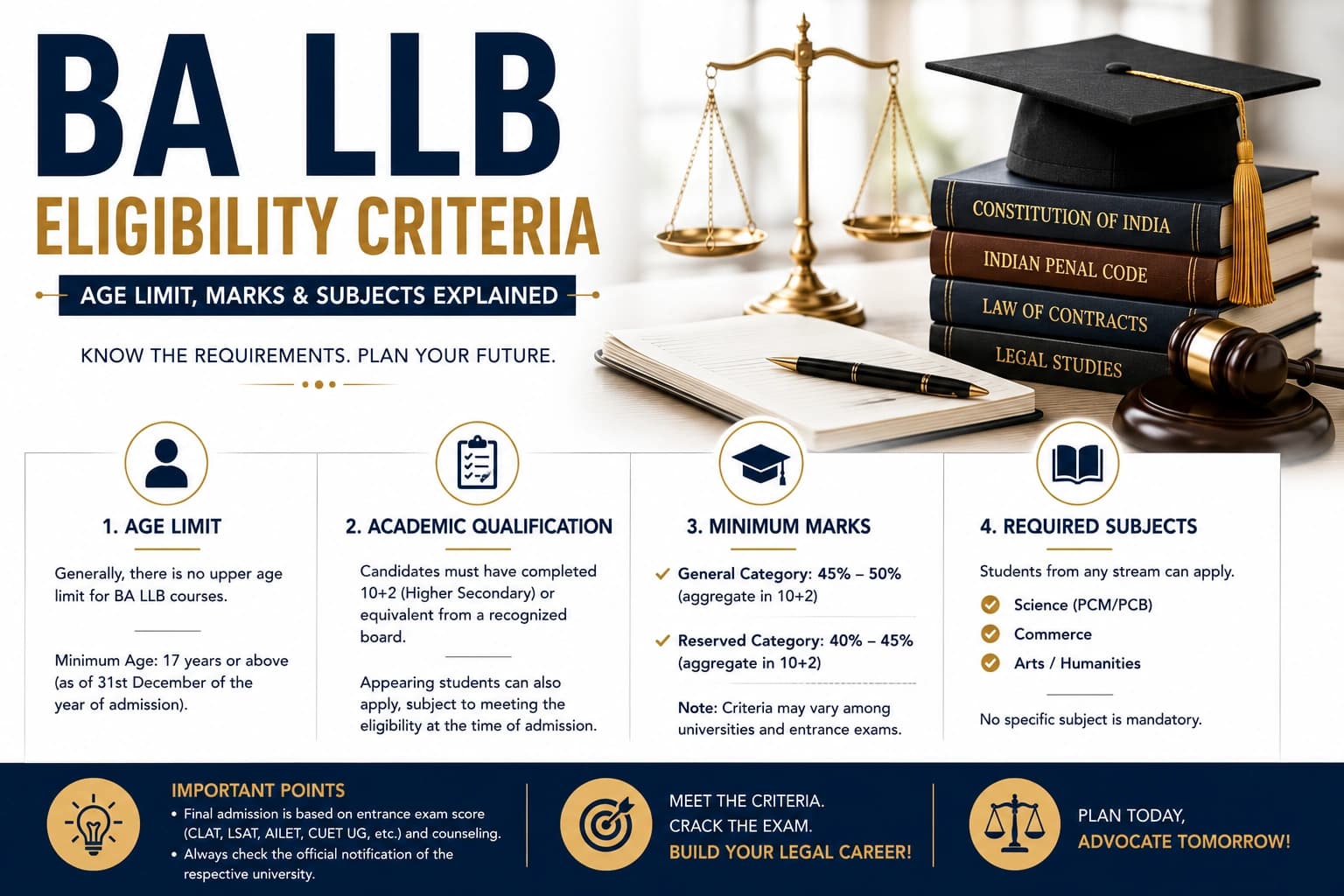
Before you spend months preparing for CLAT or any other law entrance exam, it's worth spending ten minutes confirming you actually meet the BA LLB eligibility criteria. Every year, students discover late — sometimes after clearing an exam — that a specific university had a marks cutoff, age limit, or stream requirement they didn't know about.
This guide covers everything that goes into BA LLB eligibility: academic qualifications, age limits, subject requirements, and category-based relaxations, so you can check your own eligibility with confidence before you apply anywhere.
What Is BA LLB Eligibility Criteria?
BA LLB eligibility criteria refers to the minimum academic and age requirements a student must meet to apply for the 5-year integrated BA LLB program. These requirements are set independently by each university or exam-conducting body, within the broader framework laid down by the Bar Council of India (BCI).
Why Eligibility Rules Matter
Meeting the base eligibility doesn't guarantee a seat — that still depends on your entrance exam rank or merit — but failing to meet it disqualifies your application outright, regardless of how well you perform in an entrance test. That's why checking eligibility should be the very first step, before you invest time or money into exam preparation or application fees.
Who Sets These Requirements
The Bar Council of India sets the broad minimum standards for legal education across India, but individual universities and entrance exam bodies (like the CLAT Consortium or a state's law entrance authority) often add their own specific conditions on top — such as a higher minimum percentage or additional documentation. This is why eligibility can differ from one college to another even though they all offer the "same" BA LLB degree.
Academic Qualification: Class 12 Requirements
The foundational requirement across virtually every BA LLB program is having passed Class 12 from a recognized board.
Accepted Streams and Boards
BA LLB does not require a specific stream — students from Arts, Commerce, and Science backgrounds are all eligible to apply. What matters more is that your Class 12 board is recognized (CBSE, ICSE, state boards, or an equivalent recognized qualification, including NIOS in most cases). If you're unsure whether your specific board qualifies, it's worth confirming directly with your target university.
Minimum Aggregate Marks
Most universities set a minimum aggregate score in Class 12, commonly somewhere in the 45-50% range for general category students, though this varies by institution and is often relaxed for reserved categories. Some of the more competitive, exam-based programs may set a slightly higher baseline. Always treat any percentage you've seen online as indicative rather than final, and confirm the exact number from your target university's own admission notification.
Age Limit for BA LLB Admission
Age criteria for BA LLB has changed over the years and continues to vary across institutions, so this is one of the areas most worth double-checking directly.
General Age Criteria
Some universities apply an upper age limit for BA LLB admission (often somewhere around 20-22 years for general category candidates), while a number of institutions — including several major exam-conducting bodies — have removed age limits altogether in recent years following regulatory and judicial developments. There is no single national rule that applies uniformly, so don't assume either way until you've checked.
Category-Based Relaxations
Where an age limit does apply, most universities offer a relaxation of a few years for reserved categories (SC/ST/OBC) and for candidates with disabilities. The exact relaxation period differs by institution, so if you're relying on this provision, confirm the specific number for your target college rather than a general figure you've seen elsewhere.
Subject and Stream Requirements
A common misconception is that law requires a Humanities or Arts background in school — this isn't the case for BA LLB.
Do You Need a Specific Stream?
No specific Class 12 stream is mandatory for BA LLB. Students from Science and Commerce backgrounds are admitted in large numbers alongside Arts students every year, and no university reserves BA LLB seats exclusively for a particular stream.
Subject Combinations That Help
While no specific subjects are compulsory, having studied subjects like Political Science, History, Economics, or English can make the transition into BA LLB's reading- and writing-heavy coursework a little smoother — though it's by no means a prerequisite for success. Strong reading comprehension and analytical ability matter more than any specific subject combination.
Category-Wise Reservation and Relaxations
Reservation policies affect both the marks cutoff and the number of seats available to different categories, and it's worth understanding both.
SC/ST/OBC Relaxations
Most government and several private universities extend relaxations in minimum marks (typically a few percentage points lower than the general category requirement) and, where applicable, in age limits, in line with applicable government reservation policy. The exact relaxation percentage should be confirmed from each university's official notification, since it isn't uniform everywhere.
PwD and Other Special Categories
Candidates with disabilities and other special categories (such as children of defence personnel, at some institutions) may also be eligible for relaxed marks criteria or reserved seats. These provisions vary significantly by university and by state, so check the specific admission brochure of your target institution rather than relying on a general assumption.
How to Confirm You're Eligible Before Applying
With so much variation between institutions, the safest approach is to verify eligibility directly rather than relying on secondhand information.
Checking University-Specific Notifications
Every university and entrance exam body publishes an official information bulletin or admission notification before the application window opens. This document is the authoritative source for that year's exact eligibility criteria — marks, age, category relaxations, and accepted qualifications — and should always take precedence over anything you've read on a forum or heard from a senior.
Common Eligibility Mistakes to Avoid
The most frequent mistakes are assuming a specific stream is required, using an outdated marks cutoff from a previous year, and missing a category relaxation the candidate is actually entitled to. Cross-check your eligibility against the current year's official notification for every university on your shortlist, since requirements can and do change from year to year.
Frequently Asked Questions
1. What is the minimum percentage required for BA LLB admission? Most universities set the minimum aggregate somewhere around 45-50% in Class 12 for general category students, though this varies by institution and is usually relaxed for reserved categories. Always confirm the exact figure with your target university.
2. Can Science or Commerce students apply for BA LLB? Yes. BA LLB does not require any specific Class 12 stream — Arts, Commerce, and Science students are all equally eligible to apply.
3. Is there an age limit for BA LLB admission? It depends on the university. Some institutions apply an upper age limit (often around 20-22 years for general category), while others have removed age limits entirely. Check the specific admission notification for each college you're targeting.
4. Are there relaxations for SC/ST/OBC candidates? Yes, most universities offer relaxed marks requirements and, where an age limit exists, relaxed age criteria for reserved categories, in line with applicable reservation policy. The exact relaxation varies by institution.
5. Does NIOS qualify for BA LLB eligibility? In most cases, yes — NIOS is a recognized board and generally accepted for BA LLB eligibility, though it's worth confirming with your specific target university, as recognition policies can vary slightly.
6. What documents prove my eligibility during application? Typically your Class 10 and 12 mark sheets, a passing certificate, and category or disability certificates where applicable. These are verified during the application and later during document verification after seat allotment.
Once you've confirmed you're eligible, the next step is understanding the actual application timeline — our BA LLB admission process guide walks through every step from entrance exam to counselling. If you're also weighing which entrance exam to prepare for, see our BA LLB entrance exams comparison, and if you're still deciding between degrees altogether, this BA LLB vs LLB comparison can help.
Not sure how your profile stacks up against specific colleges? Use Vidyapun's Admission Chances Predictor for an instant, data-based estimate, or explore full course details on the BA LLB course page.
Still have questions about your BA LLB eligibility? Reach out to our counsellors directly.
🌐 Website: www.vidyapun.com 📞 Call / WhatsApp: +91 96438 02216