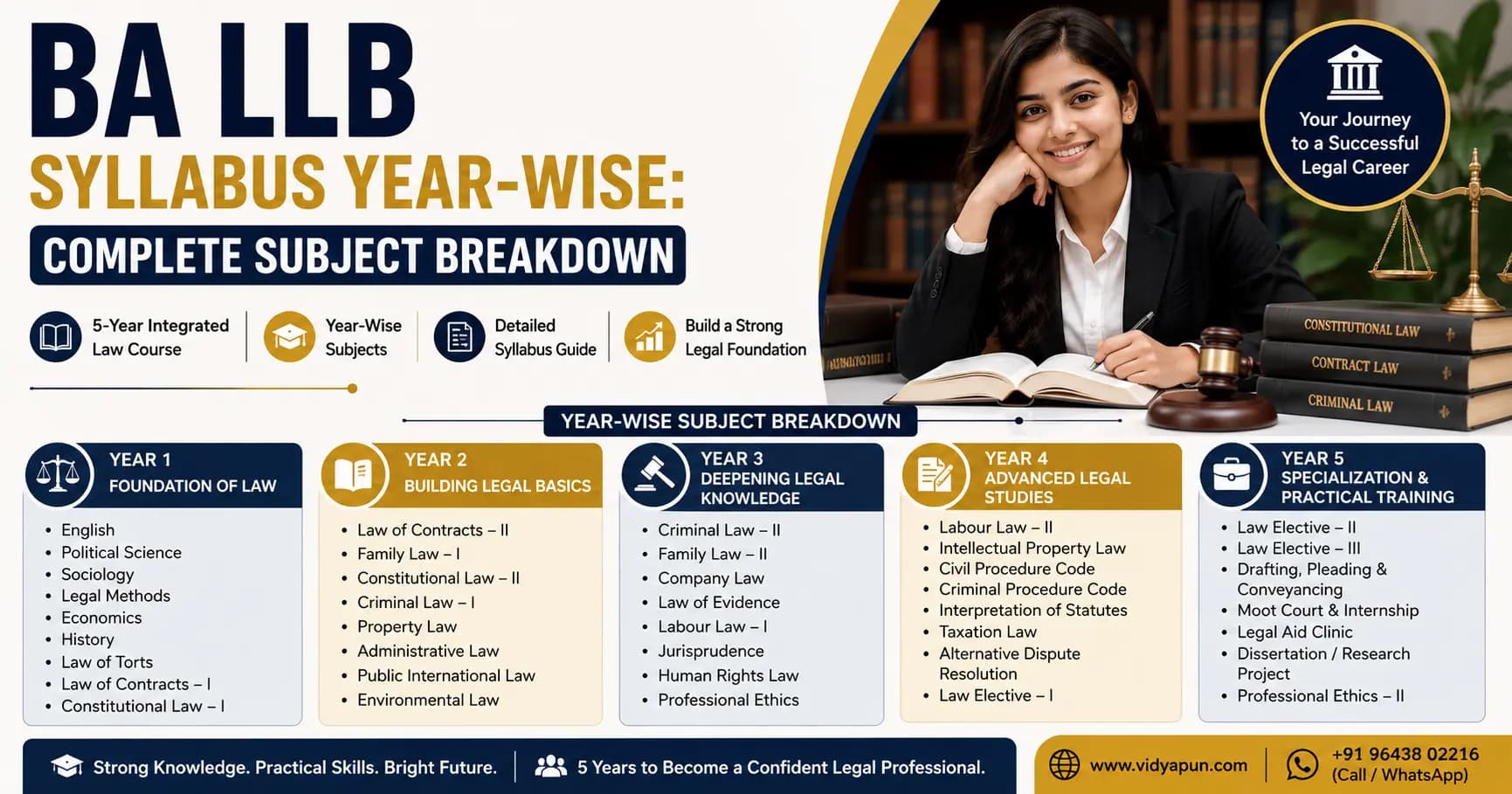
Once you've secured a BA LLB seat, the next natural question is what you'll actually be studying for the next five years. The BA LLB syllabus blends general BA subjects with core legal papers, gradually shifting weight toward law as you move through the program — by the final year, it's almost entirely legal subjects, electives, and practical training.
Knowing the year-wise structure ahead of time helps in two ways: it lets you mentally prepare for the workload shift (law-heavy years demand different study habits than general BA years), and it helps you plan when to start building specialized interests — moot court, a particular elective area, or judiciary exam preparation — rather than figuring it out reactively each semester.
This guide breaks the BA LLB syllabus down year by year, so you know roughly what to expect before your first semester begins.
BA LLB Syllabus: How the 5-Year Program Is Structured
The BA LLB syllabus follows a broad framework shaped by Bar Council of India (BCI) norms, though the exact paper names, sequencing, and elective options differ from one university to another. Every program, however, follows the same general progression: general BA subjects dominate the early years, core law subjects build up steadily, and the final years are almost entirely law-focused with heavy practical components. Understanding this progression in advance helps you set realistic expectations — the first year rarely feels overwhelming, but the workload and conceptual difficulty both increase noticeably by the third year onward.
Semester System Overview
Most universities split the 5-year program into 10 semesters (two per academic year), each combining a mix of theory papers, practical/clinical papers, and — in most curricula — a moot court or internship component in the later years. Exact credit structures and paper counts per semester vary by university, so always check your specific institution's syllabus document for the precise breakdown. Some universities also include short-term certificate courses or workshops (on topics like legal drafting, negotiation, or specific specialization areas) as optional add-ons alongside the core semester syllabus.
Law Subjects vs BA (Non-Law) Subjects
The "BA" in BA LLB reflects genuine Bachelor of Arts subjects — typically drawn from Political Science, Economics, Sociology, History, and English — studied alongside your law papers, particularly in the first two to three years. This dual structure is what distinguishes BA LLB from the 3-year LLB, and it's designed to give you a broader humanities and social science foundation before you specialize fully into law. Many students find this blend genuinely useful later — a grounding in political science and economics, for instance, often proves directly relevant in areas like constitutional law, policy work, or corporate law practice.
First Year Syllabus: Building the Foundation
The first year introduces you to legal thinking while still carrying a meaningful load of general BA subjects.
Core Subjects
Typical first-year law papers include subjects like Legal Methods (introducing legal research, citation, and reasoning), Political Science, and an introduction to the Indian Constitution. Some universities also introduce English/Legal Language and Communication Skills early on, since legal writing is a skill you'll need from day one. This first year is often less intensive than later years in terms of pure legal complexity, but it's where habits like careful reading, structured note-taking, and basic legal citation are built — habits that make the heavier years significantly more manageable.
General/BA Subjects
Alongside these, you'll usually study foundational BA papers such as Political Science, Sociology, and Economics, taught largely as they would be in a standalone BA program at this stage, before law-specific framing is introduced in later years. Many students find these papers a comfortable entry point, since they build on subjects already familiar from Class 12, easing the transition into a more legally rigorous course load in year two.
Second Year Syllabus: Introducing Core Law Areas
By the second year, core law subjects start taking up a noticeably larger share of your timetable.
Core Subjects
Common second-year papers include the Law of Contracts, Law of Torts, Family Law (covering personal laws relating to marriage, succession, and related areas), and continued BA papers like Economics or Sociology. Constitutional Law is often studied in greater depth during this year as well, moving beyond the introductory treatment from year one into detailed doctrine and case law.
Practical Components
Many universities introduce basic practical exposure in the second year — such as an introductory moot court exercise or a legal drafting assignment — to start building courtroom and documentation skills early, even before formal clinical papers begin in later years. This is also typically when students start attending court visits or observing proceedings as part of coursework at some institutions, giving an early, grounded sense of what legal practice actually looks like beyond the textbook.
Third Year Syllabus: Deepening Legal Specialization
The third year usually marks a clear shift toward law-dominant coursework, with BA subjects tapering off or concluding altogether.
Core Subjects
Typical third-year papers include Criminal Law (Indian Penal Code and related criminal statutes), Property Law, Company Law, and Administrative Law. Jurisprudence — the theoretical and philosophical study of law — is also commonly introduced around this stage, and many students find it the most conceptually demanding paper so far, since it asks you to think about law as a system rather than just learning individual rules.
Elective Introduction
Some universities begin offering elective choices in the third year, letting students start sampling specialized areas like Environmental Law, Labour Law, or Intellectual Property Law before committing to a fuller specialization track in the final two years. This is a good time to start paying attention to which subjects genuinely interest you, since it directly informs your elective choices later.
Fourth Year Syllabus: Advanced Law and Electives
The fourth year deepens both compulsory law subjects and elective specialization, alongside a heavier practical workload.
Core Subjects
Expect papers covering areas like Civil Procedure Code, Criminal Procedure Code, Evidence Law, and Human Rights Law. These procedural subjects are considered foundational for litigation practice, so they're typically treated as core requirements rather than electives across almost all universities, and they tend to carry significant weight in both academic assessment and later Bar exam preparation.
Clinical/Practical Papers
Clinical legal education — including moot court practice, client counselling simulations, and legal aid clinic work — typically becomes a more structured, credit-bearing component from the fourth year onward, alongside continued elective coursework in your chosen specialization area. Many students also begin more targeted internships during this year, applying classroom learning in real law firm, chamber, or NGO settings.
Fifth Year Syllabus: Specialization, Moot Court & Practical Training
The final year is almost entirely dedicated to advanced law, specialization electives, and hands-on practical training.
Core Subjects and Electives
Final-year papers commonly include Alternative Dispute Resolution, Professional Ethics and Bar-Bench Relations, and a set of advanced electives chosen from areas like Corporate Law, Cyber Law, International Law, or Intellectual Property Law, depending on what your university offers and what you've chosen to specialize in. Professional Ethics in particular is treated seriously across almost every university, since it directly relates to your future conduct as a practicing advocate.
Internships and Dissertation
Most programs require a mandatory internship component spread across the final year or years (often alongside a minimum number of internship weeks accumulated over the full program), plus a dissertation or research project in many universities. This is also typically when students intensify moot court participation and start preparing more seriously for placements, judiciary exams, or further studies like an LLM. By this stage, most of your timetable is shaped less by fixed lectures and more by internships, research work, and specialization electives you've actively chosen.
Frequently Asked Questions
1. Is the BA LLB syllabus the same across all universities? No. While the broad structure follows Bar Council of India guidelines, exact paper names, sequencing, and elective options vary by university. Always refer to your specific institution's official syllabus document for the precise breakdown.
2. How many subjects are there in BA LLB per semester? This varies by university and semester, typically ranging from five to eight papers per semester, including a mix of core law subjects, BA subjects (in earlier years), and practical/clinical components.
3. When do BA subjects end in BA LLB? BA subjects are usually concentrated in the first two to three years, tapering off as law subjects take priority. By the fourth and fifth years, the syllabus is almost entirely law-focused.
4. Is moot court compulsory in BA LLB? At most universities, yes — moot court is typically a credit-bearing, compulsory component, especially from the second or third year onward, though the exact structure and weightage vary by institution.
5. How many internships are required during BA LLB? Most universities mandate a minimum number of internship weeks spread across the program, often concentrated in the later years, though the exact requirement (weeks and timing) differs by institution — check your university's specific internship policy.
6. Where can I find my university's official BA LLB syllabus? Your university's official website or academic office is the most reliable source for the exact, current syllabus document, since paper names and structures can be revised between academic years.
Once you're familiar with the syllabus structure, it helps to revisit the BA LLB eligibility criteria and admission process to make sure you're on track before your course begins. If you're still comparing entrance routes, see our guide to top BA LLB entrance exams.
Not sure which colleges match your profile? Use Vidyapun's Admission Chances Predictor for an instant, data-based estimate, or explore full course details on the BA LLB course page.
Still have questions about the BA LLB syllabus or course structure? Reach out to our counsellors directly.
🌐 Website: www.vidyapun.com 📞 Call / WhatsApp: +91 96438 02216