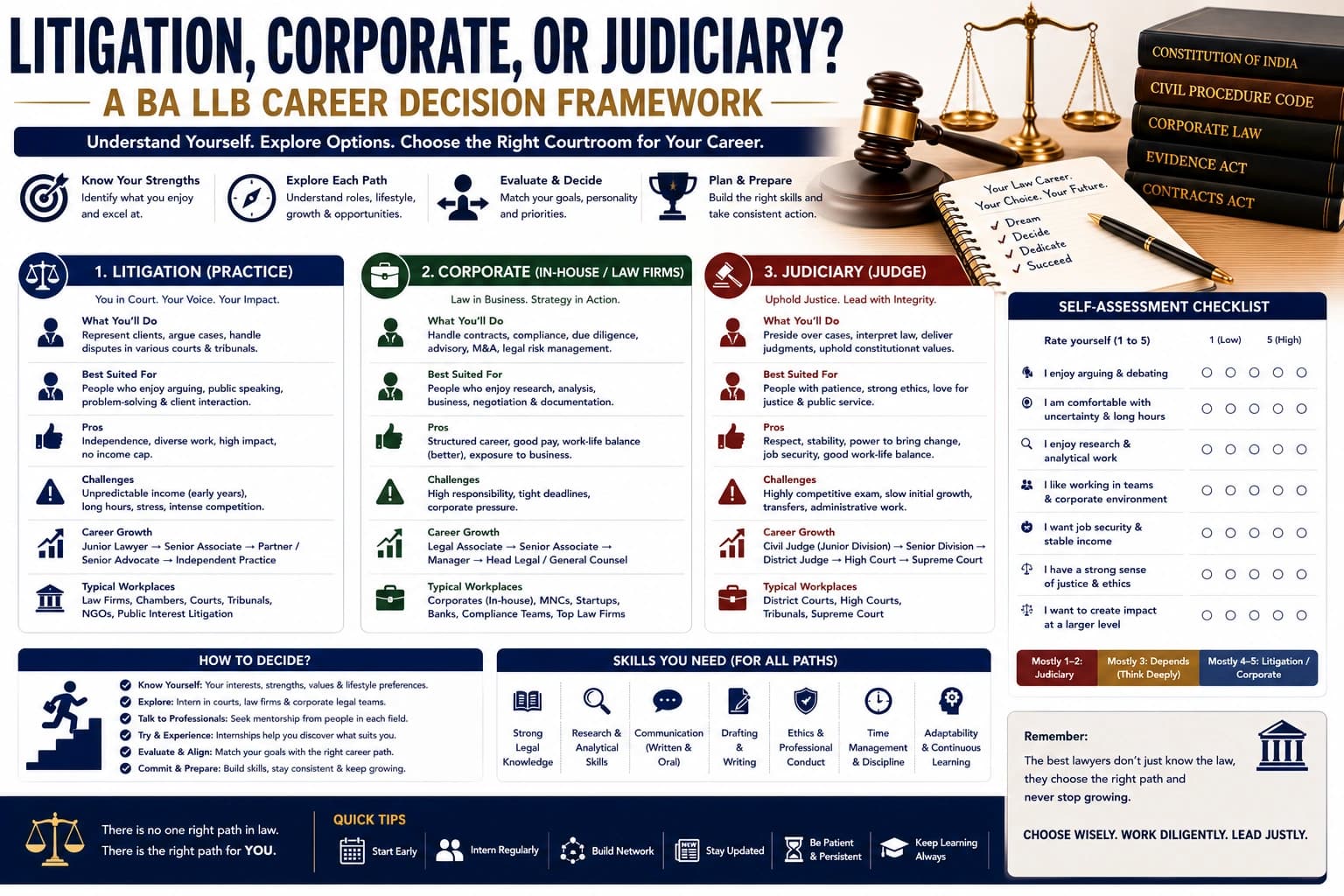
If you've read a "top career options after BA LLB" list already, you've probably still got the same problem: you now know the options exist, but not which one actually fits you. This isn't another list — it's a framework to help you decide between the three most common early-career forks: litigation, corporate law, and judiciary, based on how you actually like to work, not just what pays well on paper.
Why the Standard Lists Don't Help You Decide
Most career-option content stops at description: "corporate lawyers handle contracts and compliance," "litigators represent clients in court." That's true, but it doesn't tell you whether you would thrive in either. The better question isn't "what does this job involve" — it's "does the daily texture of this work suit how I actually operate."
The Three Early Forks, Compared on What Actually Matters
Pace and Structure
- Litigation: Unpredictable. Court dates shift, cases run long, and your schedule bends around hearings rather than the reverse.
- Corporate law: Structured but intense. Predictable office rhythm most weeks, with sharp deadline crunches around deal closings.
- Judiciary (post-exam): The most structured of the three — fixed postings, defined hierarchy, and a clear long-term career ladder set by the judicial service itself.
Income Timeline
- Litigation: Typically the slowest early-career income growth, often the highest long-term ceiling for those who build a strong independent practice or join a senior counsel's chamber successfully.
- Corporate law: Generally the fastest early-career income growth, especially at larger firms, with steady (though not unlimited) progression tied to seniority and firm tier.
- Judiciary: Stable, government-scale pay with predictable increments — lower ceiling than a successful independent litigator or senior corporate partner, but far less income volatility.
Client and People Interaction
- Litigation: Direct, ongoing relationships with individual clients, often involving emotionally charged situations (disputes, criminal matters, family law).
- Corporate law: Interaction is mostly with business stakeholders, other lawyers, and internal teams — less personal, more transactional and process-driven.
- Judiciary: Interaction shifts entirely to a decision-making role rather than an advocacy one — you're evaluating arguments, not making them.
Autonomy vs Institutional Structure
- Litigation: Highest autonomy, especially in independent practice — you build your own client base and reputation over time.
- Corporate law: Works within firm or company hierarchy; autonomy grows with seniority but is bounded by institutional structure.
- Judiciary: Operates entirely within a defined public institution, with autonomy expressed through judicial discretion rather than career freedom.
A Simple Self-Assessment
Answer honestly, not aspirationally:
- Do unpredictable schedules energise you or drain you? Energise → litigation leans favourable. Drain → corporate or judiciary.
- Do you want to see income grow quickly in your first 3-5 years, even if it means longer hours? Yes → corporate law. No, I'd rather have stability → judiciary. Willing to wait longer for a bigger long-term payoff → litigation.
- Do you want to argue a position, or decide between two positions? Argue → litigation or corporate advisory. Decide → judiciary.
- Are you comfortable with emotionally heavy client situations (disputes, criminal cases, family conflict)? Comfortable → litigation. Prefer more process-driven, less personal work → corporate law.
- Does working inside a large institution's hierarchy appeal to you, or does independence matter more? Institution → corporate law or judiciary. Independence → litigation.
What This Framework Doesn't Cover
This isn't the only decision that matters. Specialisation choice (corporate M&A vs. IP vs. tax, or civil vs. criminal litigation) matters just as much once you've picked a broad lane, and internships during your BA LLB years often shift people's assumptions about what a path is actually like day-to-day. Use this framework to narrow your first serious internship choices, not to lock in a permanent decision at 20.
It's Also Not a One-Way Door
Moving between litigation and corporate law after a few years is more common than most students assume — many lawyers try one path, build transferable skills (research, drafting, client handling), and pivot without it derailing their career. Judiciary is the one path here that's harder to enter later, since it requires clearing a specific competitive exam, so if that's genuinely your goal, it's worth building toward earlier rather than treating it as a fallback.
Frequently Asked Questions
1. Which career path pays the most after BA LLB — litigation, corporate law, or judiciary? Corporate law typically offers the fastest early-career income growth; a successful independent litigation practice or senior partnership can eventually exceed it, but takes longer to build; judiciary offers the most stable, predictable income rather than the highest ceiling.
2. Can I switch from litigation to corporate law later, or vice versa? Yes, this is a fairly common transition, especially within the first 3-5 years, since core legal research and drafting skills transfer across both paths.
3. Is judiciary a good option straight after BA LLB? Many aspirants start preparing for judiciary exams during or shortly after their BA LLB, since the exams require dedicated preparation — it's not something you fall back into casually later.
4. What if I genuinely don't know which path fits me yet? Use internships strategically — a litigation chamber internship and a corporate law firm internship during different semesters will teach you more about fit than any framework or list can.
5. Does college reputation matter more for corporate law than litigation? It matters more for landing top-tier corporate law firm placements directly out of college; independent litigation practice is built more through mentorship under a senior advocate and courtroom experience over time.
6. Is corporate law less demanding than litigation? Not necessarily less demanding — the nature of pressure differs. Litigation's pressure is unpredictable and case-driven; corporate law's pressure is deadline- and deal-driven, often within longer, more structured hours.
Related Reading
For a full breakdown of career options with descriptions, see our Top Career Options After BA LLB guide. Explore the BA LLB Course page or check your Admission Chances for university planning.
🌐 Website: www.vidyapun.com 📞 Call / WhatsApp: +91 96438 02216