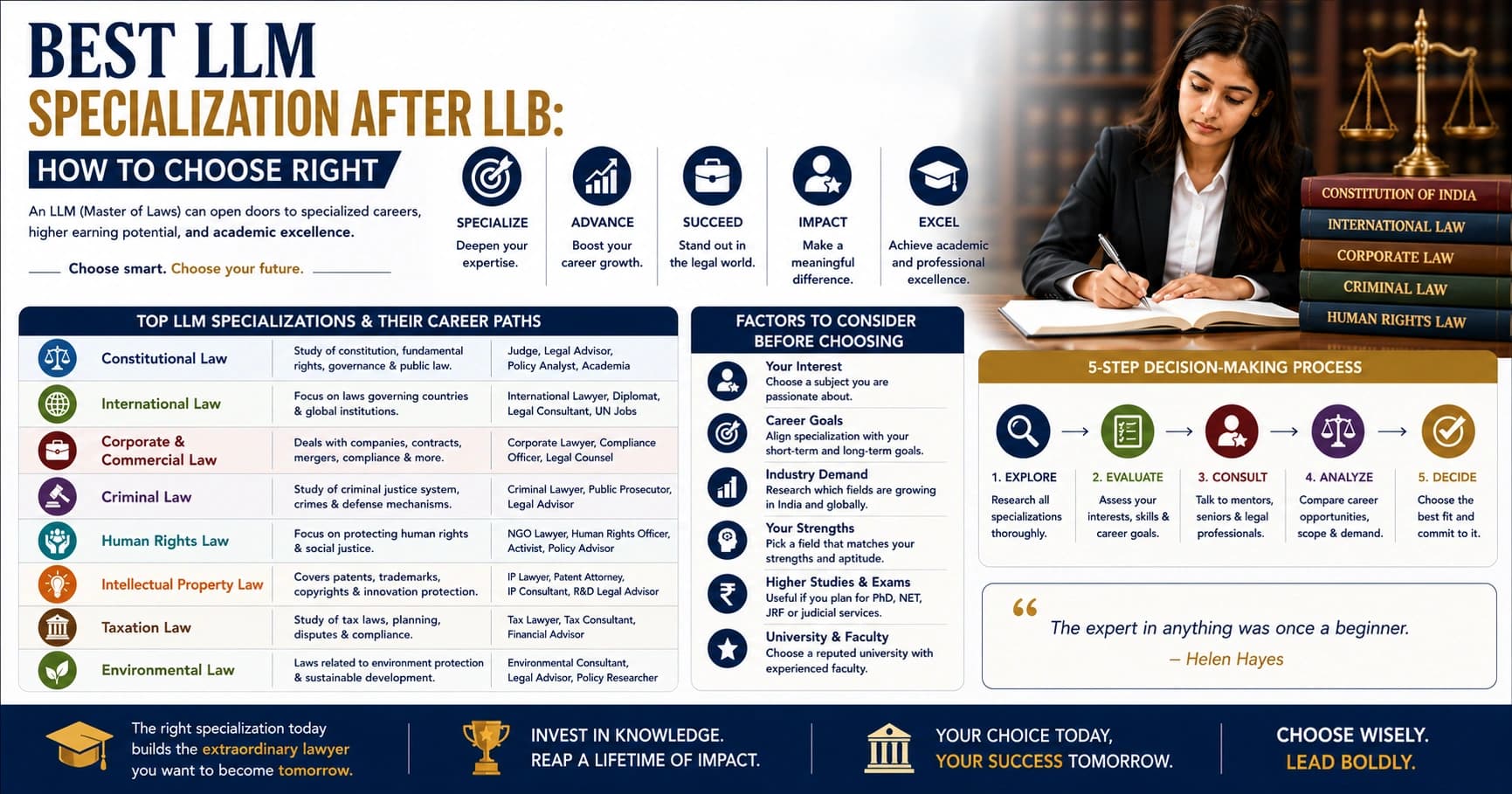
Completing a Bachelor of Laws (LLB) marks a massive milestone in your legal journey. Yet, entering the professional arena quickly reveals how highly competitive the legal ecosystem has become. General legal knowledge provides a foundation, but micro-specialization often dictates long-term career acceleration. Pursuing a Master of Laws (LLM) allows you to transition from a general practitioner into a high-demand subject matter expert.
Choosing the right path requires careful calculation. The decision you make influences your daily routine, your intellectual environment, and your earning potential for decades. Should you immerse yourself in fast-paced corporate mergers, protect digital boundaries in cyber law, or defend fundamental rights in constitutional courts?
This comprehensive strategic analysis breaks down the top postgraduate law tracks in India. You will discover core academic modules, realistic salary trajectories, and structural differences across major disciplines. Read on to discover how to align your natural academic strengths with the evolving demands of the global legal market.
⚡ Quick Answer: The Ideal LLM Choice
An LLM specialization is a targeted postgraduate law pathway focusing on a distinct legal domain like Corporate, Criminal, or Cyber Law. Choose Corporate Law or Intellectual Property Rights (IPR) for high-paying corporate firm roles. Opt for Criminal or Constitutional Law if your goals center on litigation, the judiciary, or legal academia.
[TABLE OF CONTENTS]
1. Why Specialize? The Value of an LLM Degree
2. Top LLM Specializations in India: Detailed Breakdown
3. Core Admission Criteria, Eligibility, and Duration
4. Structural Career Trajectories and Earning Potential
5. Common Pitfalls to Avoid in Selection
6. Myth vs Fact in Postgraduate Legal Studies
7. Strategic Do's and Don'ts for Candidates
8. Step-by-Step Blueprint to Finalize Your Track
1. Why Specialize? The Value of an LLM Degree
What Is It and Why Is It Crucial?
An LLM specialization shifts your professional profile from general litigation readiness to deep, authoritative expertise in a single legal domain. A standard LLB introduces you to dozens of broad subjects, whereas a Master of Laws trains your mind to dissect nuances, analyze advanced statutory interpretations, and produce publishable legal research.
Who Should Choose a Master of Laws?
- Aspiring Academics: Individuals targeting a career as a law professor or legal researcher require an LLM as a mandatory precursor to clearing the National Eligibility Test (NET) or pursuing a Ph.D.
- Corporate Climbers: Lawyers aiming for swift promotions to partner tracks within Tier-1 law firms leverage specialized corporate masters to stand out.
- Litigation Specialists: Advocates wanting to handle complex, high-value cases—such as cross-border trade disputes or white-collar crime trials—need advanced training to outperform adversaries.
2. Top LLM Specializations in India: Detailed Breakdown
A. Corporate and Commercial Law
This track stands as the most popular choice for legal professionals seeking rapid corporate advancement. The curriculum focuses heavily on corporate governance, mergers and acquisitions (M&A), banking regulations, and insolvency proceedings.
- Key Modules: Company Law, Securities Markets, International Trade Law, Bankruptcy Codes.
- Ideal For: Students possessing strong analytical skills who enjoy commercial strategy, contract structuring, and financial systems.
B. Criminal and Security Law
This specialization moves past foundational penal codes to address complex forensic evidence, international criminology, systemic human rights issues, and white-collar crime investigations.
- Key Modules: Advanced Criminology, Penology, Socio-Economic Offenses, Evidence Evaluation.
- Ideal For: Advocates passionate about courtroom advocacy, trial strategy, defense counseling, and public justice frameworks.
C. Constitutional and Administrative Law
This discipline analyzes the relationship between state apparatuses and individual citizens. It provides a comprehensive look at judicial review processes, fundamental rights enforcement, and systemic public policy design.
- Key Modules: Comparative Constitutional Law, Administrative Discretion, Human Rights Jurisprudence.
- Ideal For: Future civil servants, judicial aspirants, human rights advocates, and dedicated legal academicians.
D. Intellectual Property Rights (IPR) & Cyber Law
As technology integration reshapes global business, safeguarding intangible assets and digital networks has become a massive priority. This track addresses patent enforcement, copyright protection, data privacy frameworks, and the regulation of artificial intelligence.
- Key Modules: Patent System Dynamics, Information Technology Act Analysis, Copyright Frameworks, Cyber Crime Litigation.
- Ideal For: Professionals fascinated by technological growth, digital innovation, software engineering compliance, and global brand protection.
3. Core Admission Criteria, Eligibility, and Duration
Navigating your entry into an elite post-graduation program requires adhering to specific regulatory guidelines set forth by Indian educational frameworks.
Course Parameters
| Parameter | 1-Year LLM Program | 2-Year LLM Program |
| Primary Target | Corporate practitioners, global employment seekers | Academicians, researchers, civil services aspirants |
| Curriculum Intensity | High (Condensed research, swift trimester system) | Moderate (Extended classroom hours, deep thesis focus) |
| Core Eligibility | Three or Five-year LLB from a BCI-recognized college | Three or Five-year LLB from a BCI-recognized college |
| Minimum Marks | 50% to 55% aggregate score in undergraduate law | 50% to 55% aggregate score in undergraduate law |
Admission Pathways
Securing a seat in top-tier institutions, such as National Law Universities (NLUs), depends heavily on national and institutional entrance tests:
- CLAT PG: The Common Law Admission Test for Post Graduation serves as the premier route for NLU admissions.
- AILET: Conducted specifically for admission into National Law University, Delhi.
- CUET PG: Utilized by multiple prominent central and state universities across the country.
4. Structural Career Trajectories and Earning Potential
Your choice of specialization directly influences your day-to-day work environment, job titles, and compensation scales.
Projected Career Tracks and Initial Salaries
💵 SALARY SPECTRUM BY SPECIALIZATION (Entry-Level Annual Average)
═══════════════════════════════════════════════════════════════
Corporate Law │ █████████████████████████ ₹9,00,000 - ₹16,00,000
IPR & Cyber Law │ ███████████████████ ₹6,50,000 - ₹11,00,000
Criminal Law │ █████████████ ₹4,50,000 - ₹8,00,000 (Independent)
Constitutional │ ███████████ ₹5,00,000 - ₹7,50,000 (Academia Base)
═══════════════════════════════════════════════════════════════
Professional Opportunities Breakdown
- Corporate Law Experts: Step into roles like Corporate Legal Advisor, Compliance Officer, M&A Consultant, or Associate Partner within private firms. Earning scales remain high, with top-tier firms matching global corporate rewards.
- IPR and Cyber Attorneys: Transition into Patent Analysts, Data Privacy Officers, Trademark Consultants, or Technology Counselors for multinational tech firms.
- Litigation and Public Law Scholars: Build independent trial practices, work as Public Prosecutors, join public policy think tanks, or join university faculties as Assistant Professors.
5. Common Pitfalls to Avoid in Selection
- Chasing Direct Trends Unprepared: Selecting Corporate Law solely due to initial salary projections, despite holding zero interest in company finances, accounting principles, or business management.
- Ignoring Institution Specialization Strengths: Forgetting that certain universities excel in international law while others possess elite, world-class intellectual property research cells.
- Miscalculating Academic Writing Demands: Underestimating the deep commitment required to produce a detailed master's dissertation, which demands independent research and advanced legal analysis.
- Failing to Verify Local Bar Eligibility: Neglecting to check foreign LLM validation guidelines issued by the Bar Council of India if you intend to return to domestic litigation practice.
6. Myth vs Fact in Postgraduate Legal Studies
- Myth: You must hold an LLM to practice as a litigator in local Indian district courts.
- Fact: An LLB degree is the sole mandatory requirement for bar enrollment and courtroom practice. An LLM acts as an optional, strategic accelerator to build advanced niche expertise.
- Myth: One-year LLM programs hold less legal validity than traditional two-year degrees.
- Fact: Both formats receive equal recognition from major regulatory and employment bodies, provided the granting university holds proper University Grants Commission (UGC) approval.
- Myth: Corporate law firms only hire candidates who hold post-graduate specializations.
- Fact: While an LLM offers a competitive edge, elite law firms consistently hire talented undergraduate LLB students based on internships, analytical skills, and academic merit.
7. Strategic Do's and Don'ts for Candidates
The Do's
- Do Align Internships Wisely: Match your final-year undergraduate internships with the exact master's track you intend to pursue.
- Do Investigate Faculty Credentials: Research the publication histories and case profiles of professors leading your chosen university department.
- Do Focus on Research Skills: Dedicate systematic energy to learning advanced search strategies on databases like Manupatra, SCC Online, and Westlaw.
- Do Build a Relevant Portfolio: Write and publish articles in peer-reviewed legal journals to strengthen your post-graduate admission profile.
The Don'ts
- Don't Rush Your Choice: Avoid picking a track during the final semester without speaking to industry mentors and alumni.
- Don't Ignore Financial Realities: Skip evaluating the direct return on investment (ROI) between your target university's tuition fees and typical placement outcomes.
- Don't Overlook Alternative Dispute Resolution (ADR): Never ignore fields like arbitration and mediation, which are growing rapidly across corporate and civil sectors.
- Don't Rely Solely on Rote Learning: Avoid approaching your master's program with a memorization mindset. LLM evaluations prioritize critical legal reasoning over reciting bare acts.
8. Step-by-Step Blueprint to Finalize Your Track
- Map Out Your Long-Term Goals: Determine whether your ultimate destination is corporate boardroom consulting, public courtroom litigation, or university lecturing.
- Audit Your Natural Academic Passions: Review your undergraduate grades to see whether you performed better in public law or business-oriented subjects.
- Evaluate Core Entrance Formats: Assess standard patterns for exams like CLAT PG, focusing heavily on comprehensive reading and deep jurisprudential analysis.
- Analyze University Placement Records: Review verified graduation outcomes, firm visits, and typical package ranges over the past three years.
- Seek Direct Professional Guidance: Reach out to established education portals like Vidyapun to match your specific academic history with optimal, accredited university offerings.
Conclusion
Selecting your LLM specialization is a strategic decision that shapes the future of your legal career. Rather than choosing based on temporary trends, look for a balance between your academic interests and realistic career opportunities. Whether you choose to protect digital assets in Cyber Law or advise corporate boards in Commercial Law, prioritize building deep, specialized expertise. Align your skills with a highly regarded, accredited university program to transition successfully from a law graduate to an authoritative leader in your field.
FAQ Section
Q: Which LLM specialization yields the highest starting salary in India?
A: Corporate and Commercial Law consistently commands the highest entry-level packages in the private market. Tier-1 corporate law firms offer lucrative compensation packages to newly minted corporate masters who display exceptional skills in commercial drafting and transactional strategy.
Q: Can I change my legal track if my undergraduate focus differed?
A: Yes. An undergraduate degree provides a foundation across all standard subjects, meaning you are eligible to choose any specialized legal branch for your postgraduate studies.
Q: Is clearing CLAT PG mandatory for every master's option?
A: No. While national National Law Universities draw selections from the central CLAT PG grid, numerous prominent state, central, and private law universities run independent entrance evaluations or use scores from tests like CUET PG.
Q: What is the standard duration of an LLM program in India?
A: Indian universities offer both intensive 1-year options and traditional, research-centric 2-year routes. Both pathways enjoy equal legal status, provided the offering institution carries valid University Grants Commission validation.
Q: Can I appear for the Judicial Services Examination during my LLM studies?
A: Yes, absolutely. Because the baseline criteria for the Judicial Services Exam rests on holding a valid undergraduate law degree, you can prepare for and take the exam while pursuing your master's.
Q: What exactly is a legal master's dissertation paper?
A: A dissertation is a mandatory, deeply detailed research thesis on a highly specialized legal issue within your track. You must complete this independent project under the direct guidance of a faculty supervisor to qualify for graduation.
Q: Does an LLM degree grant automatic practice rights in foreign courts?
A: No. Courtroom practice rights overseas depend entirely on the specific bar exam requirements of each country, such as clearing the New York Bar Exam or the Qualified Lawyers Transfer Scheme (QLTS) in the UK.
Q: Can I pursue an LLM through online learning or distance education?
A: Yes, multiple universities offer distance learning formats. However, it is vital to remember that these options are primarily suited for corporate advancement or legal research roles, rather than courtroom practice.
Q: What is the age limit for entering an LLM program in India?
A: The Bar Council of India and major testing agencies enforce no upper age caps for postgraduate law admissions, allowing professionals to return to school at any point in their careers.
Q: What core skills are essential for an IPR specialization?
A: Success in Intellectual Property Rights demands precision, an analytical approach to technological innovation, and a strong understanding of international trade agreements alongside patent and trademark acts.
Q: Is legal history a major focus in Corporate Law tracks?
A: No. Corporate specializations focus primarily on current commercial law, regulatory frameworks, compliance codes, and active financial laws.
Q: Does an LLM help in securing jobs within public sector undertakings (PSUs)?
A: Yes, many leading PSUs use CLAT PG rankings to directly recruit Law Officers, making a high score valuable for securing stable government corporate roles.
Q: Can I opt for a dual specialization in an LLM course?
A: While a few specialized private institutions offer combined tracks, standard university systems typically focus on a single dedicated domain to ensure deep subject-matter expertise.
Q: What role does international law play in domestic corporate tracks?
A: International law serves as a critical asset, especially when navigating cross-border mergers, foreign direct investment rules, and international trade disputes.
Q: How does Vidyapun guide students toward the right LLM choice?
A: Vidyapun offers a detailed repository of university profiles, admission guidelines, fee structures, and personalized counseling to help law graduates choose the right path for their career goals.
Career Planning Support
Navigating the complexities of post-graduate law admissions requires a clear, calculated strategy. Let our experienced educational experts analyze your academic history and guide you toward the ideal path.
- Portal: Vidyapun Portal
- Call / WhatsApp: +91 96438 02216