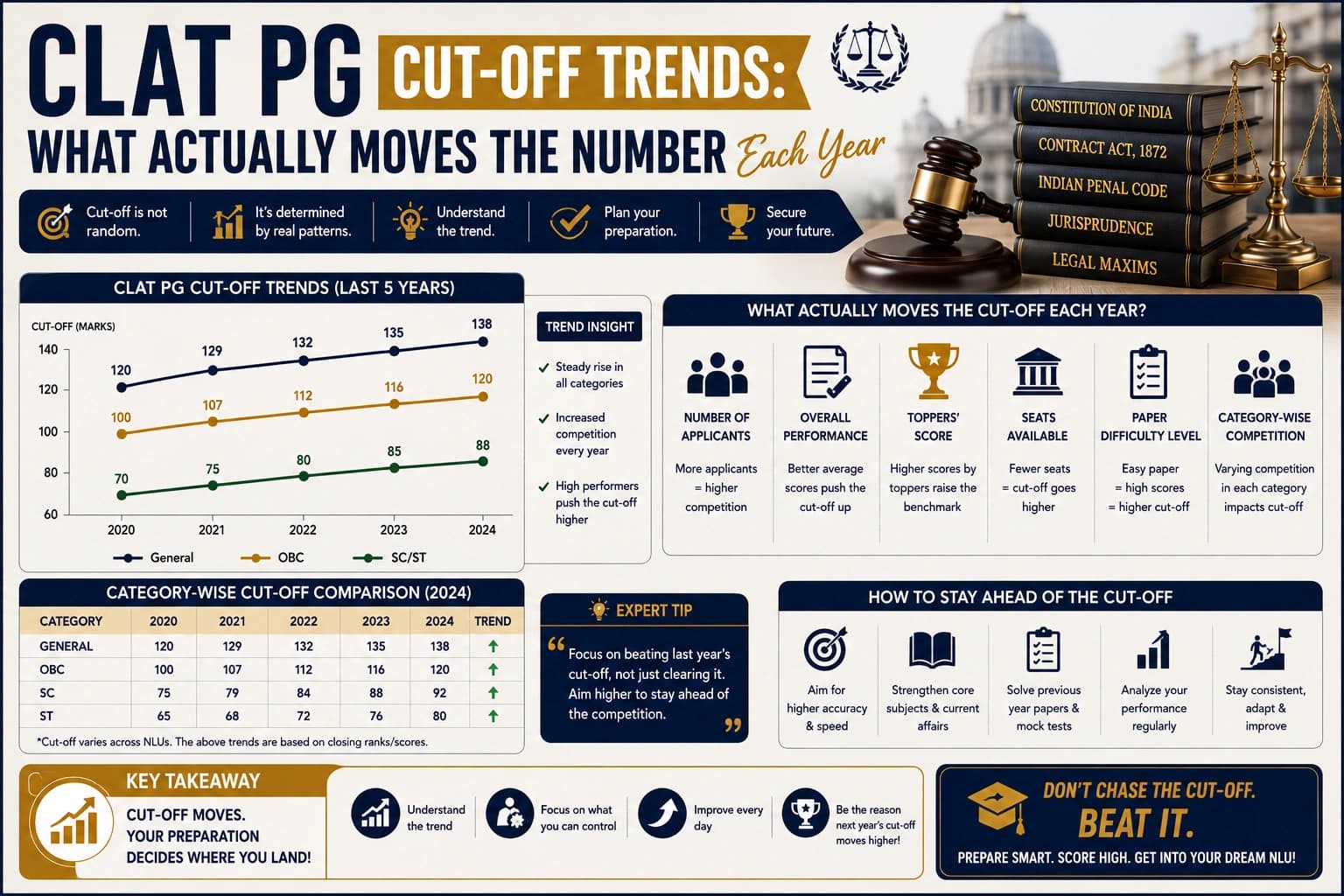
Search for "CLAT PG cut-off" and you'll find a lot of numbers online — many of them actually describing CLAT UG (a completely different, much larger exam), and others based on years-old, unverified forum estimates. Rather than repeat a number that might not even be for the right exam, this guide covers what genuinely drives CLAT PG cut-offs up or down each year, and how to read the real, official cut-off release once it's out.
Why You Can't Rely on a Single "Cut-Off Number" for CLAT PG
CLAT PG doesn't have one cut-off — it has many, and conflating them is where most confusion starts.
It's Not One Exam-Wide Number
Cut-offs are set separately for each participating NLU, and within each university, separately again by category (General, OBC, SC, ST, EWS, PwD) and often by home-state quota versus all-India seats. A single "you need X to get in" figure is almost always oversimplified.
Rank Matters More Than Raw Score
Because CLAT PG has a much smaller applicant pool than CLAT UG, results are typically discussed in terms of rank rather than absolute score — a rank of a few hundred can mean something very different depending on the specific NLU and category you're targeting.
What Actually Moves Cut-Offs Up or Down Each Year
Cut-offs aren't set arbitrarily — they respond to a handful of concrete factors every cycle.
Number of Applicants That Year
A year with a larger applicant pool for a specific NLU generally pushes its effective cut-off rank tighter, simply because more candidates are competing for the same number of seats.
Seat Availability
If a university's seat count changes year to year (a new specialisation added, or a seat matrix revision), that alone can shift how far down the merit list an NLU's admission reaches.
Paper Difficulty
A comparatively harder paper in a given year tends to compress the overall score distribution, which can shift cut-off ranks even without a change in applicant behaviour.
Category-Wise Reservation
Reserved-category cut-offs move somewhat independently of the general category figure, since they're calculated against a separate, smaller pool of reserved seats rather than the full applicant list.
Home-State Quota
Several NLUs reserve a portion of seats for home-state domicile candidates, which creates two effectively different cut-offs at the same university — one for home-state applicants, one for all-India applicants.
How to Read the Official Cut-Off Release Correctly
Once results are out, reading the release properly matters as much as having access to it.
Check the Specific NLU and Category Combination That Applies to You
Don't read a general "top NLU cut-off" headline and assume it applies to your category or domicile status — always find the specific row that matches both.
Compare Rank Trends Across a Few Years, Not Just One
A single year's cut-off can be an outlier due to an unusually easy or hard paper — looking at the trend across three or four years gives a more reliable sense of where a university typically settles.
Treat Any Third-Party "Predicted Cut-Off" With Caution
Predicted cut-offs published before official results are estimates, not guarantees — they're a planning tool for shortlisting your counselling preferences, not a reliable substitute for the Consortium's actual released figures.
Where to Find Reliable Cut-Off Data
Given how much conflicting and outdated information circulates for this specific exam, source matters more than usual here.
Go to the Consortium's Own Official Portal First
The Consortium of NLUs publishes official cut-off and seat allotment data directly — this should be your primary source, not a third-party aggregator repeating older or unverified figures.
Cross-Check Any Third-Party Figure Against That Official Source
If a coaching institute or aggregator site cites a specific historical cut-off, verify it against the Consortium's own published records before treating it as reliable, particularly for older cycles where reporting has sometimes conflated CLAT UG and CLAT PG data.
What to Do If You're Between Cut-Offs
A borderline score doesn't necessarily mean no options.
Consider the Full Counselling Rounds, Not Just Round One
Cut-offs typically ease somewhat across subsequent counselling rounds as higher-ranked candidates confirm seats elsewhere — don't rule out an NLU based only on the first round's cut-off.
Broaden Beyond the Most-Discussed NLUs
Cut-off conversations online disproportionately focus on the handful of best-known NLUs — several other participating universities offer strong LLM programmes with comparatively more accessible cut-offs.
Frequently Asked Questions
1. Why do I see very different CLAT PG cut-off numbers on different websites?
Many sources conflate CLAT PG with CLAT UG, which has a completely different scale and applicant pool, or repeat old, unverified figures — always check that a cited number is specifically for CLAT PG and from a recent, sourced cycle.
2. Is CLAT PG cut-off based on score or rank?
Results and cut-offs are typically discussed in terms of rank rather than raw score, given the smaller applicant pool relative to CLAT UG.
3. Does every NLU have the same cut-off?
No — each participating NLU sets its own effective cut-off, and it varies further by category and, at several universities, by home-state versus all-India quota.
4. Where can I find the official CLAT PG cut-off?
The Consortium of NLUs' official portal is the primary, most reliable source — treat third-party predicted or historical figures with caution unless cross-checked against it.
5. Should I trust a coaching institute's predicted cut-off?
Use it only as a rough planning tool for shortlisting counselling preferences, not as a guarantee — official released cut-offs are the only figures you should rely on for a final decision.
6. If my rank is above the first-round cut-off, am I out of the running?
Not necessarily — cut-offs often ease across later counselling rounds as higher-ranked candidates confirm seats elsewhere, so it's worth staying in the process rather than assuming an early exit.
Related Reading
For exam pattern and preparation specifics, see our guides on AILET PG and university-level LLM entrance exams. Explore the LLM Admission Guide, the BA LLB Course page, and broader Law Admission guidance.
🌐 Website: www.vidyapun.com 📞 Call / WhatsApp: +91 96438 02216