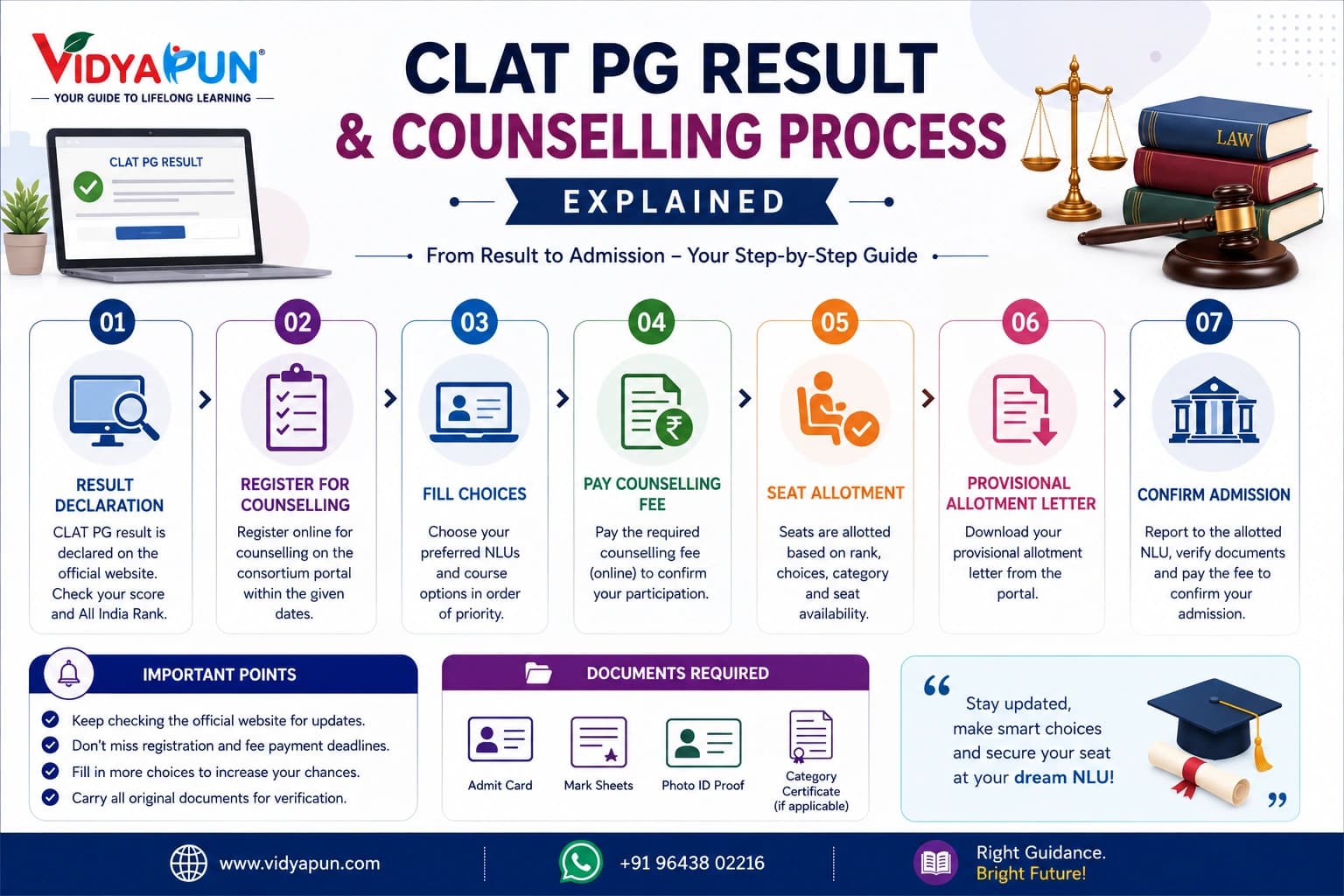
Clearing CLAT PG is a big milestone on your way to a Master of Laws (LLM), but it's really just the start of the next phase — understanding your result, navigating counselling, and securing your seat. This guide walks through exactly what happens after results are declared, from reading your scorecard to confirming your final seat.
Understanding the CLAT PG Result Process
Before diving into counselling, it helps to know how and where results actually get released.
Where and How Results Are Announced
CLAT PG results are declared on the official CLAT Consortium website, and candidates can check their scorecard by logging into the same account used during registration — always rely on the official portal rather than third-party result-checking sites.
What the Result Includes
Your result typically includes your raw score, overall rank, and category-wise rank (if applicable), giving you a clear picture of where you stand before counselling begins.
How CLAT PG Results Are Declared
The result release itself follows a fairly consistent structure each year.
Scorecard and Rank Details
Your scorecard shows your section-wise and total score alongside your all-India rank, which becomes the basis for seat allotment during counselling.
Category-Wise and Overall Merit Lists
Alongside the overall merit list, a separate category-wise merit list is published for reserved-category candidates, since seat allotment for reserved seats is based on this category-specific ranking.
Understanding Your CLAT PG Merit List Rank
Your rank is what actually determines your options during counselling, so it's worth understanding clearly.
Interpreting Your All-India Rank
Your all-India rank reflects your position among all candidates nationally, and directly affects which universities and specialisations remain realistically available to you during seat allotment.
Category Rank vs Overall Rank
If you belong to a reserved category, you'll have both an overall rank and a category rank — reserved seats are allotted based on your category rank, so pay attention to both when assessing your chances at specific universities.
What Happens During CLAT PG Counselling
Counselling is where your rank actually translates into a university seat.
Registration for Counselling
After results, eligible candidates register separately for the counselling process on the same official portal, which is a distinct step from the exam registration itself — don't assume clearing the exam automatically enrols you in counselling.
Preference Filling for Universities
During counselling, you'll list your preferred universities and specialisations in order of priority — this preference order matters significantly, since allotment is based on matching your rank against your stated preferences and seat availability.
Seat Allotment Rounds Explained
Seat allotment typically happens across multiple rounds, not a single one.
How Allotment Rounds Work
In each round, seats are allotted based on your rank, your preference order, and seat availability at that point — candidates who don't receive their top preference in an early round may still move up in later rounds as others accept, decline, or upgrade their allotted seats.
Multiple Rounds and Waitlist Movement
Waitlist movement across rounds is common, so a lower initial allotment doesn't necessarily mean your final outcome — many candidates see meaningful upward movement across two or three rounds of counselling.
Document Verification and Fee Payment
Once allotted a seat, there's a verification and payment step before it's confirmed.
Documents Needed for Verification
Keep your LLB certificates, category certificate (if applicable), CLAT PG scorecard, and identity documents ready for verification, since incomplete or mismatched documents can delay or jeopardise your seat confirmation.
Fee Payment Deadlines and Process
Each allotment round comes with a specific fee payment deadline to confirm your seat — missing this deadline typically means forfeiting the allotted seat, so track these dates closely throughout the counselling process.
Upgrading or Withdrawing Your Seat
Counselling isn't necessarily a one-shot decision — most processes allow some flexibility across rounds.
Seat Upgrade Option Explained
If you've accepted a seat but still prefer a higher-ranked preference, most counselling processes allow you to remain in the upgrade pool for subsequent rounds while keeping your current seat as a safety net.
Withdrawing From Counselling
If you decide not to pursue your allotted seat at all, most processes have a formal withdrawal option — understand the specific refund policy and deadline for withdrawal before making this decision, since it varies by round.
What to Do If You Don't Get Your Preferred Seat
Not getting your first-choice seat isn't necessarily the end of the road.
Alternative Options to Consider
If your final allotment isn't your top preference, weigh whether to accept it, wait for a later round with continued upgrade eligibility, or explore alternative admission routes at other universities that admit through merit or university-specific exams outside the CLAT PG process.
Final Thoughts
The CLAT PG result and counselling process involves more steps than most candidates expect — understanding your rank, registering separately for counselling, filling preferences carefully, and tracking document and payment deadlines across multiple rounds. Staying organised through this process, rather than assuming your first allotment is final, gives you the best chance at securing the university and specialisation you actually want.
Not sure which universities and specialisations are realistically within reach for your rank? Check Eligibility with Vidyapun's free assessment tool.
Frequently Asked Questions
Q1. Where can I check my CLAT PG result?
A: Results are declared on the official CLAT Consortium website, accessible by logging into the same account used during registration — always use the official portal rather than third-party sites.
Q2. Do I need to register separately for CLAT PG counselling?
A: Yes — counselling registration is a distinct step from exam registration, so clearing the exam alone doesn't automatically enrol you in the counselling process.
Q3. How many rounds of seat allotment does CLAT PG counselling have?
A: Counselling typically happens across multiple rounds, with waitlist movement common between rounds as candidates accept, decline, or upgrade their allotted seats.
Q4. What happens if I miss the fee payment deadline after seat allotment?
A: Missing the fee payment deadline for a given round typically means forfeiting that allotted seat, so it's important to track payment deadlines closely throughout the counselling process.
Q5. Can I upgrade my seat after accepting an initial allotment?
A: In most counselling processes, yes — you can remain in the upgrade pool for later rounds while keeping your currently accepted seat as a safety net.
Q6. What should I do if I don't get my preferred university in the final round?
A: Consider whether to accept your final allotment, or explore alternative admission routes through university-specific or merit-based LLM admission outside the CLAT PG counselling process.
🌐 Website: www.vidyapun.com 📞 Call / WhatsApp: +91 96438 02216