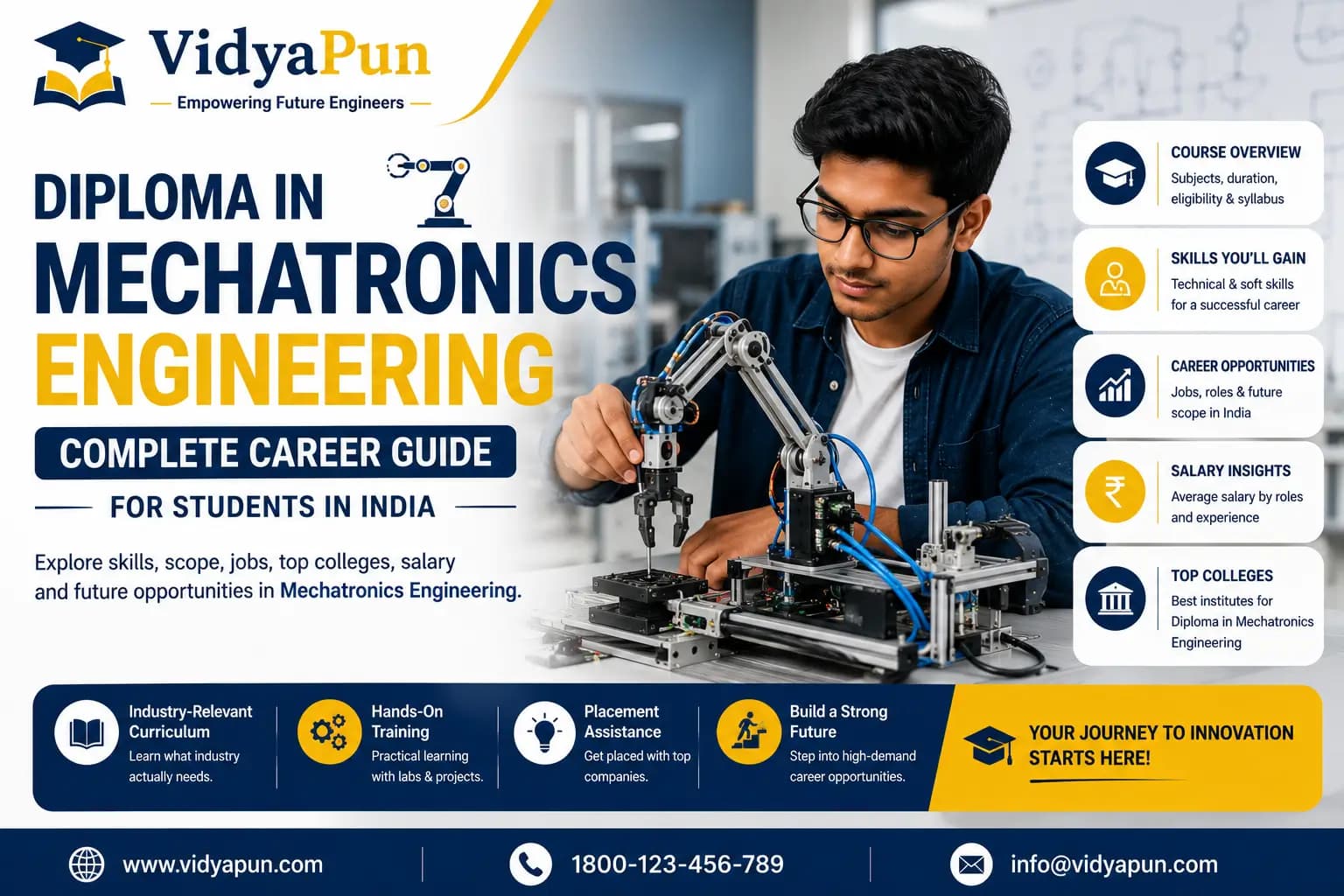
When most students hear "mechatronics," they picture something complicated and highly specialized. And while the field is certainly technical, the entry point is more accessible than most people realize — especially through a Diploma in Mechatronics Engineering.
Here is what makes this diploma genuinely interesting right now: India's manufacturing sector is automating at a pace it never has before. Automotive plants, electronics factories, food processing units, pharmaceutical companies — all of them are installing robotic systems, smart sensors, and automated production lines. And all of them need technicians and engineers who understand how these systems actually work.
That is exactly what a Diploma in Mechatronics Engineering prepares you for.
This guide covers everything you need to make an informed decision — what the program teaches, where to study, what jobs you can get, and what you can realistically expect to earn.
What Is a Diploma in Mechatronics Engineering?
Mechatronics is a discipline that blends mechanical engineering, electronics, computer science, and control systems into a single integrated field. The name itself is a combination of "mechanics" and "electronics" — and that captures the core of what practitioners do.
A Diploma in Mechatronics Engineering is a 3-year polytechnic program (after Class 10) or a lateral entry 2-year program (after Class 12 with Physics, Chemistry, and Mathematics or after an ITI course). It trains students to work with automated and intelligent mechanical systems — the kind found in modern factories, robotics labs, automotive plants, and smart manufacturing environments.
The curriculum typically includes:
- Engineering mechanics and machine design
- Electronics and electrical circuits
- Microcontrollers and embedded systems
- Pneumatics and hydraulics
- Programmable Logic Controllers (PLCs)
- Industrial automation and SCADA systems
- Robotics fundamentals and robot programming
- Sensors, actuators, and transducers
- Computer-Aided Design (CAD) and simulation
- CNC machine operation and programming
- Control systems and process automation
- Maintenance and troubleshooting of mechatronic systems
What separates mechatronics from a standalone mechanical or electronics diploma is the integration. You are not just a mechanic or just an electronics technician — you are someone who understands the full picture of how automated systems operate as one unit.
Who Should Consider This Diploma?
A Diploma in Mechatronics Engineering is a strong fit if you are:
- A Class 10 graduate interested in technical fields but not ready for a full BTech
- An ITI pass student looking to upgrade through lateral entry
- Someone who wants hands-on technical work rather than a purely theoretical degree
- Interested in automotive, manufacturing, or industrial automation as a career
- Looking for a relatively affordable technical qualification with real industry demand
It is also a popular choice for students who plan to pursue a BTech later through lateral entry — the diploma gives you practical technical depth before you enter degree-level engineering, which makes the transition significantly smoother.
Eligibility for Diploma in Mechatronics Engineering
Standard entry (after Class 10):
- Passed Class 10 (SSC / Matriculation) from a recognized board
- Minimum 35–50% aggregate (varies by state and institution)
- Physics, Chemistry, and Mathematics as subjects (some states require PCM; others accept general science)
Lateral entry (after Class 12 or ITI):
- Class 12 with PCM for direct admission to second year
- ITI certificate in a relevant trade (Electrician, Fitter, Electronics Mechanic, etc.) for direct second-year entry
- Minimum percentage requirement as specified by the state polytechnic board
Age limit: Generally 14–25 years for standard entry, though this varies by state.
Admission is primarily through state polytechnic entrance examinations or on the basis of Class 10 merit, depending on the state. Some private polytechnics offer direct admission.
Admission Process: How It Actually Works
The admission process for a Diploma in Mechatronics Engineering follows a reasonably straightforward path:
Step 1 — Check State Polytechnic Admission Notification Each state releases an annual notification for polytechnic admissions — typically between April and June for the academic year beginning in July/August. Check your state's Directorate of Technical Education (DTE) website.
Step 2 — Register and Apply Online Most states now have centralized online application portals for polytechnic admissions. Fill in the application form, upload Class 10 marksheets and certificates, and pay the nominal application fee.
Step 3 — Appear for Entrance Exam (If Applicable) States like Maharashtra (MHT CET), Delhi (CET Delhi), and others conduct dedicated polytechnic entrance exams. Many states — UP, Bihar, Rajasthan — admit on the basis of Class 10 merit without a separate exam. Check your state's specific process.
Step 4 — Counseling and Seat Allotment Based on merit or entrance rank, seats are allotted through centralized counseling. You will choose your preferred institutions and branches in order of preference. Allotment happens in multiple rounds.
Step 5 — Document Verification and Admission Confirmation Visit the allotted institution with original documents — marksheets, transfer certificate, category certificate (if applicable) — and complete admission formalities.
Top Colleges for Diploma in Mechatronics Engineering in India
Quality of institution matters significantly for skill development and placement opportunities. Here are some of the well-regarded options:
Government Polytechnics: Government polytechnics across states offer Diploma in Mechatronics at very low fees — typically ₹10,000–30,000 per year. Quality varies by state, but top government polytechnics in Maharashtra, Tamil Nadu, Karnataka, and Gujarat consistently produce well-trained diploma engineers.
- Government Polytechnic, Mumbai — One of Maharashtra's oldest and most respected polytechnics
- Central Polytechnic, Chennai — Strong industry connections in Tamil Nadu's auto and manufacturing belt
- Government Polytechnic, Bangalore — Well-placed for Karnataka's industrial clusters
- Board of Technical Education, UP — Large network of government polytechnics with mechatronics programs
Private Polytechnics:
- Thakur Polytechnic, Mumbai — Strong practical training infrastructure and placement record
- Vivekananda Polytechnic College, Hyderabad — Good industry linkages in Hyderabad's manufacturing sector
- PSG Polytechnic College, Coimbatore — One of Tamil Nadu's most respected private polytechnics, strong in automation and mechatronics
- MIT Polytechnic, Pune — Pune's industrial ecosystem makes this a strong placement option
Fees at private polytechnics typically range from ₹30,000–80,000 per year depending on location and facilities.
Core Skills You Develop During the Diploma
What makes a Diploma in Mechatronics Engineering graduate genuinely employable is not just theoretical knowledge — it is the practical skill set built through hands-on lab work.
By the end of the program, a well-trained mechatronics diploma holder should be able to:
- Read and interpret mechanical drawings and electrical circuit diagrams
- Program and troubleshoot PLCs used in industrial automation
- Operate and maintain CNC machines and robotic systems
- Work with pneumatic and hydraulic systems in industrial settings
- Handle sensors, actuators, and feedback control systems
- Use CAD software for basic design tasks
- Diagnose and repair faults in automated machinery
These are not abstract skills. They are exactly what plant managers and maintenance supervisors look for when they hire technicians for their production floors.
Career Opportunities After Diploma in Mechatronics Engineering
This is where the diploma's practical value becomes very clear. The scope is broader than most students expect.
Automation Technician
Manufacturing companies — automotive, FMCG, pharmaceuticals, electronics — hire mechatronics diploma graduates as automation technicians. You maintain, calibrate, and troubleshoot the automated systems that keep production lines running. This is one of the most in-demand roles for diploma holders right now.
CNC Machine Operator / Programmer
CNC (Computer Numerical Control) machines are the backbone of precision manufacturing. Mechatronics diploma graduates with CNC training are hired by machine tool manufacturers, auto component companies, and precision engineering firms.
PLC Technician / Programmer
Programmable Logic Controllers are used in virtually every industrial automation setup. Companies pay a premium for technicians who can program, configure, and troubleshoot PLCs — and mechatronics diploma graduates are directly trained for this.
Robotics Technician
With industrial robot installations growing rapidly in India, the demand for technicians who can install, calibrate, and maintain robotic arms and automated systems is rising. Entry-level robotics technician roles are accessible to diploma graduates.
HVAC and Building Automation Technician
Modern buildings — hospitals, hotels, commercial complexes — run on sophisticated building management systems (BMS) that integrate HVAC, lighting, security, and energy management. Mechatronics graduates find growing opportunities in this sector.
Service Engineer (OEM)
Original Equipment Manufacturers (OEMs) like Siemens, ABB, Bosch, Fanuc, Mitsubishi Electric, and Schneider Electric hire diploma graduates as service engineers — installing, commissioning, and maintaining their automation products at client sites across India.
After Diploma — What Next?
Many diploma graduates do not stop at the diploma. Common progression paths include:
- Lateral entry into BTech — Direct admission to the second year of BTech in Mechatronics, Mechanical, Electronics, or related branches. This is a highly efficient path — you complete a degree in 3 years instead of 4.
- Industry certifications — Certifications from Siemens (PLC programming), Fanuc (robotics), or Autodesk (CAD) significantly increase earning potential.
- Government jobs — Diploma holders are eligible for ITI instructor roles, technical assistant positions in PSUs like BHEL, BSNL, and state electricity boards.
Salary After Diploma in Mechatronics Engineering
Real salary expectations — not inflated averages:
Fresher (0–1 year):
- Automation technician / PLC technician: ₹1.8–3 lakhs per annum
- CNC operator / programmer: ₹2–3.5 lakhs per annum
- Service engineer (OEM): ₹2.5–4 lakhs per annum
Mid-level (2–4 years experience):
- Senior technician / team leader: ₹3.5–6 lakhs per annum
- PLC programmer / automation specialist: ₹4–8 lakhs per annum
- Robotics technician at MNC: ₹5–8 lakhs per annum
Experienced (5+ years):
- Maintenance supervisor / automation engineer: ₹7–14 lakhs per annum
- Technical trainer / instructor: ₹5–10 lakhs per annum
Salary growth accelerates significantly for those who combine work experience with additional certifications, a lateral entry BTech, or specialization in high-demand areas like robotics and industrial IoT.
Gulf and overseas opportunities: Mechatronics diploma holders with PLC and automation skills find significant demand in the Gulf countries — UAE, Saudi Arabia, Qatar — where infrastructure projects and manufacturing facilities regularly recruit Indian technicians. Salaries in these markets are 2–3 times Indian equivalents for experienced professionals.
Diploma in Mechatronics vs Diploma in Mechanical Engineering vs Diploma in Electronics
Students often compare these three options. Here is a straightforward breakdown:
Diploma in Mechanical Engineering is broader — covers manufacturing, design, thermal engineering, and production. Better if you want to work specifically in design, fabrication, or traditional manufacturing.
Diploma in Electronics Engineering focuses on circuits, communication, and electronic systems. Better for telecom, consumer electronics, or electrical maintenance.
Diploma in Mechatronics Engineering sits at the intersection of both — it is the right choice if you specifically want to work with automated systems, robots, PLCs, and smart manufacturing. It is more specialized but also more directly aligned with where Indian industry is heading.
FAQs: Diploma in Mechatronics Engineering
Q1. Is Diploma in Mechatronics Engineering a good option after Class 10? Yes — especially for students interested in automation, manufacturing technology, and robotics. It offers strong industry relevance, a shorter path to employment than a full BTech, and the option to pursue lateral entry into a degree program later.
Q2. What is the duration of Diploma in Mechatronics Engineering? The standard program is 3 years after Class 10. Students admitted through lateral entry (after Class 12 with PCM or after ITI) complete the program in 2 years, entering directly into the second year.
Q3. Which sector hires the most Diploma in Mechatronics Engineering graduates? Automotive manufacturing, industrial automation, electronics manufacturing, pharmaceutical production, and the OEM sector (Siemens, ABB, Bosch, Fanuc) are the largest employers. The Gulf construction and industrial sector also offers significant overseas opportunities.
Q4. Can I pursue BTech after completing Diploma in Mechatronics? Yes. Diploma graduates are eligible for lateral entry into the second year of BTech programs in Mechatronics, Mechanical Engineering, Electronics Engineering, or related branches at both government and private engineering colleges.
Q5. What is the fee for Diploma in Mechatronics Engineering in India? Government polytechnics charge ₹10,000–30,000 per year, making the total program cost very affordable. Private polytechnics charge ₹30,000–80,000 per year. Total program cost at a government institution typically ranges from ₹30,000–90,000.
Q6. Is Diploma in Mechatronics Engineering eligible for government jobs? Yes. Diploma holders are eligible for various government sector roles — Junior Engineer (JE) positions in state PWDs, technical assistant roles in PSUs like BHEL, BSNL, and ONGC, and ITI instructor positions. Many state government recruitment boards specifically invite diploma engineers for technical posts.
Website: www.vidyapun.com
Call / WhatsApp: +91 96438 02216