If you're a graduate looking to start LLB but missed your entrance exam window, or simply don't want to prepare for CLAT or another law entrance test, direct admission is a genuine, widely used route. It's not a shortcut around the system — it's a separate, recognized admission mechanism that a large number of private and self-financed law colleges offer.
That said, because direct admission skips a centralized, standardized exam, it also carries a higher burden of due diligence on your end. This guide walks through how direct LLB admission actually works, what it costs, and — importantly — how to verify a college before you pay anything.
What Is Direct LLB Admission Without Entrance Exam?
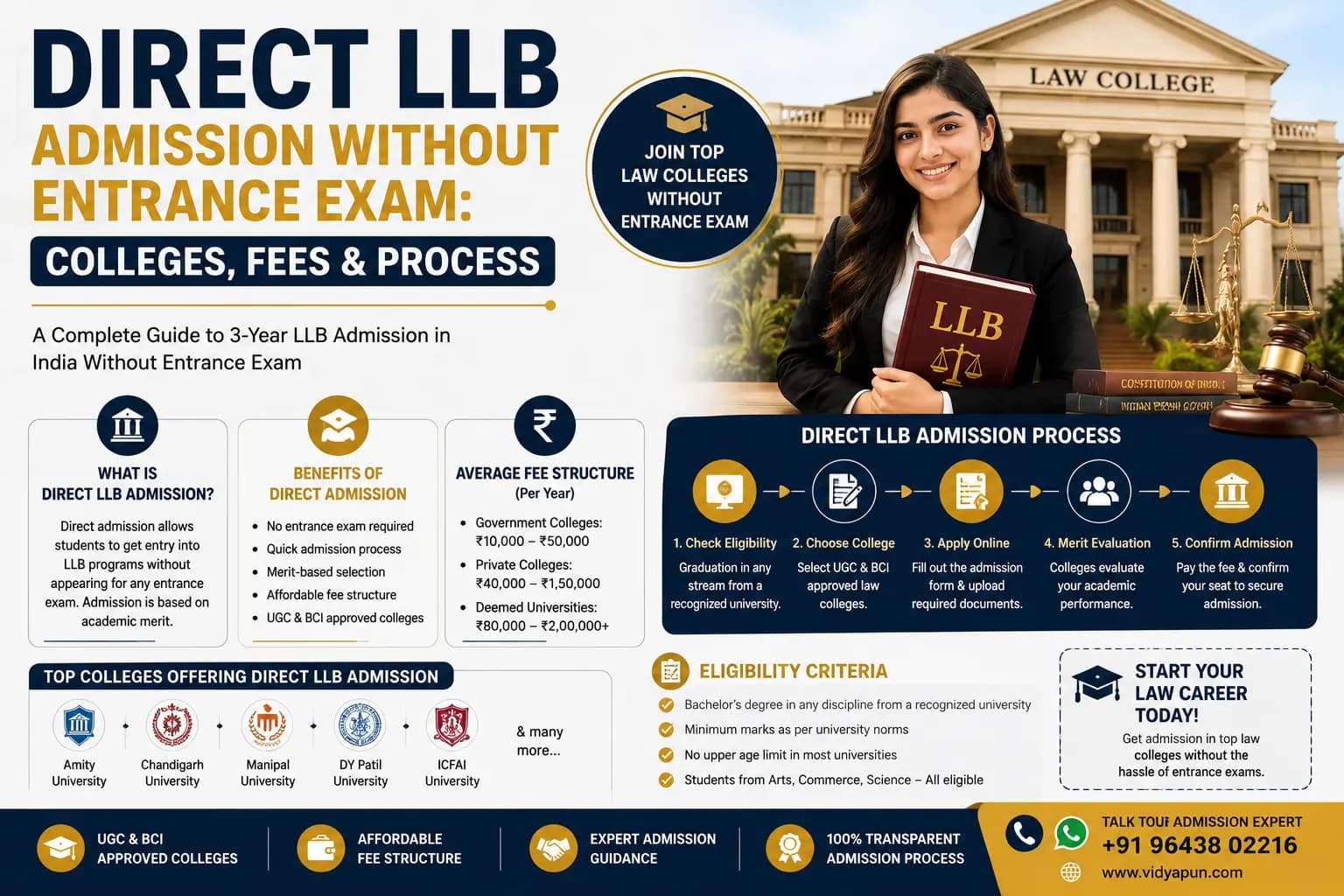
Direct admission means a law college evaluates and admits you based on your existing academic qualification (typically your graduation marks for the 3-year LLB) rather than requiring you to clear a separate entrance test.
How It Differs from Entrance-Based Admission
In entrance-based admission, your rank or score in an exam like CLAT determines eligibility and seat allotment through a centralized counselling process. In direct admission, the college itself evaluates your application — usually your graduation percentage — and admits you through its own internal process, without a shared exam or consortium involved.
Is It Legally Valid?
Yes, provided the institution is properly recognized. Direct admission is not inherently less legitimate than exam-based admission — many well-established private law colleges use this model for a portion or all of their seats. What matters is that the specific college holds valid Bar Council of India (BCI) approval and is affiliated with a recognized, UGC-approved university, which we'll cover in more detail further down.
Which Colleges Offer Direct LLB Admission?
Not every institution offers this route, and it's worth knowing where it's more commonly available.
Private and Self-Financed Law Colleges
Most direct admission seats are offered by private and self-financed law colleges, which run their own admission processes independent of a centralized exam consortium. These institutions vary considerably in quality, faculty, and outcomes, so treat "private" as a category to research individually, not a fixed indicator of quality either way.
Do Government Colleges Offer Direct Admission?
Government and state-affiliated law colleges typically fill their seats through centralized counselling based on entrance exam ranks or state-level merit lists, with very limited or no direct admission provision. If a government or well-known state college is on your shortlist, assume an entrance exam or formal merit process is required unless you've confirmed otherwise directly with the institution.
Direct LLB Admission Process Explained
The process is generally more streamlined than entrance-based admission, though the exact steps vary by college.
Application and Merit Evaluation
You typically apply directly through the college's admission office or portal, submitting your graduation mark sheets and required documents. The college evaluates your application against its minimum eligibility criteria and, where seats are limited, its own merit or interview process.
Document Submission and Verification
Expect to submit your graduation degree certificate and mark sheets, Class 10 and 12 certificates, transfer and migration certificates, category certificates if applicable, and identity proof. Colleges typically verify these documents before confirming your seat — keep both digital and physical copies ready.
Direct LLB Admission Fees and Cost Structure
Cost is one of the most important factors to get clarity on before committing to this route.
How Direct Admission Fees Compare
Direct admission fees at private colleges can vary widely — from figures broadly comparable to entrance-based private seats to significantly higher for colleges with limited direct-admission capacity. There's no single reliable "typical" figure across the country, since fee structures differ by state, college reputation, and infrastructure. Always request a complete, itemized fee breakdown in writing (tuition, exam fees, library, hostel, and any one-time charges) directly from the college's admission office before making any payment.
Payment Structure and Refund Policy
Most colleges require an initial admission or seat-confirmation payment, followed by semester or annual fee instalments. Before paying anything, ask specifically about the refund and cancellation policy in case you later decide not to join — UGC guidelines require institutions to have a defined refund policy, and a legitimate college should be able to share this clearly and in writing.
Management Quota and Other Seat Categories
Some direct admission seats fall under specific quota categories, which are worth understanding separately.
Management Quota Seats
Management quota refers to a portion of seats a private college is permitted to fill at its own discretion, often (though not always) at a different fee structure than merit or entrance-based seats. This is a recognized category at many institutions, but the exact proportion of management quota seats and their fee difference varies by college and state regulation.
NRI and Other Special Quotas
Many colleges also maintain a separate NRI quota, typically at a different fee structure, along with other special categories depending on the institution. If you fall into one of these categories, ask the admission office directly about eligibility documentation and fee differences specific to that quota.
Verifying a College Before You Pay
Because direct admission skips a centralized filtering exam, verification responsibility shifts more heavily onto you.
Checking Recognition and Accreditation
Before paying any amount, confirm the college's law program has valid Bar Council of India approval and that its affiliating university holds UGC recognition. Ask for these details in writing, and independently cross-check them rather than relying solely on what an admission office or brochure tells you — this is non-negotiable for your degree to be valid for future Bar Council enrolment.
Red Flags with Admission Consultants and Agents
Be especially cautious with admission consultants or agents who guarantee a seat regardless of your marks, pressure you to pay a large non-refundable amount before you've seen an official offer letter, or discourage you from contacting the college directly. Many consultants operate on commission and may not always represent your best interest. Wherever possible, communicate directly with the college's official admission office rather than exclusively through a third party.
Direct Admission for Repeaters and Gap Year Students
This route is often specifically useful for candidates in less conventional academic timelines.
Eligibility Considerations
A gap year or a previous unsuccessful entrance exam attempt generally does not affect your eligibility for direct admission, as long as your graduation qualification meets the college's minimum requirement. This makes direct admission a practical option for candidates who want to start LLB without waiting another full year to reattempt an entrance exam.
Direct Admission vs Entrance Exam Admission: Which Should You Choose?
Both routes are legitimate — the right choice depends on your specific priorities and constraints.
Making the Right Call for Your Situation
If you value a faster, more predictable admission timeline and have already identified a specific, verified college, direct admission can make sense. If you're aiming for a more selective institution, want access to entrance-based scholarships, or simply have time to prepare, an entrance exam route may open more (and sometimes more affordable) options. Neither path is objectively better — what matters most is thorough verification of whichever specific college you choose.
Frequently Asked Questions
1. Which colleges offer LLB admission without an entrance exam? Primarily private and self-financed law colleges that run their own admission process. Government and state-affiliated colleges typically require an entrance exam or centralized merit process. Always confirm directly with your specific target institutions.
2. Is direct LLB admission valid and recognised? Yes, provided the college holds valid Bar Council of India approval and is affiliated with a UGC-recognized university. Verify these credentials independently before enrolling or paying any fee.
3. How much does direct LLB admission cost? Fees vary significantly by college, state, and infrastructure, with no single typical figure across the country. Always request a complete, written fee breakdown directly from the college's admission office before committing.
4. Are management quota seats available in direct LLB admission? Yes, many private colleges offer a portion of seats under management quota, often at a different fee structure than merit-based seats. The exact proportion and fee difference vary by institution and state regulation.
5. Is direct admission available in government LLB colleges? Generally no — government and state-affiliated colleges typically fill seats through centralized entrance exam or merit-based counselling, with very limited or no direct admission provision.
6. What documents are required for direct LLB admission? Typically your graduation degree certificate and mark sheets, Class 10 and 12 certificates, transfer/migration certificates, category certificates if applicable, and identity proof.
7. What are the risks of using admission consultants or agents? Some consultants operate on commission and may pressure you toward a specific college or push for early non-refundable payments. Always verify a college's recognition independently and communicate directly with its official admission office wherever possible.
8. Can NRI students get direct LLB admission? Yes, many colleges maintain a separate NRI quota with its own eligibility and fee structure. Contact the college's admission office directly for the specific documentation and fee details that apply to this category.
Ready to explore verified options? Browse the Best Colleges in India for law, review full details on the LLB Course page, or check Law Admission guidance for the complete process either way.
Talk to Admission Expert before you pay any college:
🌐 Website: www.vidyapun.com 📞 Call / WhatsApp: +91 96438 02216