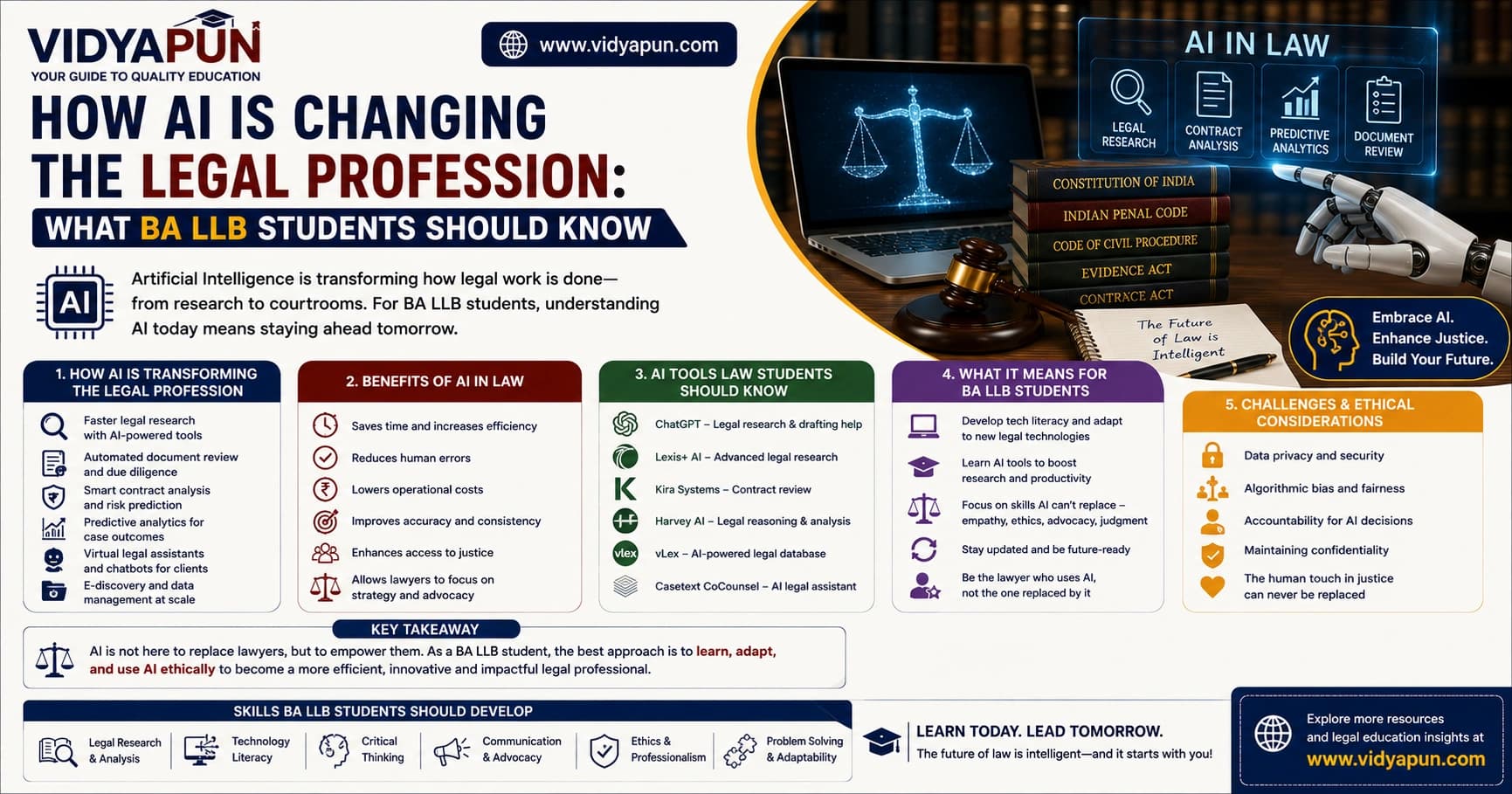
"Will AI replace lawyers?" has gone from a hypothetical seminar question to something students genuinely ask before choosing a law school, and lawyers ask before choosing a practice area. The honest answer, based on where the profession actually stands in 2026, is more nuanced than either the panic or the dismissal you'll find online. This guide covers what's actually changing in Indian legal practice, what isn't, and how to prepare regardless of where you are in your BA LLB journey.
Where AI Actually Stands in the Legal Profession Today
AI adoption in the legal industry has moved well past the experimental phase. Globally, corporate legal AI adoption more than doubled in a single year, and nearly 70% of legal professionals now report using general-purpose AI tools for work, up sharply from the year before. India's legal-tech sector has grown alongside this: the country's AI-powered legal tech and compliance market is now valued in the billions of dollars, and Indian legal-tech startups raised significantly more funding in the past year than in any previous year, producing the country's first legal-tech unicorn.
What's actually being automated:
- Document review and contract analysis – flagging risks and inconsistencies across large volumes of documents far faster than manual review
- Legal research – AI-powered research tools now offer far greater visibility into case law, judicial trends, and even judge-specific patterns than was possible even a few years ago
- Compliance monitoring – combining regulatory updates into real-time "risk maps" for legal teams managing obligations across jurisdictions
- Court and case data infrastructure – platforms ingesting and indexing large volumes of Indian court records to make legal research more comprehensive
How AI Is Being Used in Indian Law Firms and Courts
This isn't a distant, foreign trend — it's actively unfolding within Indian legal institutions:
- Major Indian law firms have deployed AI platform-wide, including firm-wide generative AI tools selected after extensive internal pilot programs involving hundreds of lawyers
- Indian courts are adopting AI too — the government has allocated significant funding under the e-Courts Phase III project specifically for AI and blockchain technologies across High Courts, and at least one High Court has already deployed AI for witness depositions
- The judiciary has set up a dedicated AI oversight body responsible for conceptualizing and monitoring AI use within the Indian judicial system, reflecting a "human-in-the-loop" approach — AI assists with research and drafting, but lawyers remain responsible for verifying and signing off on everything that reaches clients or courts
This human-in-the-loop principle is the throughline across nearly every serious analysis of legal AI in 2026: AI accelerates specific tasks, but accountability, judgment, and final sign-off remain squarely with lawyers.
Will AI Replace Lawyers?
Every major legal industry analysis converges on the same answer: no, but the composition of legal work is changing meaningfully.
- Junior-level, routine work is shrinking – tasks like first-pass document review, once a rite of passage for junior associates, are increasingly automated
- Judgment-heavy work isn't going anywhere – legal work requiring accountability, ethical oversight, negotiation, courtroom advocacy, and client counseling remains squarely human territory
- The real risk isn't AI itself — it's falling behind on it – across surveys, a meaningful share of legal professionals say they'd turn down a role that didn't offer access to AI tools, and firms without demonstrable AI capability are increasingly seen as facing a structural disadvantage
- India's legal services market is still growing substantially even as AI adoption accelerates, driven by firms using technology to handle larger volumes of work with leaner teams rather than shrinking overall demand for legal services
For a BA LLB student, the practical takeaway isn't "avoid AI-exposed practice areas" — it's "build the judgment-heavy skills AI can't replicate, while getting genuinely comfortable using AI tools yourself."
Skills BA LLB Students Should Build for an AI-Driven Legal Career
Given where the profession is heading, a few skill areas matter more than they did even a couple of years ago:
- AI tool fluency – comfort using legal research and drafting AI tools isn't optional anymore; treat it as a core professional skill, not an elective interest
- Strong legal writing and reasoning – AI can draft a first pass, but verifying, refining, and standing behind that output requires the underlying skill it's meant to accelerate, not replace
- Digital and data literacy – understanding how legal-tech tools work, including their limitations, matters increasingly across practice areas; our guide on digital skills for LLB students is a useful starting point
- Practical legal skills beyond drafting – negotiation, client counseling, courtroom advocacy, and ethical judgment remain the areas least exposed to automation; see our guide on BA LLB practical legal skills
- Domain specialization – cyber law and technology regulation are growing fields shaped directly by this shift; our primer on introduction to cyber law for BA LLB students is worth reading if this interests you
Our broader guides on modern legal skills for BA LLB students and skills for BA LLB students cover the fuller picture of what's worth building alongside your core coursework. Legal research specifically is being reshaped by AI tools directly, so it's worth revisiting fundamentals through our guide on legal research skills every BA LLB student needs — knowing how to verify and interpret AI-assisted research output matters as much as knowing how to conduct research manually.
How Legal Education Is Adapting to AI
Law schools and legal education more broadly are beginning to respond to this shift, though unevenly across institutions:
- Some universities are introducing AI and legal-tech electives directly into the LLB and BA LLB curriculum
- Moot court and clinical legal education programs are increasingly incorporating AI-assisted research as part of the process, not treating it as separate from "real" legal training
- Corporate law practice areas — where AI adoption has moved fastest — are prompting curriculum updates that emphasize both technology fluency and the judgment-based skills that remain distinctly human
For a fuller look at how AI specifically intersects with legal education, see our dedicated guide on AI in legal education, and our broader guide on the future of legal education in India for how curricula are evolving beyond just AI. If you're weighing how this shift affects specific career paths, our guides on career after BA LLB, top job roles for BA LLB graduates, and corporate law career path for BA LLB graduates are useful next reads, since corporate practice is where this shift is currently most visible.
Curious how your profile stacks up for programs that prepare you well for this shift? Explore verified BA LLB programs on the Vidyapun BA LLB course page.
Frequently Asked Questions
Will AI replace lawyers in India?
No, according to virtually every major legal industry analysis. AI is automating routine, high-volume tasks like document review and legal research, but judgment-heavy work — courtroom advocacy, negotiation, client counseling, and final legal accountability — remains squarely human.
Should BA LLB students learn AI tools during their degree?
Yes. AI tool fluency is increasingly treated as a core professional skill rather than an optional interest, given how quickly adoption has accelerated across Indian law firms and courts.
Which legal practice areas are most affected by AI?
Document-heavy corporate practice areas — contract review, compliance monitoring, and large-scale legal research — have seen the fastest AI adoption. Litigation and advocacy-heavy practice remain comparatively less automated, since they depend on courtroom skill and judgment.
Are Indian courts using AI too, or just law firms?
Both. Indian courts are adopting AI under government-funded initiatives like the e-Courts Phase III project, with some High Courts already using AI for specific functions like witness depositions, alongside a dedicated judicial AI oversight body monitoring responsible adoption.
Is India's legal job market shrinking because of AI?
No — India's legal services market continues to grow substantially even as AI adoption accelerates, largely because firms are using AI to handle greater work volume with leaner teams rather than reducing overall demand for legal expertise.
Final Thoughts
AI isn't replacing lawyers, but it is genuinely reshaping what junior legal work looks like — and the students and professionals who treat AI fluency as a core skill, rather than a threat to avoid, will have a real advantage as adoption accelerates further. Build your judgment-based skills deliberately, but don't wait to get comfortable with the tools reshaping the profession around you.
Wondering how to build the right skill set during your BA LLB for an AI-changed legal profession? Check Your Admission Chances for personalized guidance.
🌐 Website: www.vidyapun.com 📞 Call / WhatsApp: +91 96438 02216