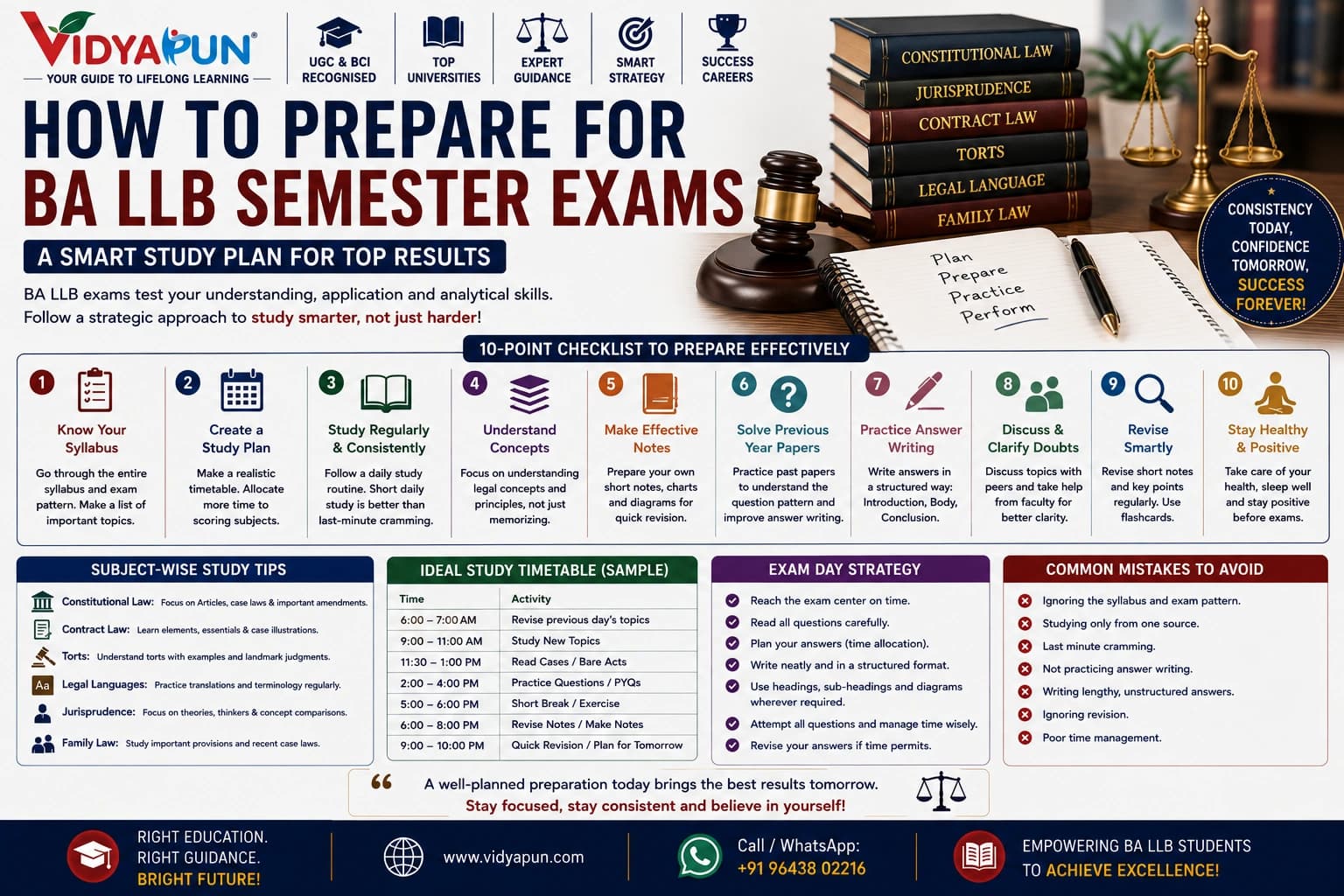
Semester exams in BA LLB reward preparation that's planned well in advance, not crammed in the final week. This guide walks through the exam format itself, how to build a realistic revision timetable, how to use previous year papers effectively, and the answer-writing habits that tend to separate strong scores from average ones.
Understanding the BA LLB Semester Exam Format
Before building a study plan, it helps to know exactly what you're preparing for.
Types of Questions Typically Asked
BA LLB exams generally mix short-answer conceptual questions with longer, application-based questions built around hypothetical fact patterns — knowing this split in advance helps you allocate revision time appropriately across both formats.
Weightage of Internal vs External Marks
Most subjects combine internal assessment (assignments, class participation, mid-semester tests) with a final external exam, and understanding your specific internal-to-external weightage for each subject helps you prioritise where extra effort actually moves your final grade.
Building a Pre-Exam Revision Timetable
A structured timetable is the single biggest factor separating calm, effective preparation from last-minute panic.
Starting Revision Early Enough
Begin your dedicated revision phase at least two to three weeks before exams start, giving yourself enough runway to cover every subject at least once before narrowing down to focused practice.
Allocating Time by Subject Difficulty
Don't split revision time equally across all subjects — give more time to subjects you find genuinely difficult or where your internal assessment scores suggest weaker understanding.
Using Previous Year Papers Strategically
Previous year papers are one of the most underused resources by BA LLB students, often skipped in favour of just re-reading notes.
Identifying Recurring Question Patterns
Go through several years of question papers for each subject to spot recurring themes or frequently tested topics — this gives you a realistic sense of where to focus your revision effort.
Timed Practice Under Exam Conditions
Attempt at least one or two full papers under actual timed conditions before the exam — this reveals pacing problems that don't show up when you're practicing without a clock running.
Answer Writing Techniques That Score Higher
Two students with similar knowledge can score very differently based purely on how they structure their answers.
Structuring Answers Clearly
Lead with the relevant legal issue, state the applicable rule or provision, apply it to the facts given, and close with a clear conclusion — examiners consistently reward this kind of visible structure over a dense, unstructured paragraph covering the same content.
Citing Case Law and Statutes Correctly
Where relevant, cite specific case names and statutory provisions accurately rather than vaguely referencing "a case" or "the relevant law" — precise citation signals genuine command of the material and is usually rewarded accordingly.
Managing Internal Assessments Alongside Exam Prep
Internal assessments shouldn't be treated as separate from your exam preparation — they're closely connected.
Balancing Assignments With Exam Revision
Try to complete internal assignments well ahead of the exam revision period, so the two don't compete for the same limited time right when you need to focus fully on revision.
Using Internal Marks as a Safety Net
Strong internal assessment performance gives you some cushion heading into the final exam, so don't underweight assignments and class participation just because the final exam feels like the "real" test.
Exam Week: Final Preparation and Mindset
The final stretch before exams calls for a different approach than the weeks before it.
Final Revision Without New Learning
Use exam week for quick recall of material you've already studied — condensed notes, key case names, important provisions — rather than trying to learn new content this late, which tends to create more anxiety than benefit.
Managing Exam Anxiety and Rest
Prioritise sleep in the final days before each exam over additional last-minute study; fatigue affects recall and clear thinking during the exam far more than most students expect it to.
Final Thoughts
Strong performance in BA LLB semester exams comes down to a few consistent habits: starting revision early, prioritising subjects strategically rather than equally, practicing with previous year papers under real time pressure, and writing structured, well-cited answers. None of this requires extraordinary effort — it just requires planning ahead rather than relying on last-minute intensity.
Curious how your BA LLB profile is shaping up? Check Your Admission Chances with Vidyapun's free assessment tool.
Frequently Asked Questions
Q1. When should I start revising for BA LLB semester exams?
A: Aim to start your dedicated revision phase at least two to three weeks before exams begin, giving yourself enough time to cover every subject before narrowing into focused practice.
Q2. How can previous year question papers help with exam preparation?
A: They reveal recurring question patterns and help you identify frequently tested topics, and practicing them under timed conditions also exposes pacing issues before the real exam.
Q3. What's the best way to structure a law exam answer?
A: Lead with the legal issue, state the applicable rule, apply it to the given facts, and close with a clear conclusion — this visible structure tends to score better than an unstructured answer covering the same content.
Q4. Do internal assessments really matter for my final grade?
A: Yes — most subjects combine internal assessment with the final exam, so strong internal performance gives you a real cushion heading into exams and shouldn't be treated as an afterthought.
Q5. Should I study all subjects equally before exams?
A: No — allocate more revision time to subjects you find genuinely difficult or where your internal assessment scores suggest weaker understanding, rather than splitting time equally.
Q6. What should I do in the final days before a BA LLB exam?
A: Focus on quick recall of material you've already studied rather than learning new content, and prioritise rest over additional last-minute study, since fatigue significantly affects recall during the exam itself.
🌐 Website: www.vidyapun.com 📞 Call / WhatsApp: +91 96438 02216