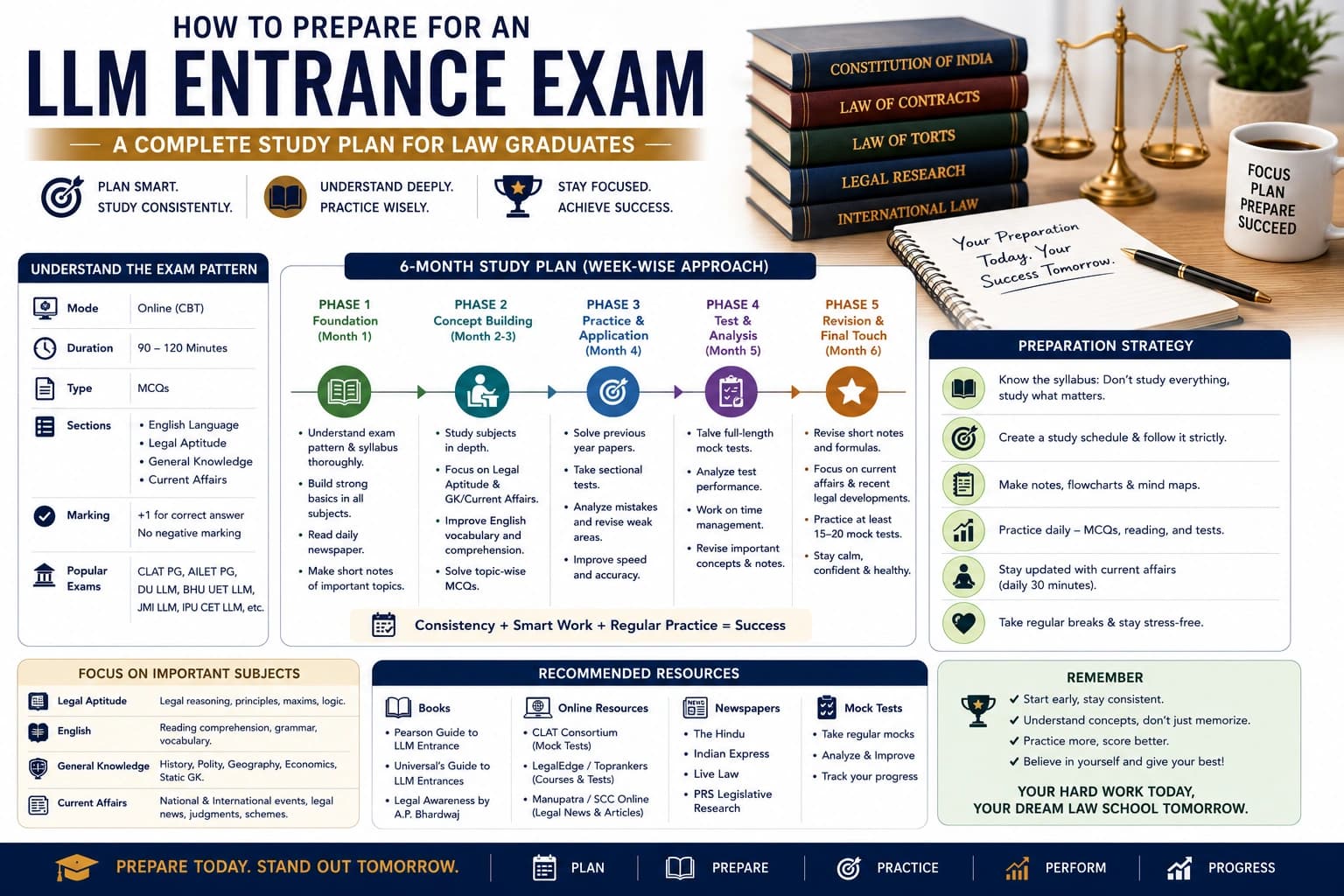
Pursuing a Master of Laws (LLM) is an excellent way to deepen your legal knowledge, specialize in a particular field, and enhance your career prospects. Admission to many universities requires candidates to qualify for an LLM entrance examination or meet specific admission criteria.
Whether you are a recent Bachelor of Laws (LLB) graduate or have completed a BA LLB Course, having a structured preparation strategy can improve your confidence and readiness for the admission process.
This guide outlines practical preparation tips, important subjects to revise, and strategies to help you prepare effectively for an LLM entrance exam.
Why Prepare Early for an LLM Entrance Exam?
Starting your preparation early allows you to:
- Build a strong legal foundation
- Revise core law subjects thoroughly
- Improve legal reasoning and analytical skills
- Practice time management
- Identify strengths and areas for improvement
- Reduce last-minute exam stress
Consistent preparation is generally more effective than intensive last-minute studying.
Understand the Admission Process
Different universities may have different admission procedures. Some institutions conduct entrance examinations, while others may offer admission based on merit or other eligibility criteria.
Before you begin preparing:
- Review the eligibility criteria.
- Check the admission process of your preferred universities.
- Understand the syllabus and exam pattern (if applicable).
- Keep track of application deadlines.
Know the Important Law Subjects
A strong understanding of core legal subjects is important during preparation.
Focus on topics such as:
- Constitutional Law
- Jurisprudence
- Contract Law
- Criminal Law
- Family Law
- Administrative Law
- Property Law
- Tort Law
- Environmental Law
- Public International Law
- Intellectual Property Rights
- Company Law
Revision of these foundational subjects can improve conceptual clarity.
Create a Realistic Study Plan
Develop a weekly study schedule that balances revision and practice.
Example:
Monday–Friday
- Read one legal subject
- Revise previous topics
- Solve practice questions
- Read recent legal developments
Saturday
- Mock test
- Review mistakes
Sunday
- Revision
- Current legal affairs
- Rest and planning for the next week
A structured timetable helps maintain consistency.
Improve Legal Reasoning Skills
Legal reasoning is an important skill for postgraduate legal studies.
Practice:
- Reading legal problems
- Applying legal principles
- Analyzing judgments
- Writing logical conclusions
- Identifying relevant legal provisions
Regular practice improves analytical thinking.
Read Landmark Judgments
Understanding significant judicial decisions strengthens legal concepts.
Develop the habit of reading:
- Constitutional Bench judgments
- Important Supreme Court decisions
- High Court judgments
- Recent legal developments
This also improves legal interpretation skills.
Stay Updated with Current Legal Developments
Law is constantly evolving.
Follow updates on:
- New legislation
- Significant judgments
- Constitutional amendments
- International legal developments
- Emerging areas such as AI Law and Data Privacy
Reading legal news regularly helps improve awareness.
Practice Previous Question Papers
If previous papers are available, use them to:
- Understand question patterns
- Improve time management
- Identify frequently tested topics
- Assess preparation levels
Practice under timed conditions whenever possible.
Strengthen Legal Research Skills
Research is an essential part of postgraduate legal education.
Practice:
- Finding reliable legal sources
- Reading case laws
- Interpreting statutes
- Writing concise legal notes
- Comparing judicial opinions
These skills also support dissertation writing later in your LLM.
Improve Answer Writing
Well-structured answers often demonstrate clear legal understanding.
Follow this approach:
- Understand the question
- Identify relevant legal principles
- Support arguments with authorities
- Present logical conclusions
- Write clearly and concisely
Practice improves speed and accuracy.
Manage Your Time Effectively
Avoid studying for long hours without breaks.
Instead:
- Set daily goals
- Prioritize difficult topics
- Revise regularly
- Take short breaks
- Maintain a balanced routine
Consistency is more sustainable than overloading yourself.
Common Mistakes to Avoid
Many students make avoidable mistakes during preparation.
These include:
- Ignoring basic law subjects
- Delaying revision
- Not practicing mock tests
- Depending only on notes
- Skipping current legal developments
- Poor time management
Recognizing these early can help you prepare more effectively.
Skills That Support LLM Success
Along with subject knowledge, work on developing:
- Legal Research
- Critical Thinking
- Legal Writing
- Communication Skills
- Analytical Reasoning
- Time Management
- Problem Solving
- Academic Discipline
These skills remain valuable throughout your legal career.
Benefits of Pursuing an LLM
Completing an LLM can help you:
- Develop specialized legal expertise
- Explore advanced legal research
- Improve career opportunities
- Prepare for academic and research roles
- Build professional credibility
- Expand your legal network
Conclusion
Preparing for an LLM entrance exam requires planning, consistency, and a solid understanding of core legal concepts. By creating a structured study plan, revising foundational subjects, improving legal reasoning, and staying updated with legal developments, you can approach the admission process with greater confidence.
If you're planning to pursue an LLM, LLB, or BA LLB, Vidyapun can help you explore leading universities, compare programs, understand eligibility requirements, and receive expert admission guidance.
🌐 Website: www.vidyapun.com
📞 Call / WhatsApp: +91 96438 02216
Connect with Vidyapun today and take the next step toward achieving your legal education and career goals.
Frequently Asked Questions
1. When should I start preparing for an LLM entrance exam?
Starting several months before the application or exam timeline gives you enough time for revision and practice.
2. Which subjects are important for LLM preparation?
Constitutional Law, Jurisprudence, Contract Law, Criminal Law, Administrative Law, Company Law, Public International Law, and other core legal subjects are commonly revised.
3. Are mock tests useful?
Yes. Mock tests help improve time management, identify weak areas, and build confidence.
4. How important are current legal developments?
Keeping up with recent legal changes and landmark judgments helps strengthen your overall legal understanding.
5. Can I prepare for an LLM entrance exam while working?
Yes. With a realistic study schedule and consistent effort, many candidates successfully balance work and preparation.