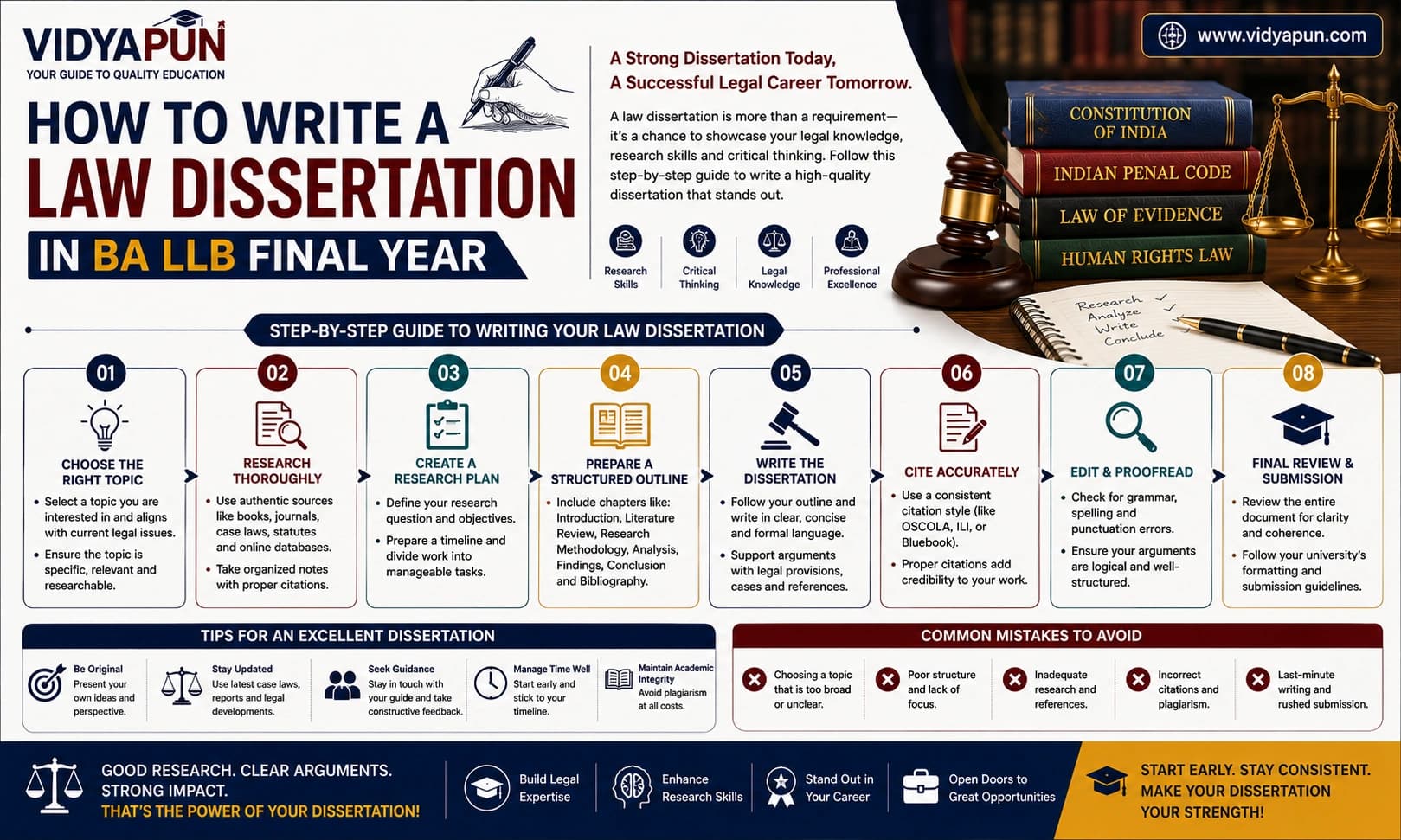
If you're in your final year of BA LLB, the dissertation is probably the single largest piece of independent academic work you'll produce before graduating — and unlike semester exams, there's no fixed syllabus to fall back on. This guide walks through the process step by step: choosing a topic, structuring your dissertation, researching it properly, and avoiding the mistakes that cost students the most marks.
Understanding the BA LLB Dissertation Requirement
Most BA LLB programs require a dissertation in the final year as a core academic component, typically carrying significant weightage toward your overall grade. Before you start writing, get clear on:
- Word count and formatting requirements – these vary by university, so check your specific college's guidelines rather than assuming a standard length
- Submission deadlines and viva voce requirements – most dissertations require an oral defense after submission
- Your supervisor's expectations – some faculty expect regular chapter drafts, others prefer a single full submission for review
- Plagiarism and originality thresholds – nearly all universities now run submissions through plagiarism-detection software with a maximum similarity percentage
If you're still getting a handle on how your final year fits together with other academic requirements, our guide on BA LLB semester-wise guide: what to expect each year is a useful companion read.
How to Choose a Strong Dissertation Topic
Your topic choice affects everything downstream — how much research material is available, how original your argument can be, and how engaged you'll stay over months of writing. A strong BA LLB dissertation topic typically:
- Is narrow enough to research deeply – "Constitutional Law in India" is too broad; "Judicial interpretation of Article 21 in environmental cases post-2015" is workable
- Has sufficient available material – confirm there's enough case law, journal literature, and secondary sources before committing
- Connects to a genuine question or gap – the strongest dissertations argue something, rather than just summarizing existing law
- Aligns with your interests or career direction – if you're leaning toward a specific practice area, a related dissertation topic can double as a talking point in interviews later
If you're drawing a blank, browsing recent judgments, amendments, or contemporary legal debates in newspapers and law journals is often more productive than searching for "dissertation topic lists." For a related process further down the academic ladder, our guide on how to choose the right LLM dissertation topic covers similar topic-selection principles that apply just as well here.
Structuring Your Law Dissertation
Most law dissertations follow a broadly consistent structure, even though exact chapter names vary by university:
- Introduction – research question, objectives, scope, and significance of the study
- Literature Review – existing scholarship and legal position on your topic, identifying the gap your dissertation addresses
- Research Methodology – doctrinal, empirical, or comparative approach, and why you chose it
- Main Analysis Chapters – typically 2–3 chapters presenting your core argument, case analysis, and findings
- Conclusion and Recommendations – summarizing findings and, where relevant, suggesting legal or policy reform
- Bibliography and Annexures – properly formatted citations following your university's required style (often Bluebook or OSCOLA for Indian law dissertations)
Building this structure early — even as a rough outline before you've written a single paragraph — makes the actual writing process considerably faster, since you're filling in sections rather than staring at a blank document.
Research Methodology and Sources
Most BA LLB dissertations use one of two broad approaches:
- Doctrinal research – analyzing statutes, case law, and legal commentary to build an argument (the most common approach for undergraduate dissertations)
- Empirical research – involving surveys, interviews, or data collection, less common at the BA LLB level but increasingly used for socio-legal topics
Strong sources include:
- Case law from primary databases (SCC Online, Manupatra, or official court websites)
- Peer-reviewed law journals and law review articles
- Government reports, Law Commission reports, and parliamentary debates
- Books and treatises by recognized legal scholars
Avoid relying heavily on blog posts, coaching-institute notes, or unreferenced online summaries — examiners can tell, and it weakens your argument's credibility. If your legal research skills need sharpening before you dive in, our guides on legal research skills every BA LLB student needs and building a legal research portfolio are worth reviewing first.
Writing, Citation & Common Mistakes to Avoid
Once your research and structure are in place, keep these points in mind while writing:
- Write in clear, formal academic language – avoid overly casual phrasing, but also avoid unnecessarily dense legalese where a simpler sentence would do
- Cite consistently – pick one citation style (usually specified by your university) and apply it uniformly throughout; inconsistent citation is one of the most common reasons marks are deducted
- Avoid over-reliance on quotations – examiners want your analysis, not a string of quoted passages; paraphrase and analyze rather than just compiling quotes
- Don't skip proofreading – a dissertation full of typos and formatting inconsistencies undermines otherwise strong research
- Start early and work in stages – dissertations written entirely in the final two weeks are usually obvious to examiners, and rushed research tends to show in shallow analysis
If you want to sharpen your writing specifically, our guide on how to improve legal writing skills in law school covers techniques that apply directly to dissertation writing. And since a dissertation competes for time with everything else in your final year, our guide on time management tips for BA LLB students is worth revisiting as deadlines approach.
Common mistakes worth specifically avoiding:
- Choosing a topic so broad it can't be meaningfully covered in the required word count
- Writing the literature review as a list of summaries rather than a synthesized argument about what's missing in existing scholarship
- Leaving the viva voce preparation until after submission, rather than anticipating likely questions while you write
For a broader look at what comes after you've cleared your dissertation and BA LLB overall, our guides on career after BA LLB and top job roles for BA LLB graduates are useful next reads. If you're considering an LLM afterward, the dissertation habits you build now carry over directly — see our guide on understanding LLM dissertation writing for what to expect at the next level.
Curious how your profile stacks up for further study or specialization after BA LLB? Explore verified programs on the Vidyapun BA LLB course page.
Frequently Asked Questions
How long should a BA LLB dissertation be?
This varies significantly by university, typically ranging from 8,000 to 15,000 words. Always confirm the exact requirement with your college's dissertation guidelines rather than assuming a standard length.
What is the best dissertation topic for BA LLB final year?
The best topic is narrow enough to research deeply, has sufficient available case law and literature, and connects to a genuine legal question or gap — rather than simply summarizing an established area of law.
Should I use doctrinal or empirical research for my BA LLB dissertation?
Doctrinal research (analyzing statutes, case law, and legal commentary) is the most common approach at the BA LLB level. Empirical research is used less often but can work well for socio-legal topics involving surveys or data collection.
How do I avoid plagiarism in my law dissertation?
Cite every source consistently using your university's required citation style, paraphrase rather than over-quote, and run your draft through plagiarism-detection tools before submission to confirm you're within your university's similarity threshold.
When should I start working on my BA LLB dissertation?
Ideally several months before your submission deadline. Starting early allows time for proper research, feedback from your supervisor, and revision — all of which are difficult to compress into the final few weeks.
Final Thoughts
A strong BA LLB dissertation isn't about picking a trendy topic or writing the longest possible document — it's about choosing a focused question, building a clear structure early, and giving yourself enough time to research and revise properly. Start now, even if submission feels far away; the students who struggle most are almost always the ones who started late.
Wondering what comes after your BA LLB — further study, specialization, or career options? Check Your Admission Chances for personalized guidance.
🌐 Website: www.vidyapun.com 📞 Call / WhatsApp: +91 96438 02216