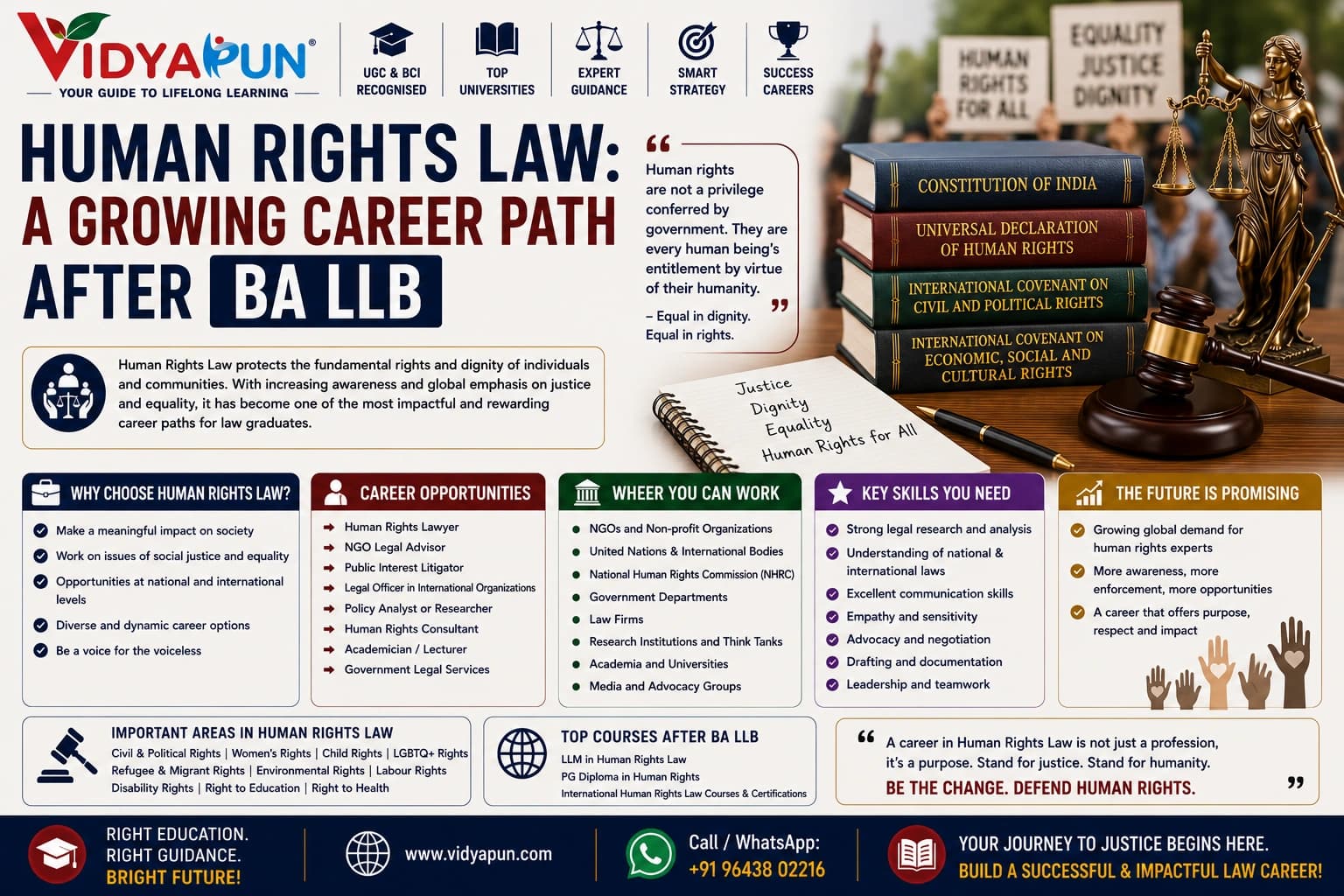
If you're finishing your BA LLB course and looking for a specialization that combines legal skill with social impact, human rights law is worth serious consideration. As India's civil society sector expands and international attention on human rights issues grows, the demand for lawyers who understand both domestic and international human rights frameworks continues to rise.
This guide covers what a human rights law career after BA LLB actually looks like — the roles available, the organizations that hire, the skills you'll need, and how to start building this path while you're still a student.
What Is Human Rights Law?
Human rights law is the body of domestic and international law that protects the fundamental rights and freedoms of individuals — from civil liberties and freedom of expression to protections against discrimination, torture, and exploitation.
Constitutional and Civil Rights
In India, much of human rights practice begins with the Constitution — particularly Fundamental Rights under Part III — and extends into civil rights litigation before the High Courts and Supreme Court.
International Human Rights Law
This branch deals with treaties, conventions, and frameworks such as the Universal Declaration of Human Rights and various UN conventions that India is a signatory to. Lawyers working in this space often engage with international bodies, reporting mechanisms, and cross-border advocacy.
Specialized Areas
Human rights law also branches into specialized practice areas like labor rights, refugee and migration law, child rights, gender justice, disability rights, and environmental justice — each with its own statutory framework and advocacy ecosystem.
Why BA LLB Graduates Are Well-Positioned for Human Rights Law
The five-year BA LLB structure gives students grounding in sociology, political science, and economics alongside legal training — subjects that directly inform human rights practice, where legal arguments are inseparable from social and political context.
This extended timeline also gives BA LLB students more opportunity than three-year LLB students to intern with NGOs, legal aid clinics, and human rights organizations well before graduation, building a portfolio of practical experience that matters enormously in this field.
Career Paths in Human Rights Law for BA LLB Graduates
Human rights law offers a wider range of employer types than most legal specializations, spanning courtrooms, NGOs, government bodies, and international organizations.
Litigator in Constitutional and Human Rights Cases
Litigators bring writ petitions and public interest litigation (PIL) before the High Courts and Supreme Court on issues ranging from custodial violence to environmental harm to discrimination. This path suits graduates who enjoyed moot courts and want to remain in active courtroom practice.
NGO and Civil Society Legal Roles
NGOs working on child rights, women's rights, prisoners' rights, and similar causes regularly hire legal officers and researchers to support litigation, draft reports, and engage with policy. These roles offer meaningful, hands-on work, though compensation is typically modest compared to corporate law.
Legal Aid and Public Interest Roles
Legal aid clinics and public interest law organizations provide free or subsidized legal representation to marginalized communities. Many BA LLB graduates enter this space directly after graduation, often through fellowship or clerkship programs.
Policy and Research Roles
Think tanks, research organizations, and advocacy groups need legal researchers to analyze legislation, draft policy briefs, and support law reform efforts. This path suits graduates who enjoy writing and analysis as much as advocacy.
International Organization and UN-Affiliated Roles
Organizations such as UN agencies, international NGOs, and human rights commissions occasionally hire legal staff for India-based or regional programs, though these roles are competitive and often require postgraduate specialization or several years of field experience.
Government and Statutory Body Roles
The National Human Rights Commission (NHRC) and various state human rights commissions employ legal staff to investigate complaints and support inquiries — a path that combines legal work with quasi-judicial process.
Skills You Need to Build a Human Rights Law Career
- Strong legal research and writing — much of the work involves drafting petitions, reports, and policy submissions.
- Understanding of constitutional and international law frameworks — a working knowledge of both is expected across most roles.
- Interviewing and fieldwork skills — many roles involve direct engagement with affected communities, requiring sensitivity and strong communication.
- Resilience and patience — human rights litigation often moves slowly and deals with emotionally difficult subject matter.
- Networking within civil society — much of this sector operates through relationships between NGOs, lawyers, and academic institutions.
Courses to Specialize in Human Rights Law
LLM in Human Rights Law
An LLM specialization in human rights, offered by several national law universities and international institutions, is the most direct way to deepen subject expertise and build credibility for research, litigation, or international roles.
Diploma and Certificate Courses
Shorter diploma and certificate programs in human rights law — offered by national law schools and international bodies — let students build foundational knowledge without committing to a full postgraduate degree, and are a popular option for those who want to start working immediately after BA LLB.
How to Start Your Human Rights Law Journey During BA LLB
Internships with NGOs and Legal Aid Clinics
Seek internships with human rights NGOs, legal aid clinics, and litigation chambers that handle PIL and constitutional matters. Direct exposure to casework, community engagement, and drafting will teach you far more than classroom study alone.
Moot Courts and Research Publications
Participating in human rights-focused moot court competitions and writing papers or blog posts on human rights issues builds a visible record of specialization that stands out to NGOs, litigation chambers, and postgraduate admissions committees alike.
Frequently Asked Questions
1. Is human rights law a good career after BA LLB?
Yes, particularly for graduates motivated by social impact. It offers varied roles across litigation, NGOs, research, and policy, though compensation in some sectors is lower than corporate law.
2. Do human rights lawyers earn less than corporate lawyers in India?
Generally, yes — especially in NGO and legal aid roles. However, litigation practice, international organization roles, and senior positions in government bodies can offer competitive compensation over time.
3. Can I combine human rights law with litigation practice? Absolutely. Many human rights lawyers build active PIL and constitutional litigation practices while also engaging with NGOs and advocacy organizations on specific causes.
4. What is the best way to start a career in human rights law right after BA LLB?
Building a track record of NGO internships, legal aid clinic work, and moot court participation during your BA LLB years is the most effective starting point, often followed by a legal aid fellowship or an LLM specialization.
5. Which BA LLB colleges are strong for students interested in human rights law?
Look for colleges with active legal aid clinics, human rights moot court teams, and NGO partnerships. You can check your admission chances based on your academic profile to see which colleges with strong human rights programs are realistically within reach.
Explore more in our BA LLB course guide, or check your admission chances to find the right law college for your goals.
🌐 Website: www.vidyapun.com 📞 Call / WhatsApp: +91 96438 02216