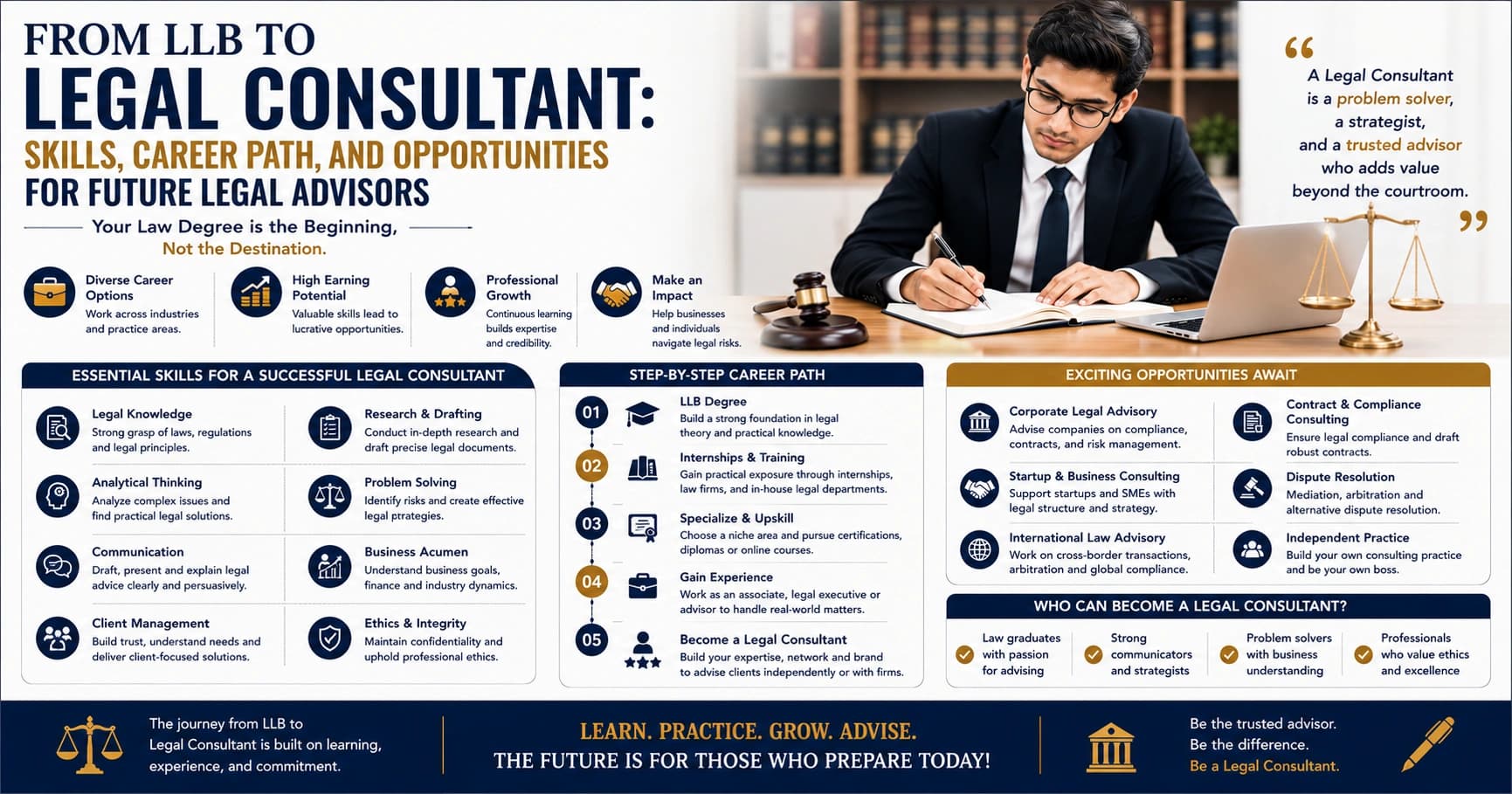
An LLB degree opens the door to a wide range of professional opportunities beyond traditional courtroom practice. One of the most rewarding career options is becoming a Legal Consultant, where legal knowledge is used to advise businesses, organizations, institutions, and individuals on legal matters before disputes arise.
Legal consultants play an important role in helping clients understand laws, reduce legal risks, review agreements, and maintain compliance with applicable regulations. Instead of representing clients in court every day, many consultants focus on preventive legal advice, documentation, policy review, and strategic decision-making.
If you enjoy research, communication, analytical thinking, and solving practical legal problems, a career as a legal consultant can be an excellent choice after completing your LLB.
What Does a Legal Consultant Do?
A legal consultant provides professional advice on legal matters based on applicable laws and regulations.
Typical responsibilities include:
- Reviewing legal documents
- Explaining legal obligations
- Advising on regulatory compliance
- Drafting contracts and agreements
- Identifying legal risks
- Supporting policy development
- Assisting with legal research
- Advising on dispute prevention
Their objective is to help clients make informed legal decisions.
Why Consider Legal Consulting After LLB?
Many graduates choose legal consulting because it combines legal knowledge with business problem-solving.
Some advantages include:
- Diverse work opportunities
- Continuous learning
- Exposure to different industries
- Strong research-oriented work
- Professional growth
- Opportunity to specialize
Legal consultants often work with corporate organizations, educational institutions, startups, non-profit organizations, and consulting firms.
Industries That Hire Legal Consultants
Legal expertise is valuable across multiple sectors.
Legal consultants may work with:
- Corporate Companies
- Technology Firms
- Educational Institutions
- Healthcare Organizations
- Banking and Financial Services
- Real Estate Companies
- Manufacturing Industries
- Government Projects
- Startups
- Non-Governmental Organizations (NGOs)
Every industry requires legal awareness to operate responsibly.
Essential Skills Every Legal Consultant Should Develop
Success in legal consulting depends on both legal knowledge and professional skills.
Legal Research
Consultants must quickly locate reliable legal information, interpret legislation, and analyse judicial decisions.
Legal Drafting
Preparing contracts, notices, agreements, legal opinions, and policy documents requires accuracy and clarity.
Communication Skills
Legal consultants regularly explain complex legal concepts to people without legal backgrounds.
Clear communication builds trust and prevents misunderstandings.
Analytical Thinking
Every legal issue requires careful evaluation.
Students should learn to:
- Interpret facts
- Compare legal provisions
- Assess risks
- Recommend practical solutions
Negotiation Skills
Negotiation helps consultants resolve legal issues before they become disputes.
Professional negotiation supports better business relationships.
Time Management
Consultants frequently handle multiple projects simultaneously.
Effective planning ensures timely delivery of quality work.
How to Prepare During LLB
Students can begin preparing for legal consulting while pursuing their LLB.
Helpful activities include:
- Participating in legal research projects
- Improving legal writing
- Reading recent judgments
- Attending seminars
- Learning contract drafting
- Understanding business law
- Building communication skills
Early preparation creates a stronger professional profile.
Build Knowledge Beyond the Classroom
A successful consultant never stops learning.
Students should regularly explore:
- Constitutional Law
- Contract Law
- Company Law
- Labour Law
- Consumer Protection
- Intellectual Property
- Data Privacy
- Environmental Law
A broad legal understanding increases career flexibility.
Importance of Professional Ethics
Trust is one of the most valuable qualities for any legal consultant.
Students should always practice:
- Confidentiality
- Honesty
- Professional integrity
- Objective legal analysis
- Ethical decision-making
Strong ethics contribute to long-term professional credibility.
Career Growth Opportunities
As consultants gain experience and expertise, they may expand into different legal practice areas or leadership roles.
Possible growth areas include:
- Corporate Legal Advisory
- Compliance Management
- Contract Management
- Legal Risk Assessment
- Policy Advisory
- Regulatory Affairs
- Legal Research
- Legal Training
Continuous learning supports long-term career development.
Common Mistakes New Graduates Should Avoid
Many graduates delay professional growth by making avoidable mistakes.
Avoid:
- Ignoring legal writing practice
- Depending only on theoretical knowledge
- Not improving communication skills
- Avoiding legal research
- Failing to stay updated with legal developments
- Neglecting professional networking
Developing practical skills alongside academics leads to better career readiness.
Emerging Trends in Legal Consulting
The legal profession continues to evolve.
Modern consultants increasingly work with:
- Legal Technology
- Digital Compliance
- Artificial Intelligence in Legal Research
- Data Protection Regulations
- ESG Compliance
- Online Dispute Resolution
- Cybersecurity Policies
Understanding these emerging areas prepares students for future opportunities.
How Vidyapun Supports Aspiring Law Students
Choosing the right university is the first step toward building a successful legal career.
Vidyapun provides:
- LLB Admission Guidance
- BA LLB Admission Support
- LLM Admission Counselling
- University Comparison
- Eligibility Assessment
- Documentation Assistance
- Career Counselling
- Personalized Admission Support
Our experienced education counsellors help students choose recognised universities that align with their academic interests and career aspirations.
Frequently Asked Questions
Can I become a legal consultant after completing an LLB?
Yes. An LLB provides the legal foundation required to pursue consulting opportunities in various industries, depending on applicable qualifications and career goals.
What skills are important for legal consulting?
Legal research, drafting, communication, analytical thinking, negotiation, problem-solving, and professional ethics are essential.
Do legal consultants only work for law firms?
No. Legal consultants may work with corporations, educational institutions, startups, NGOs, financial organizations, healthcare companies, and government projects.
Is legal consulting a good career choice?
Legal consulting offers opportunities to apply legal knowledge in advisory, compliance, documentation, and strategic decision-making roles across multiple sectors.
How can Vidyapun help?
Vidyapun provides expert law admission guidance, university comparison, eligibility assessment, and personalised counselling for students planning careers in legal education.
Author Information
Reviewed by: Vidyapun Education Team
Conclusion
A career as a Legal Consultant after LLB offers graduates the opportunity to apply legal knowledge in practical, business-oriented environments. By developing strong research, drafting, communication, and analytical skills, aspiring consultants can build rewarding careers across diverse industries. Starting skill development during law school and choosing the right educational pathway can create a strong foundation for long-term professional success.
Start Your Legal Career with Vidyapun
Planning to pursue an LLB, BA LLB, or LLM from a recognised university?
Vidyapun offers expert admission guidance, university comparison, and personalised counselling to help you choose the right law programme for your future.
🌐 Website: www.vidyapun.com
📞 Call / WhatsApp: +91 96438 02216
Contact Vidyapun today and take the next step toward a successful legal career.