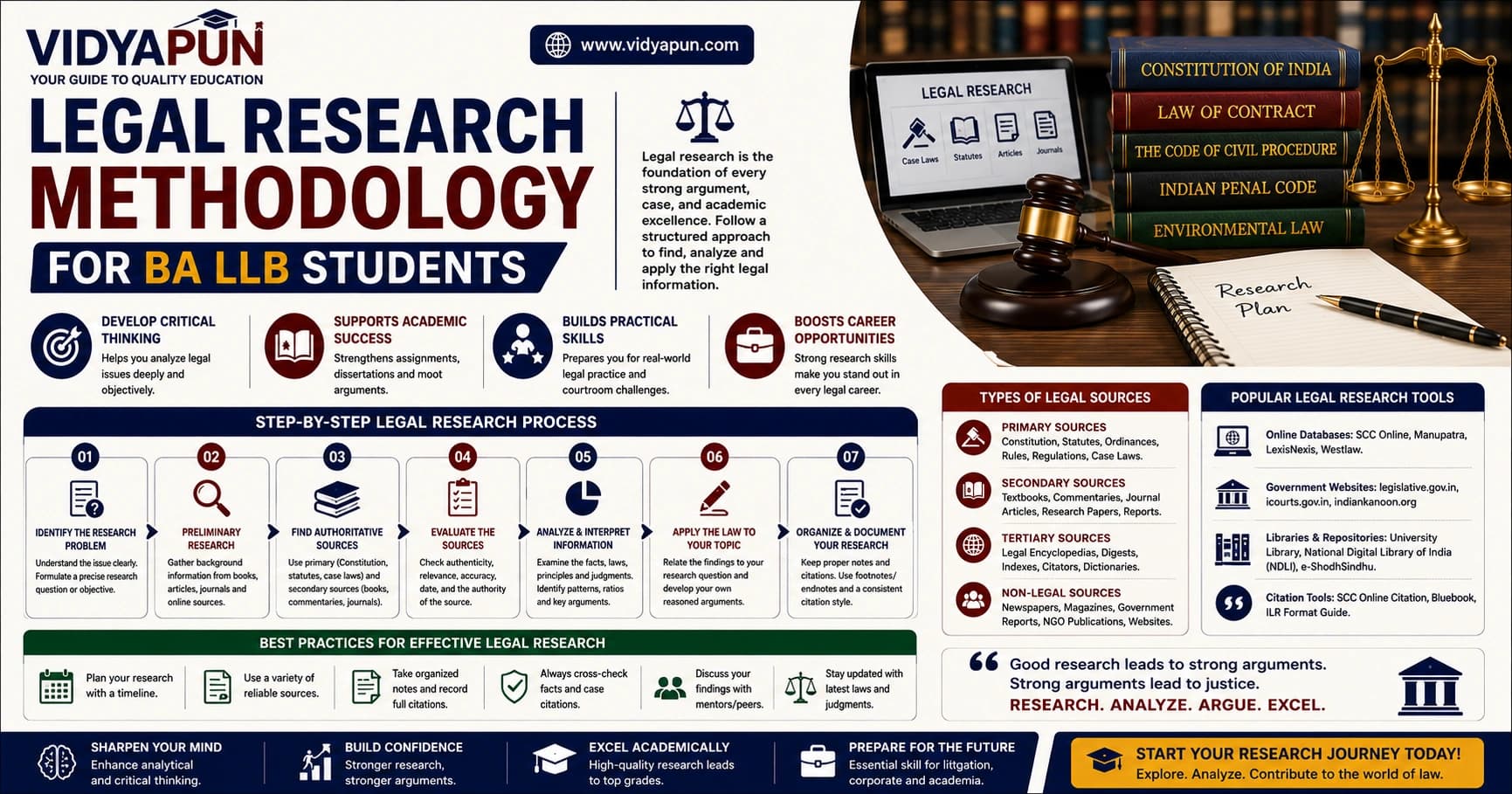
Legal research methodology is the part of dissertation and thesis writing that trips up the most BA LLB students — not because the concepts are difficult, but because most courses mention "doctrinal" and "empirical" research without ever explaining what they actually mean in practice, or how to pick between them. This guide breaks down legal research methodology in plain terms: the main approaches, how to choose one, where to find credible sources, and how to cite your work properly.
What Is Legal Research Methodology and Why It Matters
Legal research methodology is simply the systematic approach you use to investigate a legal question — it determines what kind of sources you rely on, how you structure your analysis, and what kind of conclusions your research can credibly support. Getting your methodology right matters because:
- It shapes what evidence counts – a doctrinal study and an empirical study draw on entirely different kinds of material
- Examiners specifically evaluate it – a strong argument built on the wrong methodology can still lose marks for methodological weakness
- It determines feasibility – some methodologies require access (court data, interviews) that may not be realistic within your timeline
If you're working on your final-year dissertation or thesis, our companion guides on how to write a law dissertation in BA LLB final year and BA LLB thesis topics: how to choose the right one cover the surrounding process this methodology feeds into.
Doctrinal vs Non-Doctrinal Research: What's the Difference
Doctrinal research (also called "black-letter law" research) analyzes legal rules, statutes, and case law to answer a legal question. It's the most common approach for BA LLB dissertations and theses because it doesn't require external data collection — your primary task is analyzing existing legal texts and building an argument from them.
- Best suited for questions like: "How has the judiciary interpreted X provision?" or "What are the gaps in Y statute?"
- Relies entirely on library and database research — no interviews, surveys, or fieldwork required
- Strongly favored by supervisors for undergraduate work because it's more contained and easier to complete within a semester or two
Non-doctrinal (empirical/socio-legal) research studies how law actually functions in practice, using methods like surveys, interviews, or case studies to gather primary data.
- Best suited for questions like: "How effectively is X law being implemented at the ground level?" or "What are stakeholder perceptions of Y policy?"
- Requires more planning — ethical clearance, participant access, and more time for data collection and analysis
- Less common at the BA LLB level, but increasingly used for socio-legal or policy-oriented topics
Most BA LLB students should default to doctrinal research unless they have a specific reason — and enough time — to pursue an empirical approach.
Common Legal Research Methods
Within doctrinal and non-doctrinal research, a few specific methods come up repeatedly:
- Analytical method – examining legal provisions and case law to identify their meaning, scope, and application
- Comparative method – comparing legal frameworks across jurisdictions or time periods to draw insights
- Historical method – tracing how a legal principle or provision has evolved over time
- Case study method – examining a specific case, dispute, or policy in depth to draw broader conclusions
- Survey/interview method – used in empirical research to gather primary data from practitioners, litigants, or the public
Most strong dissertations combine two methods — for example, an analytical study of case law supplemented by a comparative look at how another jurisdiction handles the same issue. This combination often produces more original insight than either method alone.
Sources of Legal Research: Primary vs Secondary
Understanding the distinction between primary and secondary sources is essential to building a credible research base:
Primary sources:
- Constitutions, statutes, and delegated legislation
- Case law and judicial decisions
- Government reports, Law Commission reports, and parliamentary debates
- International treaties and conventions (for comparative or international law topics)
Secondary sources:
- Peer-reviewed law journal articles and law reviews
- Textbooks and treatises by recognized legal scholars
- Legal commentaries and annotated statutes
- Reputable legal news and analysis platforms (used sparingly, mainly for context rather than authority)
A strong dissertation or thesis is built primarily on primary sources, with secondary sources used to support interpretation and situate your argument within existing scholarship. Avoid over-relying on blogs, coaching-institute notes, or unreferenced online summaries — they weaken the credibility of your research. For guidance on sharpening this skill specifically, our guides on legal research skills every BA LLB student needs and building a legal research portfolio are worth reviewing.
Citation Styles and Referencing in Legal Research
Consistent, accurate citation is non-negotiable in legal research — inconsistent or incomplete citations are one of the most common reasons marks are deducted in dissertations and theses.
- Common citation styles used in Indian law schools – Bluebook (widely used) and OSCOLA (also common, especially in universities with UK-influenced curricula); always confirm which one your university requires
- Cite every source you rely on – including case law, statutes, journal articles, and any data or quotations you use
- Be consistent throughout – switching citation formats partway through a document signals carelessness to examiners
- Use citation management tools where possible to keep track of sources as your research grows, rather than trying to compile references manually at the end
Strong research methodology and strong writing go hand in hand — if you want to sharpen the writing side specifically, our guide on how to improve legal writing skills in law school is a useful companion resource. And since research methodology comes up throughout your degree, not just at dissertation time, our guides on effective study tips to excel in BA LLB and academic success for BA LLB students touch on related study habits worth building early.
For a broader look at where strong research and writing skills lead after your BA LLB, see our guide on career after BA LLB. Curious how your profile stacks up for further study or specialization? Explore verified programs on the Vidyapun BA LLB course page.
Frequently Asked Questions
What is the difference between doctrinal and non-doctrinal legal research?
Doctrinal research analyzes existing legal texts — statutes, case law, and commentary — to answer a legal question, without collecting new data. Non-doctrinal (empirical) research studies how law functions in practice using methods like surveys or interviews to gather primary data.
Which research methodology should I use for my BA LLB dissertation?
Doctrinal research is the most common and practical choice for undergraduate dissertations, since it doesn't require external data collection and can be completed within a typical academic timeline. Empirical research suits socio-legal topics but requires more planning and time.
What citation style is used in Indian law schools?
Bluebook and OSCOLA are the two most commonly used citation styles in Indian legal education. Always confirm which style your specific university requires before you start writing, since requirements vary.
What are primary and secondary sources in legal research?
Primary sources include constitutions, statutes, case law, and government reports. Secondary sources include journal articles, textbooks, and legal commentaries that interpret or analyze primary legal material.
Can I combine doctrinal and empirical research in one dissertation?
Yes, and many strong dissertations do — for example, combining doctrinal analysis of case law with a smaller empirical component like a survey of practitioner opinions, provided your timeline and university guidelines allow for it.
Final Thoughts
Getting your legal research methodology right early saves significant time later — it determines what sources you'll need, how your analysis is structured, and how credible your final argument will look to examiners. For most BA LLB students, a well-executed doctrinal approach, backed by consistent citation and a clear mix of primary and secondary sources, is the safest and most achievable path to a strong dissertation or thesis.
Wondering what comes after your BA LLB — further study, specialization, or career options? Check Your Admission Chances for personalized guidance.
🌐 Website: www.vidyapun.com 📞 Call / WhatsApp: +91 96438 02216