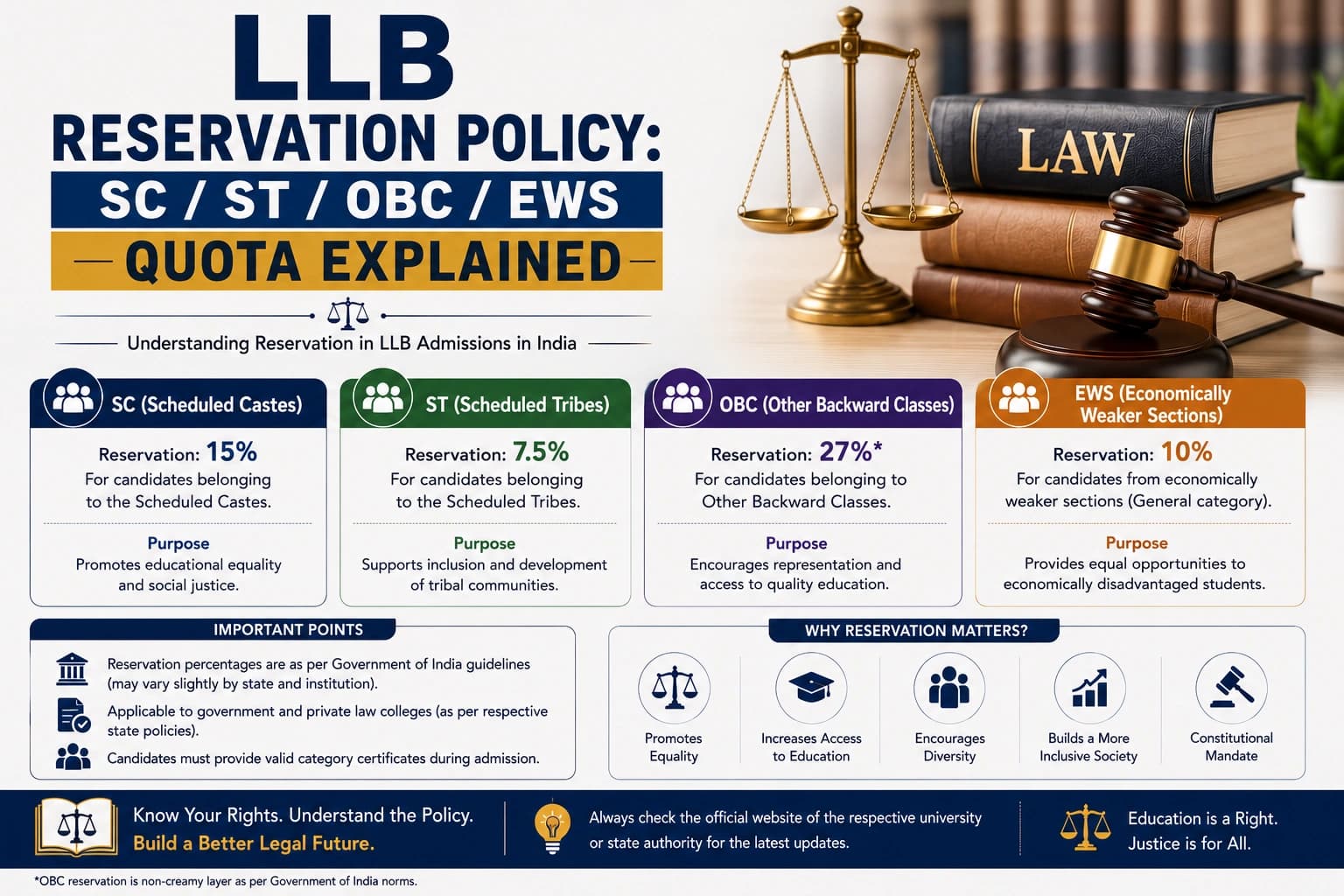
Reservation policy directly affects how many seats you're competing for, what cut-off applies to you, and which documents you'll need at counseling. This guide breaks down how SC, ST, OBC, EWS, and PwD reservation works for LLB admission in India — the percentages, the state-vs-central differences, and how to actually claim your category during the admission process.
How Reservation Works for LLB Admission
Reservation in Indian higher education, including law colleges affiliated with central institutions, generally follows this broad structure:
- SC (Scheduled Castes): 15%
- ST (Scheduled Tribes): 7.5%
- OBC (Other Backward Classes - Non-Creamy Layer): 27%
- EWS (Economically Weaker Section): 10%
That totals 59.5% of seats reserved, with the remainder open to general category candidates (who can also compete for reserved seats on merit if they qualify). These are the widely-used central government percentages — state universities and state-run law colleges may apply different figures based on their own state's reservation policy, so always verify against your specific target institution rather than assuming the central figures apply uniformly.
Horizontal vs Vertical Reservation
It's worth understanding this distinction early:
- Vertical reservation (SC, ST, OBC, EWS) applies across the board and is category-specific
- Horizontal reservation (PwD, women in some states, defence quota) cuts across all vertical categories — meaning a PwD candidate from the general category still gets a PwD seat, and a PwD candidate from SC category gets both benefits applied together
State vs Central Reservation Policy
This is one of the most confusing aspects for LLB applicants, because there's no single rulebook.
Central Institutions and National Law Universities
National Law Universities and centrally-administered institutions generally align with the central government's reservation framework, though individual NLUs often have their own additional reservation categories (home-state quota, for instance, is common at state-established NLUs).
State Law Colleges and Universities
State-run law colleges typically follow their own state's reservation policy, which may include categories not present at the central level (for example, some states reserve seats for specific regional or linguistic communities). Percentages can also differ meaningfully from the central figures.
The practical takeaway: don't assume the 15/7.5/27/10 breakdown applies everywhere. Check the specific admission bulletin of every college you're applying to.
EWS Reservation: What You Need to Know
EWS reservation, introduced more recently than the SC/ST/OBC categories, is meant for economically weaker candidates from the general category (not already covered by SC/ST/OBC reservation). Eligibility is primarily income and asset-based, verified through an EWS certificate issued by a competent authority — the exact income threshold and asset criteria are set by government notification and can be revised, so confirm the current figures when you apply rather than relying on an older reference.
Reservation Certificates: What's Required
Documents You'll Typically Need
- SC/ST certificate issued by a competent authority (varies by state — usually Tehsildar, SDM, or equivalent)
- OBC (non-creamy layer) certificate, which usually needs periodic renewal, unlike SC/ST certificates
- EWS certificate, issued annually in most states
- PwD certificate from a government medical board, specifying disability percentage
A Note on Certificate Validity
OBC non-creamy-layer and EWS certificates are typically valid only for a specific period (often one financial year), unlike SC/ST certificates which are usually permanent. If your certificate is close to expiring during your admission cycle, get it renewed before counseling rather than after — a lapsed certificate can cause your reserved-category claim to be rejected during verification.
Reservation in Private LLB Colleges
Private, unaided law colleges are not always bound by the same reservation mandates as government and government-aided institutions — this varies significantly by state law and by whether the institution is classified as "unaided minority" or "unaided non-minority." Some states do extend reservation requirements to private colleges through specific state legislation. If reservation-based admission to a private college matters to your decision, this is worth confirming directly with the institution rather than assuming either way.
Defence Quota and Other Special Categories
Many state and central institutions maintain a separate defence quota for children of serving or deceased armed forces personnel, along with other special categories like sports quota or Kashmiri migrant quota at some universities. These typically function as horizontal reservations, meaning they apply on top of, not instead of, your vertical category.
How Reservation Affects Cut-Off Marks and Seat Matrix
Reservation directly shapes your effective cut-off. A reserved-category candidate typically needs a lower rank or percentile than a general-category candidate to secure the same seat, because they're competing within a smaller, dedicated pool of reserved seats — not against the full applicant pool. This is why published cut-offs are typically listed separately by category (General, OBC, SC, ST, EWS) rather than as one single number.
Grievance Redressal for Reservation Disputes
If you believe your reservation claim was wrongly rejected during counseling, most universities and counseling authorities have a formal grievance redressal mechanism — usually a written appeal within a specified window, sometimes with an escalation route to a state or central grievance cell. Keep copies of all your certificates and any rejection communication, since you'll typically need to submit these as part of an appeal.
Frequently Asked Questions
1. What is the total reservation percentage for LLB admission? At the central level, it's commonly 59.5% (15% SC, 7.5% ST, 27% OBC-NCL, 10% EWS), though state institutions may apply different figures — always check your specific college's bulletin.
2. Is reservation applicable in private LLB colleges? It depends on the state and the college's classification. Some states extend reservation mandates to private aided or unaided institutions; others don't. Confirm directly with the college.
3. How do I get a reservation certificate for LLB admission? SC/ST and OBC certificates are issued by a designated local authority (commonly the Tehsildar or SDM office); EWS certificates follow a similar process with income and asset verification. Apply well before your admission deadline, as processing can take time.
4. Does reservation apply the same way in National Law Universities? Broadly yes, but many NLUs also apply additional categories like home-state reservation, so the effective seat matrix differs from college to college.
5. What is the difference between horizontal and vertical reservation? Vertical reservation (SC/ST/OBC/EWS) is category-specific; horizontal reservation (PwD, defence quota, and others) applies across all vertical categories simultaneously.
6. How long is an OBC or EWS certificate valid? Typically one financial year for non-creamy-layer OBC and EWS certificates, unlike SC/ST certificates which don't usually expire. Renew before your admission cycle if it's close to lapsing.
7. What happens if my reservation claim is rejected during counseling? Most universities have a formal grievance redressal process — usually a written appeal within a set window. Keep all your original documents and any rejection notice ready to support your appeal.
8. Does reservation affect my LLB admission cut-off? Yes. Reserved-category cut-offs are published separately from the general category cut-off and are typically lower, since you're competing within a smaller reserved-seat pool rather than against all applicants.
Related Reading
For the full document checklist across all categories, see Documents Required for LLB Admission. For the broader admission process, explore the LLB Course page or check Best Colleges in India.
🌐 Website: www.vidyapun.com 📞 Call / WhatsApp: +91 96438 02216