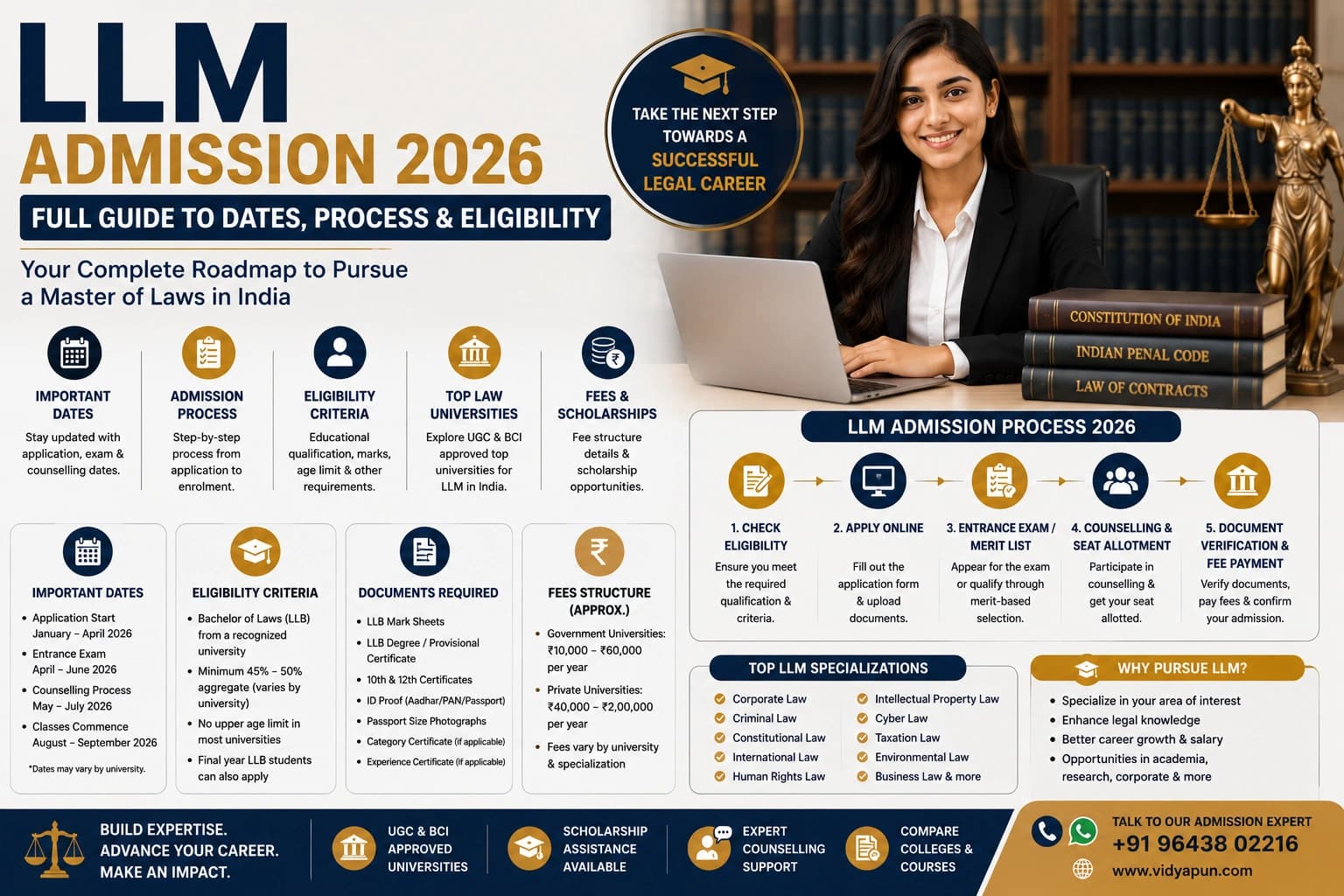
If you're an LLB graduate or a final-year law student, "LLM admission 2026" has probably become one of your most-searched terms in the last few months. And for good reason — an Master of Laws (LLM) can be the difference between staying in general practice and building deep expertise in a specialised area like corporate law, cyber law, or human rights law.
But before you get to specialisations and career outcomes, you need to get through the admission process itself — and that process looks a little different depending on whether you're applying through an entrance exam, a merit-based route, or direct admission. This guide walks you through everything: eligibility, the step-by-step process, the 2026 timeline, required documents, reservation policy, and scholarships.
What Is an LLM and Why It Matters in 2026
An LLM (Legum Magister, or Master of Laws) is a one- or two-year postgraduate law degree that lets you specialise after your LLB. In 2026, demand for LLM graduates is being shaped by a few clear trends: growing corporate legal hiring, expansion of compliance and data-privacy roles, and law schools adding newer specialisations like AI law, ESG law, and cyber law to keep pace with the market.
If you're still deciding whether an LLM is the right next step — as opposed to going straight into practice, judiciary preparation, or an MBA — it helps to first get clarity on the admission process itself, since that will also shape which universities and specialisations are realistically open to you this year.
LLM Eligibility Criteria for 2026
Before applying anywhere, confirm you meet the baseline eligibility. Most Indian universities follow a broadly similar structure, though specific numbers vary by institution.
Educational Qualification
You need a recognised Bachelor of Laws (LLB) degree — whether a 3-year LLB after graduation or a 5-year integrated BA LLB / BBA LLB — from a university approved by the Bar Council of India (BCI) or recognised by the University Grants Commission (UGC).
Minimum Marks Requirement
Most government and top private universities require a minimum of 50% aggregate marks in LLB (45% for reserved categories, as per applicable reservation policy). Some private universities and online/distance LLM programs accept slightly lower cut-offs, so it's worth checking each university's specific requirement rather than assuming a single national standard.
Age Limit
Unlike a few years ago, most universities offering LLM in 2026 no longer enforce a strict upper age limit, which is good news if you're a working professional returning to full-time or part-time study after a gap. A handful of state-run universities still apply an age cap for their entrance exams, so confirm this on the specific exam's official notification.
LLM Admission Process 2026: Step-by-Step
Here's how the admission cycle typically plays out, from shortlisting to your first day of class.
Step 1: Shortlist Universities and Specializations
Start by narrowing down universities based on ranking, specialisation strength, fee structure, and placement record. If you already know you want to go into, say, IP law or cyber law, check our guide to Best LLM Specializations before finalising your shortlist — not every university is equally strong in every specialisation.
Step 2: Check the Entrance Exam Requirement
Some universities admit through national or state-level entrance exams (like CLAT PG or AILET PG), others through merit (your LLB marks), and some private universities offer direct admission with just an interview. Confirm which route each shortlisted university follows before you plan your preparation timeline.
Step 3: Fill Out the Application Form
Applications are almost entirely online now. You'll need a scanned photograph, signature, and your academic documents ready before you start, since most portals don't allow you to save and resume indefinitely.
Step 4: Submit Required Documents
Upload or courier the documents listed in the section below, depending on the university's process. Incomplete document submission is one of the most common reasons applications get stuck in verification.
Step 5: Attend Counselling, Interview, or Group Discussion
Depending on the university, this stage might be a straightforward document-verification counselling session, a personal interview, or (at a few top institutions) a written test plus interview.
Step 6: Pay Fees and Confirm Your Seat
Once you're offered a seat, there's usually a short window — often 3 to 7 days — to pay the confirmation fee. Missing this window can mean losing your seat to the waitlist.
LLM Admission Without Entrance Exam
Not everyone wants to spend months preparing for CLAT PG or a similar exam, and the good news is that it isn't the only route in.
Merit-Based Admission
Many state universities and a number of well-regarded private universities admit students purely on LLB marks, without a separate entrance test. This route suits candidates with a strong academic record who'd rather not add exam preparation to their plate.
Direct Admission at Private Universities
Several private universities offer direct admission based on your application and a short interview, particularly for their online or distance-mode LLM programs. This is a common route for working professionals who need flexibility around a full-time job.
LLM Admission Timeline 2026 (Month-Wise)
While exact dates vary by university, the broad admission cycle for LLM in India typically follows this pattern:
Application Window
Applications generally open between February and June for the July/August intake, with several private universities keeping rolling admissions open even later.
Entrance Exam and Result Dates
Where applicable, entrance exams are usually conducted between April and June, with results and merit lists released within 3–5 weeks.
Counselling and Session Start
Counselling rounds typically run through June and July, with most LLM programs starting classes in late July or August.
Because these dates shift slightly every year, it's worth setting reminders around March so you don't miss an early application deadline for your preferred university.
Documents Required for LLM Admission
Keep these ready well before you start applying, so document collection doesn't become the bottleneck:
- LLB / BA LLB / BBA LLB degree certificate and mark sheets (all semesters)
- Graduation certificate (for 3-year LLB applicants)
- Entrance exam scorecard, where applicable
- Category certificate (for reserved-category applicants)
- Valid photo ID (Aadhaar/passport)
- Passport-size photographs and signature scan
- Migration and transfer certificate
- Character/conduct certificate from your previous institution
- Gap-year affidavit, if applicable
LLM Reservation Policy Explained
Reservation policy for LLM admission in India broadly follows the same structure applied to other postgraduate programs at government and government-aided universities.
Category-Wise Reservation
Seats are typically reserved for SC, ST, OBC (non-creamy layer), EWS, and PwD categories, in line with each university's applicable state or central reservation norms. Private universities aren't bound by the same reservation mandates, though several voluntarily offer fee concessions to specific categories.
How to Apply for Reserved-Category Seats
You'll need a valid, current-year category certificate issued by the competent authority at the time of application or counselling — an expired or non-updated certificate is one of the most common reasons reserved-category applications get rejected at the verification stage.
Scholarships and Fee Waivers for LLM Students in 2026
If cost is a factor in your decision, know that LLM students in India have more scholarship options than most people assume — from central and state government scholarships for SC/ST/OBC/EWS/minority candidates, to merit scholarships offered directly by universities for top rank-holders, to specific fee waivers for students pursuing research-heavy or under-enrolled specialisations. If you're also exploring options abroad, our LLM Abroad Guide covers international scholarship routes as well.
Final Thoughts
LLM admission 2026 doesn't have to feel overwhelming once you break it into stages: confirm your eligibility, pick your route (entrance exam, merit, or direct), track the timeline for your shortlisted universities, and keep your documents ready in advance. Getting these basics right early gives you more time to focus on what actually matters — choosing the right specialisation and university for your career goals.
Not sure which route or university fits you best? Book a Free Counselling session with Vidyapun's admission experts and get a personalised LLM admission 2026 plan.
Frequently Asked Questions
1. What is the minimum eligibility for LLM admission in 2026? You need a recognised LLB degree (3-year or 5-year integrated) with a minimum of 50% aggregate marks (45% for reserved categories at most universities), though exact cut-offs vary by institution.
2. Can I get LLM admission without an entrance exam? Yes. Many universities offer merit-based admission using your LLB marks, and several private universities offer direct admission after a short interview, especially for online and distance LLM programs.
3. When do LLM applications open for the 2026 intake? Most universities open applications between February and June, with entrance exams (where applicable) conducted around April to June and classes starting in July or August.
4. Is there an age limit for LLM admission? Most universities no longer enforce a strict age limit, though a few state-run entrance exams still apply one — always check the specific exam notification.
5. What documents are required for LLM admission? You'll typically need your LLB degree certificate and mark sheets, entrance scorecard (if applicable), category certificate (if applicable), photo ID, migration certificate, and passport-size photographs.
6. Are scholarships available for LLM students in India? Yes — central and state government scholarships for reserved categories, university-specific merit scholarships, and fee waivers for select specialisations are all available depending on the institution.
🌐 Website: www.vidyapun.com 📞 Call / WhatsApp: +91 96438 02216