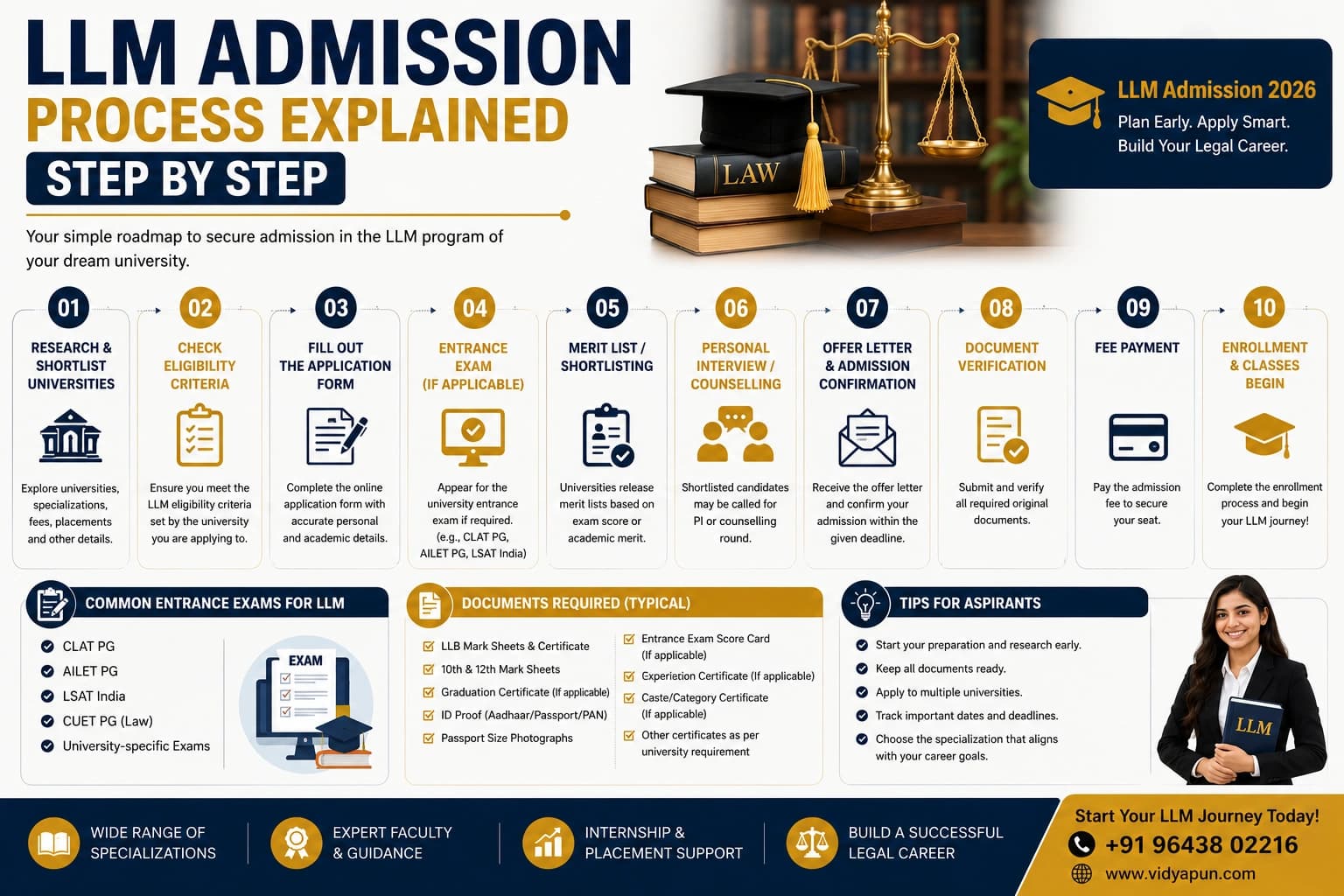
Unlike LLB, where a handful of well-known exams (CLAT, AILET) dominate the conversation, LLM admission in India is spread across a wider mix of national exams, university-specific tests, and merit-based routes — which makes the process feel less standardized if you don't know what to expect at each stage.
This guide walks through the entire LLM admission process step by step, from deciding your specialization to settling into your first semester, so you know exactly what's coming at every stage.
Why Understanding the LLM Admission Process Matters
Getting a clear picture of the full process before you start saves you from making decisions reactively — like choosing a university before checking eligibility, or missing an application window because you assumed the timeline mirrors your LLB experience.
How LLM Admission Differs from LLB
LLB admission (especially the 5-year integrated route) is shaped heavily by a few large, centralized exams like CLAT. LLM admission, by contrast, runs across many more independent university timelines and criteria, and specialization choice plays a much bigger role in your decision-making than it typically did for LLB.
Who This Process Applies To
This process applies to anyone who has completed an LLB (3-year or 5-year integrated) and is considering a Master of Laws, whether you're applying immediately after graduation or after some years of practice.
Step 1: Decide Your Specialization and Shortlist Universities
Your specialization choice shapes almost every subsequent decision, so it's worth starting here rather than working backward from a university's reputation alone.
Researching Specialization Options
Common LLM specializations include Corporate and Commercial Law, Constitutional Law, Criminal Law, International Law, Intellectual Property Law, and Human Rights Law, among others. Research which specialization genuinely aligns with the career direction you're aiming for — corporate practice, litigation, academia, policy work, or judiciary preparation each point toward a different specialization. Our guide on Best LLM Specializations breaks these down in more depth.
Building a Realistic University Shortlist
Once you have a specialization direction, shortlist universities that actually offer strong programs in that specific area — not every university offers every specialization, and depth of faculty expertise varies significantly by institution even within the same specialization. Our Best LLM Universities guide and Compare Universities tool can help you shortlist based on your chosen specialization and other priorities like location and fees.
Step 2: Check Eligibility Before You Apply
Confirming eligibility before investing preparation time avoids wasted effort on institutions you don't actually qualify for.
Minimum Qualification Requirements
You need a completed LLB (3-year or 5-year integrated) from a recognized university. Some universities accept an equivalent recognized law qualification, but a completed LLB is the standard baseline almost everywhere.
Marks Cutoffs and Category Relaxations
Most universities set a minimum aggregate in your LLB — commonly around 50-55% for general category candidates, though this varies by institution and program selectivity. Reserved category candidates typically receive a relaxation of a few percentage points. Always verify the current-year exact cutoff directly with your target university.
Step 3: Choose Your Entrance Route
Not every university uses the same admission mechanism, so this decision shapes your entire preparation plan.
CLAT PG and National Exams
CLAT PG is the most widely used national-level entrance exam for LLM, accepted by National Law Universities and several other institutions. It tests legal knowledge and reasoning specifically at a postgraduate level, distinct from the undergraduate CLAT.
University-Specific and Merit-Based Routes
Many universities conduct their own LLM entrance tests, while others offer merit-based admission using your LLB percentage directly, without any separate exam. Check which route each university on your shortlist uses — this determines whether you need to prepare for an exam at all.
Step 4: Complete Your Application
Once you know your route, the application itself follows a fairly standard sequence across institutions.
Registration and Document Upload
Register on the relevant exam's or university's official portal, fill in your personal and academic details, and upload your LLB mark sheets, degree certificate (or provisional certificate if not yet issued), and other required documents. Keep digital copies in the correct format ready in advance to avoid last-minute upload issues.
Application Fees and Deadlines
Application fees vary by exam and institution, and deadlines are typically announced a few months before the academic session begins. Because LLM timelines are spread across many individual university calendars rather than one centralized schedule, track each institution's specific deadline separately rather than assuming they align.
Step 5: Prepare for the Entrance Exam (If Applicable)
If your chosen route involves an entrance exam, focused preparation over a realistic timeline makes a meaningful difference.
Exam Pattern and Syllabus Overview
LLM entrance exams like CLAT PG typically test legal knowledge across core LLB subjects — Constitutional Law, Jurisprudence, Contract Law, and others — along with reasoning and comprehension sections. Always check the specific exam's official syllabus and pattern for the current year, since these details can shift.
Preparation Timeline and Resources
Give yourself several months of structured preparation where possible, revisiting core LLB subjects rather than treating this as entirely new material. Past papers and official mock tests (where available) are generally more useful than generic prep material, since they reflect the actual difficulty and question style of the specific exam.
Step 6: Counselling and Seat Allotment
Clearing an exam or qualifying on merit is only the midpoint — what follows determines your actual seat.
How Counselling Rounds Work
Based on your entrance score or merit ranking, you'll typically go through a counselling process — filling university and specialization preferences, with seats allotted in rounds. Some universities handle this directly rather than through a centralized counselling body, so confirm the specific process for your admission route.
Filling Preferences Strategically
Order your preferences based on genuine priority (specialization fit, location, cost) rather than reputation alone, and don't leave preference-filling to the last moment — missing a window can cost you an entire round of allotment.
Step 7: Document Verification and Fee Payment
Once a seat is allotted, verification and payment finalize your admission.
Documents You'll Need
Typically your LLB mark sheets and degree certificate, Class 10 and 12 certificates, category certificates if applicable, and identity proof. Keep both digital scans and physical photocopies ready, since incomplete verification is a common reason seats are cancelled and reallotted.
Confirming Your Seat
After document verification, you'll need to complete fee payment within the university's specified deadline to confirm your admission. Make sure you understand the full fee structure (tuition, hostel, one-time charges) before this stage, so there are no surprises at payment time.
Step 8: Orientation and Starting Your LLM
Getting your seat confirmed isn't the finish line — a little preparation before classes start smooths the transition significantly.
What to Expect in Your First Semester
Most universities hold an orientation covering academic expectations, faculty introductions, and campus resources. Your first semester typically combines foundational postgraduate law theory with an early introduction to your chosen specialization track.
Settling Into Specialization Coursework
LLM coursework moves faster and goes deeper than LLB, since you're building on an existing foundation rather than starting from scratch. It helps to review your chosen specialization's core texts and recent developments before your first semester begins, so you're not encountering the material for the first time in class.
Common Mistakes to Avoid During LLM Admission
A few recurring mistakes are worth watching out for deliberately.
Application and Deadline Mistakes
The most common mistakes are missing a specific university's deadline (because LLM timelines aren't centralized like CLAT for LLB), uploading documents in the wrong format, and underestimating how much cutoffs can shift year to year. Track every target institution's timeline individually rather than assuming a shared calendar.
Specialization and University Selection Mistakes
Choosing a specialization based on prestige rather than genuine career alignment, or picking a university purely by overall ranking without checking its strength in your specific specialization, are two of the most common longer-term regrets students report. Research each university's actual faculty and outcomes in your chosen specialization area specifically, not just its general reputation.
Frequently Asked Questions
1. What is the step-by-step process for LLM admission? Broadly: decide your specialization, shortlist universities, confirm eligibility, choose your entrance route, complete the application, prepare for any required exam, go through counselling and seat allotment, complete document verification and fee payment, and finally attend orientation.
2. How long does the entire LLM admission process take? It varies by university and route, but from application opening to admission confirmation, the process typically spans a few months, often starting several months before the academic session begins.
3. Do all universities require CLAT PG for LLM? No. While CLAT PG is widely used, many universities also offer merit-based admission using your LLB percentage or conduct their own separate entrance test.
4. What documents are required at the LLM counselling stage? Typically your LLB mark sheets and degree certificate, Class 10 and 12 certificates, category certificates if applicable, and identity proof. Confirm the exact list with your specific university.
5. Can I apply to multiple LLM universities at the same time? Yes, there's generally no restriction preventing you from applying to multiple universities and entrance exams simultaneously, as long as deadlines don't clash.
6. What happens if I miss an LLM application deadline? Missing a deadline typically means waiting for the next admission cycle for that specific university, though some institutions occasionally offer late or spot admission rounds if seats remain vacant — check directly with the university rather than assuming this option exists.
7. Is work experience required before applying for LLM? Most universities allow you to apply immediately after completing your LLB, without requiring prior work experience, though a few specialized or executive-style programs may prefer or require some professional background — check the specific program's requirement.
8. How do I choose between multiple LLM admission offers? Weigh specialization strength, faculty expertise, cost, location, and post-LLM outcomes in your specific area of interest, rather than relying on a university's general reputation alone.
Ready to move forward? Review full details on the Master of Laws (LLM) page, revisit your Bachelor of Laws (LLB) foundation, or explore Best LLM Specializations and Best LLM Universities to firm up your shortlist. Curious what comes after? See Career After LLM, or use Compare Universities to evaluate your options side by side.
Book a Free Counselling session to walk through your LLM admission plan:
🌐 Website: www.vidyapun.com 📞 Call / WhatsApp: +91 96438 02216