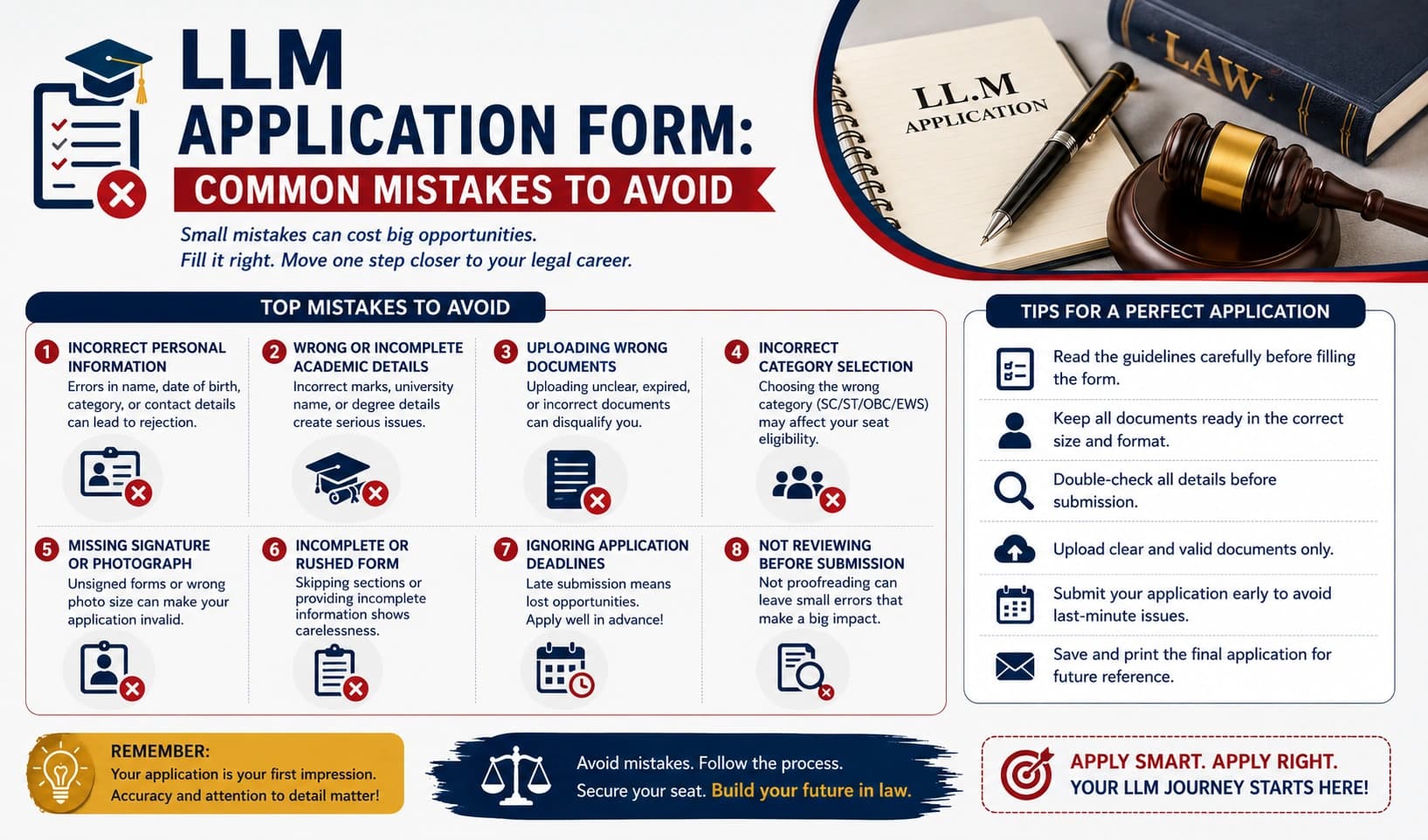
A strong LLB record and a clear specialization plan can still be undermined by something as simple as a mismatched name spelling or a missed deadline buried in a separate university's timeline. LLM applications, spread across many independent university processes rather than one centralized system, leave more room for these small but consequential errors than most applicants expect — and unlike a single national exam application, there's no shared system quietly catching inconsistencies for you.
This guide walks through the mistakes that come up most often in LLM applications, and how to catch each one before you hit submit.
Why Small Application Mistakes Have Big Consequences
Understanding why universities treat these errors seriously helps explain why careful review matters so much.
How Universities Handle Errors
Many universities process applications in high volume with limited manual review at the initial stage, meaning inconsistencies (a mismatched name, an incorrect percentage) can trigger automatic rejection or flag your application for delayed manual verification, pushing you behind in a process that's already time-sensitive.
Why LLM Applications Are Less Forgiving Than You'd Expect
Because LLM admission runs across many separate university timelines rather than one shared calendar, a mistake that costs you time on one application can mean missing another university's deadline entirely while you're resolving the first issue.
Mistake 1: Missing or Inconsistent Personal Details
This sounds trivial but is one of the most common reasons applications get flagged.
Name and Date of Birth Mismatches
Ensure your name and date of birth are entered exactly as they appear on your official documents (LLB certificate, Class 10 certificate) — even small discrepancies, like a missing middle name or a different date format, can cause verification issues later.
Contact Information Errors
Double-check your email address and phone number before submitting, since these are typically how universities communicate admit cards, results, and counselling schedules. A single typo here can mean missing critical updates entirely.
Mistake 2: Incorrect or Incomplete Academic Information
Academic details form the core of your eligibility check, so errors here are treated seriously.
Wrong LLB Percentage or CGPA Conversion
If your LLB result is reported in CGPA rather than percentage, use your university's official conversion formula rather than an approximate or online conversion tool, since an inaccurate figure can misrepresent your actual eligibility.
Missing Provisional Certificate Details
If you're applying before your final LLB result is declared, make sure you correctly indicate your provisional status and expected completion date rather than leaving this section incomplete or ambiguous, since some portals reject incomplete academic status fields outright.
Mistake 3: Document Upload Errors
Technical formatting issues are a surprisingly frequent cause of application delays.
Wrong File Format or Size
Each university portal specifies its own accepted file formats and size limits for uploaded documents. Review these specifications carefully before uploading, since a rejected upload due to formatting can sometimes go unnoticed until much later in the process.
Illegible or Outdated Scans
Ensure your scanned documents are clear and legible, and that you're uploading current, valid versions rather than an outdated scan from a previous application. Blurry or low-resolution scans are a common reason for manual verification delays.
Mistake 4: Missing Deadlines Across Multiple Universities
This is arguably the single most consequential category of mistake for LLM applicants specifically.
Confusing Application Windows
Because each university runs its own timeline, applicants sometimes mix up deadlines between institutions, assuming they align when they don't. Maintain a dedicated tracker listing each university's specific opening and closing dates rather than relying on memory, and review it weekly during your active application period rather than only when you happen to remember.
Forgetting Entrance Exam Registration Separately
If you're applying to a university that requires CLAT PG or its own entrance test, remember that exam registration is often a separate process from the university application itself. Completing one doesn't automatically complete the other, and candidates occasionally discover this gap only after an exam registration window has already closed.
Mistake 5: Weak or Generic Statement of Purpose
Where a statement of purpose or essay is required, this is often where genuinely strong applications get let down.
Generic, Copy-Pasted Content
Submitting a generic statement that could apply to any university, or one that isn't clearly tailored to the specific program, tends to read as impersonal and can weaken an otherwise strong application. Admission committees generally notice when an essay hasn't been adapted for their specific institution, especially when it mentions details that don't quite match the program's actual focus.
Not Aligning With the Chosen Specialization
A vague statement about "wanting to study law further" is far less compelling than a specific, well-reasoned explanation of why a particular specialization matters to you, grounded in your actual LLB experience or professional background. Concrete examples from your own academic or work history tend to carry far more weight than general statements of interest.
Mistake 6: Payment and Fee Errors
Financial transaction errors can quietly delay an otherwise complete application.
Wrong Fee Category Selected
Make sure you select the correct fee category (general, reserved category, or any applicable concession) during payment, since an incorrect selection can create discrepancies that need to be resolved before your application is processed further.
Payment Confirmation Not Saved
Always save or download your payment confirmation and transaction reference number immediately after payment. If a payment doesn't reflect correctly on the university's end, this confirmation is essential for resolving the issue quickly.
How to Review Your Application Before Submitting
A final structured review catches most of the mistakes covered above before they become a problem.
A Final Pre-Submission Checklist
Before submitting, cross-check your personal details against your official documents, verify your academic information and percentage conversion, confirm all required documents are uploaded in the correct format, re-read your statement of purpose for genuine specificity to that university, and save your payment confirmation. Taking twenty extra minutes here is consistently worth it compared to resolving an error after submission.
Frequently Asked Questions
1. What are the most common mistakes in LLM application forms? Personal detail mismatches, incorrect academic information or CGPA conversion, document upload errors, missed deadlines across multiple universities, a generic statement of purpose, and payment or fee category errors.
2. Can I correct a mistake after submitting my LLM application? This depends on the specific university's policy — some allow a limited correction window before the deadline, while others don't permit changes after submission. Contact the admission office immediately if you notice an error.
3. How important is the statement of purpose in an LLM application? It can meaningfully influence your application, particularly at universities that weigh it during selection. A generic or unclear statement can weaken an otherwise strong academic profile.
4. What happens if my LLB result is in CGPA but the application asks for percentage? Use your university's official CGPA-to-percentage conversion formula rather than an approximate or third-party tool, to ensure your reported eligibility figure is accurate.
5. Do I need to register separately for CLAT PG and my target university's application? Yes, in most cases. Entrance exam registration and the university's own application process are typically separate steps, and completing one doesn't automatically complete the other.
6. What should I do if my document upload fails or is rejected? Check the specific file format and size requirements for that portal, ensure your scan is clear and current, and re-upload promptly. If the issue persists, contact the university's admission helpdesk directly.
Ready to start your application with confidence? Review full details on the Master of Laws (LLM) page, browse our LLM Admission Guide for the complete process, or revisit your BA LLB Course foundation. Considering studying abroad instead? See our LLM Abroad Guide, or explore PHD Admission if research is part of your longer-term plan.
Start your application with guidance from our admission experts:
🌐 Website: www.vidyapun.com 📞 Call / WhatsApp: +91 96438 02216