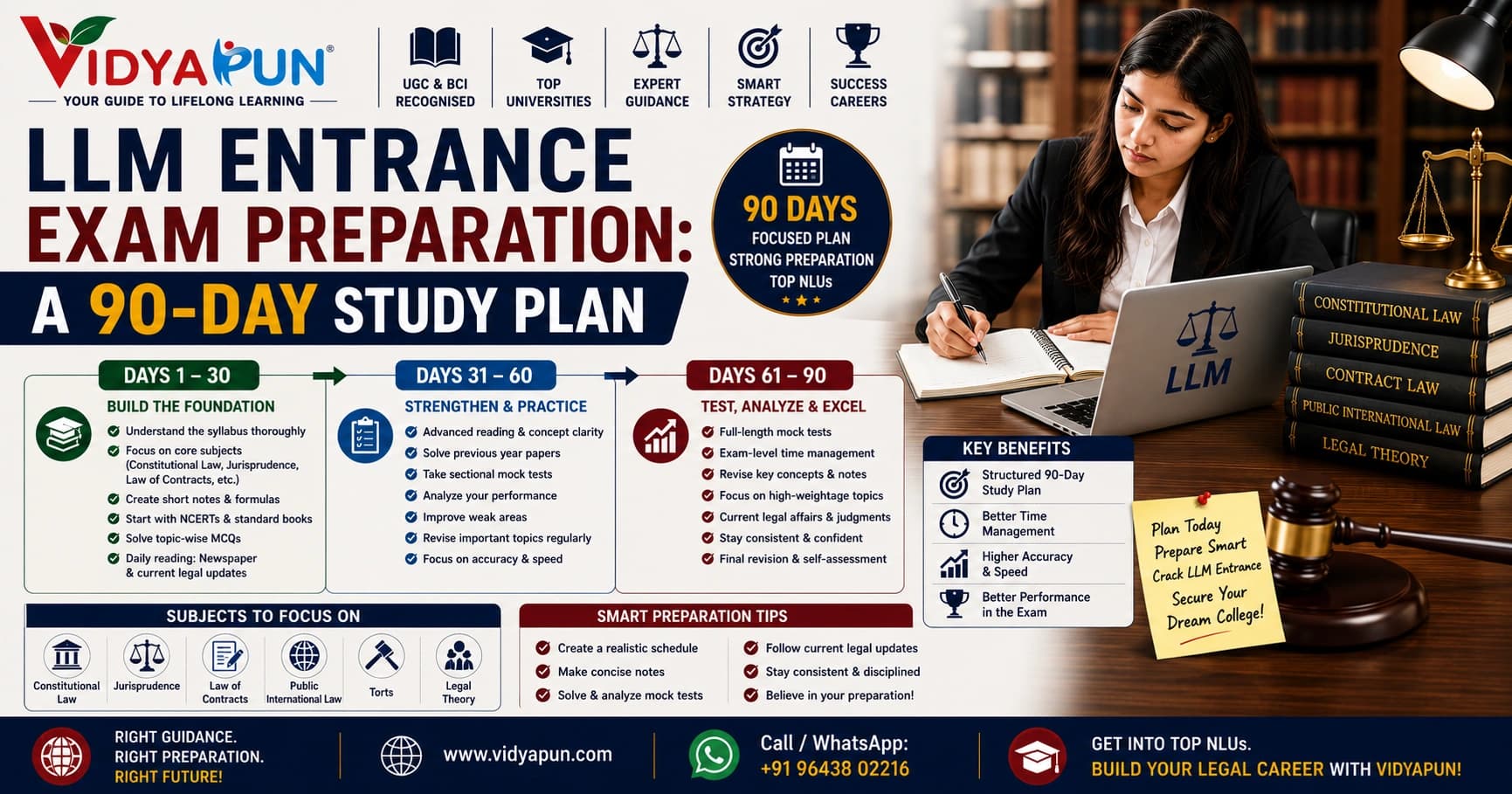
Three months before your LLM entrance exam is exactly the right amount of time to prepare well — if you use it with a plan, rather than a vague intention to "study more" as the exam gets closer. Whether you're targeting CLAT PG, AILET PG, or a university-specific exam for your Master of Laws (LLM), this guide breaks your 90 days into three clear phases so you go in prepared, not panicked.
Why a Structured 90-Day Plan Works for LLM Entrance Exams
A plan matters more than raw hours studied, especially when you're managing this alongside final-year coursework.
Avoiding Last-Minute Cramming
Spreading foundational learning across the first month, depth and practice across the second, and revision across the third avoids the common trap of cramming an entire syllabus into the final two weeks.
Balancing Multiple Exams in Parallel
If you're preparing for more than one entrance exam (say, CLAT PG alongside a university-specific test), a structured plan lets you identify overlapping syllabus areas early and avoid duplicating effort later.
Understanding the LLM Entrance Exam Pattern First
Before you start studying, know exactly what you're studying for.
CLAT PG Pattern and Syllabus
CLAT PG typically tests constitutional law, jurisprudence, and other core LLB subjects through objective-type questions, with a strong emphasis on conceptual clarity over rote memorisation.
AILET PG and University-Specific Exams
AILET PG and individual university entrance exams often follow a broadly similar structure but can differ in weightage given to specific subjects, so check each exam's official syllabus rather than assuming they're identical.
Days 1–30: Building Your Foundation
The first month is about coverage, not mastery — get through the full syllabus at least once.
Core Subject Revision: Constitutional Law and Jurisprudence
Start with the subjects that carry the heaviest weightage across most LLM entrance exams — constitutional law and jurisprudence — since strong fundamentals here pay off across nearly every other topic.
Building a Daily Study Routine
Set a realistic daily target (2–3 focused hours is enough if it's consistent) and stick to it, rather than alternating between long study marathons and days off, which tends to hurt retention.
Days 31–60: Deepening Subject Knowledge and Practice
The second month is where you move from "covered" to "confident."
Subject-Wise Deep Dive
Go back through each subject in more depth, focusing especially on areas where your first pass left gaps, and start connecting concepts across subjects rather than studying them in isolation.
Practicing Previous Year Papers
Begin working through previous year question papers subject-wise (not full-length yet) to see how concepts are actually tested, which is often quite different from how they're presented in textbooks.
Days 61–80: Mock Tests and Time Management
This phase is about exam simulation, not new content.
Full-Length Mock Tests
Start taking full-length, timed mock tests under exam-like conditions at least once or twice a week, gradually increasing frequency as the exam approaches.
Analyzing Mock Test Performance
After each mock, spend as much time reviewing your mistakes as you did taking the test — this analysis is where most of the actual score improvement happens in this phase.
Days 81–90: Final Revision and Exam-Day Readiness
The final ten days are about consolidation, not new learning.
Quick Revision Notes and Formula Sheets
Rely on the condensed notes you've built through the previous two phases rather than returning to full textbooks — this is the time for quick recall, not first-time learning.
Managing Exam-Day Anxiety
Plan your exam-day logistics (admit card, ID, exam centre route) a few days in advance, and prioritise sleep over last-minute study in the final 48 hours — fatigue affects recall far more than most students expect.
Best Books and Resources for LLM Entrance Exam Prep
Good resources make each phase of this plan more effective.
Recommended Textbooks and Guides
Standard LLB textbooks on constitutional law and jurisprudence, combined with an entrance-exam-specific guide covering the exact syllabus and question style, work well as a core resource set.
Online Test Series and Apps
A structured online mock test series — ideally one that mirrors the real exam's format and difficulty — is one of the highest-value additions to your preparation, especially during the mock test phase.
Common Mistakes to Avoid During Your 90-Day Prep
A few avoidable habits account for most underperformance on LLM entrance exams.
Ignoring Weak Areas Until Too Late
It's tempting to keep revising subjects you're already comfortable with, but consistently avoiding your weaker areas until the final days leaves too little time to actually fix the gap — address weak areas head-on during the second phase, not the last one.
Final Thoughts
A 90-day plan works because it forces you to separate learning, practice, and revision into distinct phases instead of blending them together under pressure. Cover the syllabus early, deepen your understanding and start practicing in the middle phase, and use the final stretch purely for consolidation and exam-day readiness. Students who follow this kind of structure consistently walk into the exam calmer — and better prepared — than those relying on last-minute intensity alone.
Want personalised guidance on which LLM entrance exams and universities fit your goals? Talk to Admission Expert for a tailored preparation and application plan.
Frequently Asked Questions
Q1. Is 90 days enough to prepare for an LLM entrance exam?
A: Yes, for most students — 90 days is enough time to cover the syllabus, build depth through practice, and complete a proper mock-test and revision cycle, provided you follow a structured plan rather than studying inconsistently.
Q2. What subjects should I prioritise first in LLM entrance exam preparation?
A: Constitutional law and jurisprudence typically carry the heaviest weightage across most LLM entrance exams and are a strong starting point before moving to other subjects.
Q3. How many mock tests should I take before the exam?
A: Aim for at least one to two full-length mock tests per week during the final month of preparation, with thorough review of your mistakes after each one.
Q4. Should I prepare for CLAT PG and university-specific exams together?
A: Yes, where possible — most LLM entrance exams share significant syllabus overlap, so preparing for the core subjects together and adding exam-specific practice later is an efficient approach.
Q5. What should I do in the final week before the LLM entrance exam?
A: Focus on revising condensed notes rather than new material, confirm your exam-day logistics in advance, and prioritise rest over additional study in the final 48 hours.
Q6. What resources are most helpful for LLM entrance exam preparation?
A: Standard LLB textbooks on core subjects, an entrance-exam-specific preparation guide, previous year question papers, and a structured online mock test series together cover most of what you need.
🌐 Website: www.vidyapun.com 📞 Call / WhatsApp: +91 96438 02216