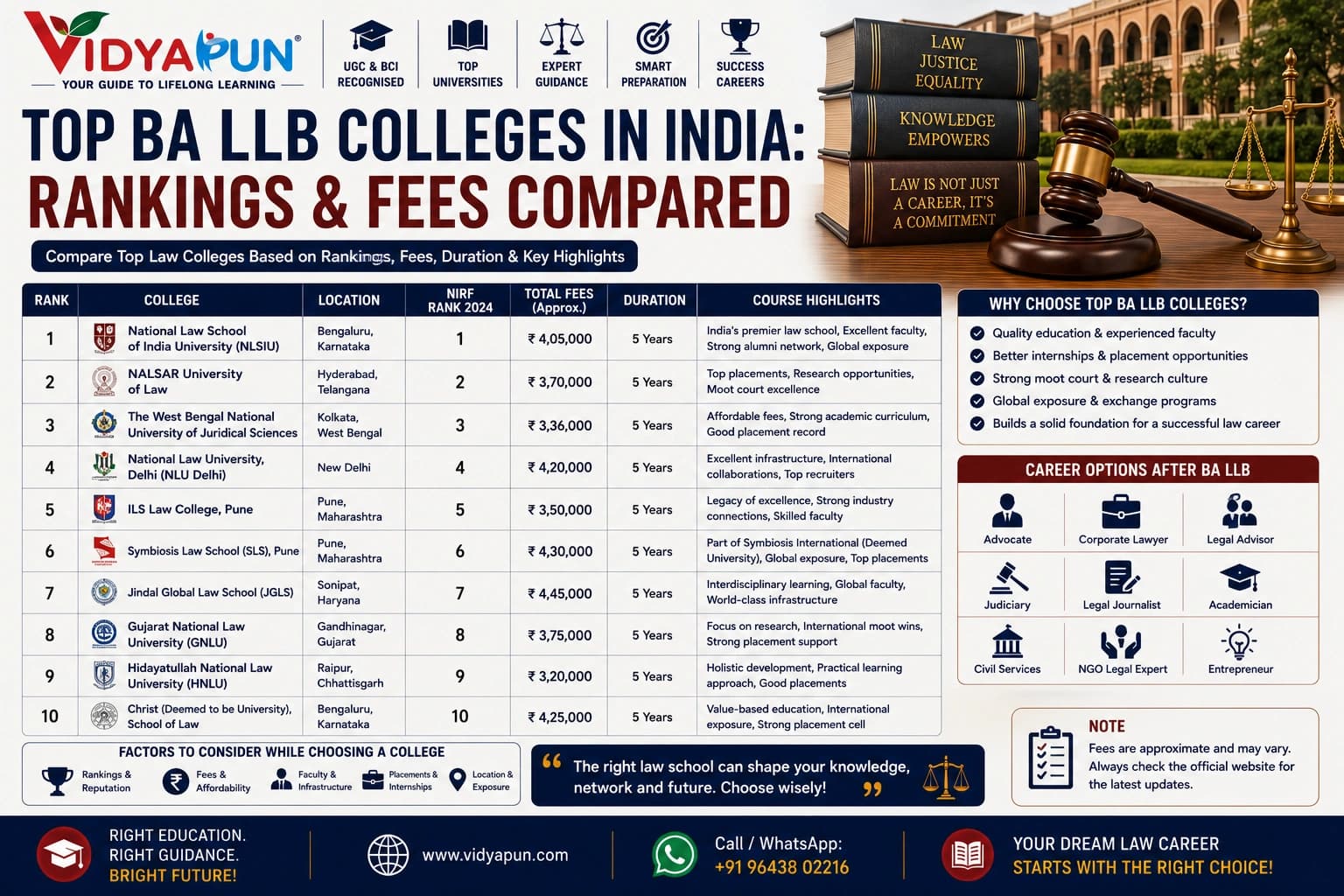
Choosing where to study BA LLB is one of the biggest decisions a law aspirant will make. The five-year integrated degree combines a Bachelor of Arts with a Bachelor of Laws, and the college you pick will shape everything from the quality of your legal education to your placement prospects and starting salary. With more than a thousand law colleges in India — a mix of National Law Universities (NLUs), state universities, and private institutions — narrowing down the right one can feel overwhelming.
This guide breaks down the top BA LLB colleges in India by NIRF ranking, fee structure, and admission route, so you can compare your options in one place before you apply.
Why BA LLB Is a Popular Choice Among Law Aspirants
BA LLB is the most widely chosen route into the legal profession in India, and for good reason:
- Integrated structure – You complete your undergraduate degree and law degree together in five years, instead of doing a three-year LLB after a separate bachelor's degree.
- Broader foundation – The BA component covers subjects like political science, sociology, history, and economics, which build context for constitutional and public law.
- Bar Council of India (BCI) recognition – All accredited BA LLB programs are approved by the BCI, making graduates eligible to practice law and appear for the All India Bar Examination.
- Strong placement pipeline – Top NLUs and reputed private law schools attract corporate law firms, litigation chambers, judicial clerkships, and public policy recruiters during campus placements.
- Entry via CLAT/AILET – Most government law schools admit students through the Common Law Admission Test (CLAT) or the All India Law Entrance Test (AILET), while private colleges often run their own entrance tests alongside CLAT scores.
Top Government Law Universities (NLUs) for BA LLB
National Law Universities remain the gold standard for BA LLB in India. Admission to most NLUs is through CLAT, and a handful — most notably NLU Delhi — use their own AILET.
| Rank (NIRF) | College | City | Admission | Approx. Annual Fees |
| 1 | National Law School of India University (NLSIU) | Bengaluru | CLAT | ₹3–4 lakh |
| 2 | National Law University (NLU) | Delhi | AILET | ₹2.5–3 lakh |
| 3 | NALSAR University of Law | Hyderabad | CLAT | ₹2.5–3 lakh |
| 4 | WB National University of Juridical Sciences (NUJS/WBNUJS) | Kolkata | CLAT | ₹2–2.5 lakh |
| 5 | Gujarat National Law University (GNLU) | Gandhinagar | CLAT | ₹2–2.5 lakh |
| 6 | National Law University | Jodhpur | CLAT | ₹1.8–2.2 lakh |
NLSIU Bengaluru has held the top NIRF Law rank consistently for several years, followed closely by NLU Delhi and NALSAR Hyderabad. Beyond these, RMLNLU Lucknow, MNLU Nagpur, HNLU Raipur, and NLU Jodhpur are also strong second-tier NLU options that regularly place in the NIRF top 15.
Note: NIRF rankings are updated annually by the Ministry of Education. Fee figures above are approximate and can change year to year — always confirm current fees on the official college website before applying.
Top Private BA LLB Colleges in India
Private law schools have closed much of the gap with NLUs over the past decade, particularly in infrastructure, international exposure, and corporate law placements.
| College | City | Admission | Approx. Annual Fees |
| Symbiosis Law School | Pune | SLAT / CLAT | ₹3–3.5 lakh |
| Jindal Global Law School (O.P. Jindal Global University) | Sonipat | LSAT-India / CLAT | ₹8–10 lakh |
| Kirit P. Mehta School of Law, NMIMS | Mumbai | NPAT / CLAT | ₹5–6 lakh |
| SASTRA Deemed University | Thanjavur | CLAT / merit | ₹1.5–2 lakh |
| Amity Law School | Multiple campuses | CLAT / Amity entrance | ₹1.5–2.5 lakh |
Private colleges are generally easier to get into than the top NLUs and often have more seats, but tuition is significantly higher. Some, like Jindal Global Law School, position themselves as premium, internationally oriented law schools, while others like SASTRA and Amity offer a more accessible middle ground.
BA LLB Fees: Private vs Government Colleges
Fee structure is often the deciding factor for many families, so here's how the two categories typically compare:
Government NLUs and state law universities
- Annual fees generally range from ₹1.5 lakh to ₹4 lakh
- Additional costs: hostel, mess, and CLAT counselling fees
- Merit-based scholarships and fee waivers are more commonly available
- Seats are limited, and competition through CLAT/AILET is intense
Private law colleges
- Annual fees generally range from ₹1.5 lakh to ₹10 lakh+, depending on the institution's reputation and location
- Wider seat availability, often with multiple entrance routes
- Merit and need-based scholarships offered by many top private colleges
- Infrastructure, moot court facilities, and international tie-ups can be stronger at premium private schools
As a rule of thumb: NLUs offer the best value-for-money if you can crack CLAT/AILET, while premium private law schools are worth the higher fees mainly if placements, brand recognition, or a specific specialization (like IP law or international law) matter more to you than cost.
Government vs Private BA LLB Colleges: Which Should You Choose?
There's no universal right answer — it depends on your CLAT score, budget, and career goals.
Choose a government NLU if:
- You have a strong CLAT/AILET rank
- You want the strongest brand name for litigation, judiciary, or civil services aspirations
- Cost is a major factor in your decision
- You value peer competitiveness and a research-heavy academic culture
Choose a private law college if:
- Your CLAT score doesn't secure an NLU seat you're happy with
- You're targeting corporate law firms that also actively recruit from top private schools
- You want a wider choice of city, campus culture, or elective specializations
- You can afford the higher fee bracket, potentially with scholarship support
Many students also apply to both NLUs and private colleges simultaneously and make a final decision only after seeing their CLAT results and counselling options.
How to Evaluate a BA LLB College Beyond Rankings
NIRF rankings and fees are a good starting point, but they don't tell the whole story. Before finalizing your choice, also look at:
- Placement reports – Ask for the last three years of placement data, not just headline numbers.
- Faculty strength – Full-time faculty-to-student ratio and faculty research output matter for teaching quality.
- Moot court and internship culture – Strong colleges run active moot court societies and help arrange internships with law firms, NGOs, and courts.
- Infrastructure – Library resources, legal databases (Manupatra, SCC Online), and hostel facilities.
- Location – Colleges in Delhi, Mumbai, Bengaluru, and Pune generally offer easier access to internships at law firms and courts during the academic year.
- BCI approval – Always verify the college is currently BCI-approved; this affects your eligibility to practice law after graduation.
Frequently Asked Questions
Which is the No. 1 BA LLB college in India?
NLSIU Bangalore is consistently ranked the top law college in India by NIRF, offering BA LLB admission through CLAT.
Is BA LLB better than a 3-year LLB?
BA LLB is a five-year integrated program taken after Class 12, while LLB is a three-year program taken after any bachelor's degree. BA LLB is generally preferred by students who know early that they want a legal career, since it saves a year compared to doing a separate bachelor's degree first.
How much does BA LLB cost in India?
Fees range widely — from around ₹1.5 lakh per year at government NLUs and some private colleges, up to ₹8–10 lakh per year at premium private law schools.
Do I need to clear CLAT for all BA LLB colleges?
Most NLUs require CLAT (except NLU Delhi, which uses AILET). Many private colleges accept CLAT scores too, but also run their own entrance exams like SLAT, LSAT-India, or NPAT.
Are private BA LLB colleges as good as NLUs?
Top private law schools like Jindal Global Law School and Symbiosis Law School have strong placement records and are considered on par with mid-tier NLUs for corporate law careers, though NLSIU, NLU Delhi, and NALSAR remain the most prestigious names overall.
Final Thoughts
The "best" BA LLB college depends on your CLAT score, budget, and career direction — a top-ranked NLU isn't automatically the right fit for every student, and a well-chosen private law school can be an excellent path into corporate law or litigation. Use rankings and fees as your starting filter, then dig into placement data, faculty, and campus culture before you commit five years of your education to a college.
Explore verified BA LLB programs and compare colleges side by side on the Vidyapun BA LLB course page.
Not sure where you stand? Check Your Admission Chances based on your academic profile and CLAT score.
🌐 Website: www.vidyapun.com 📞 Call / WhatsApp: +91 96438 02216