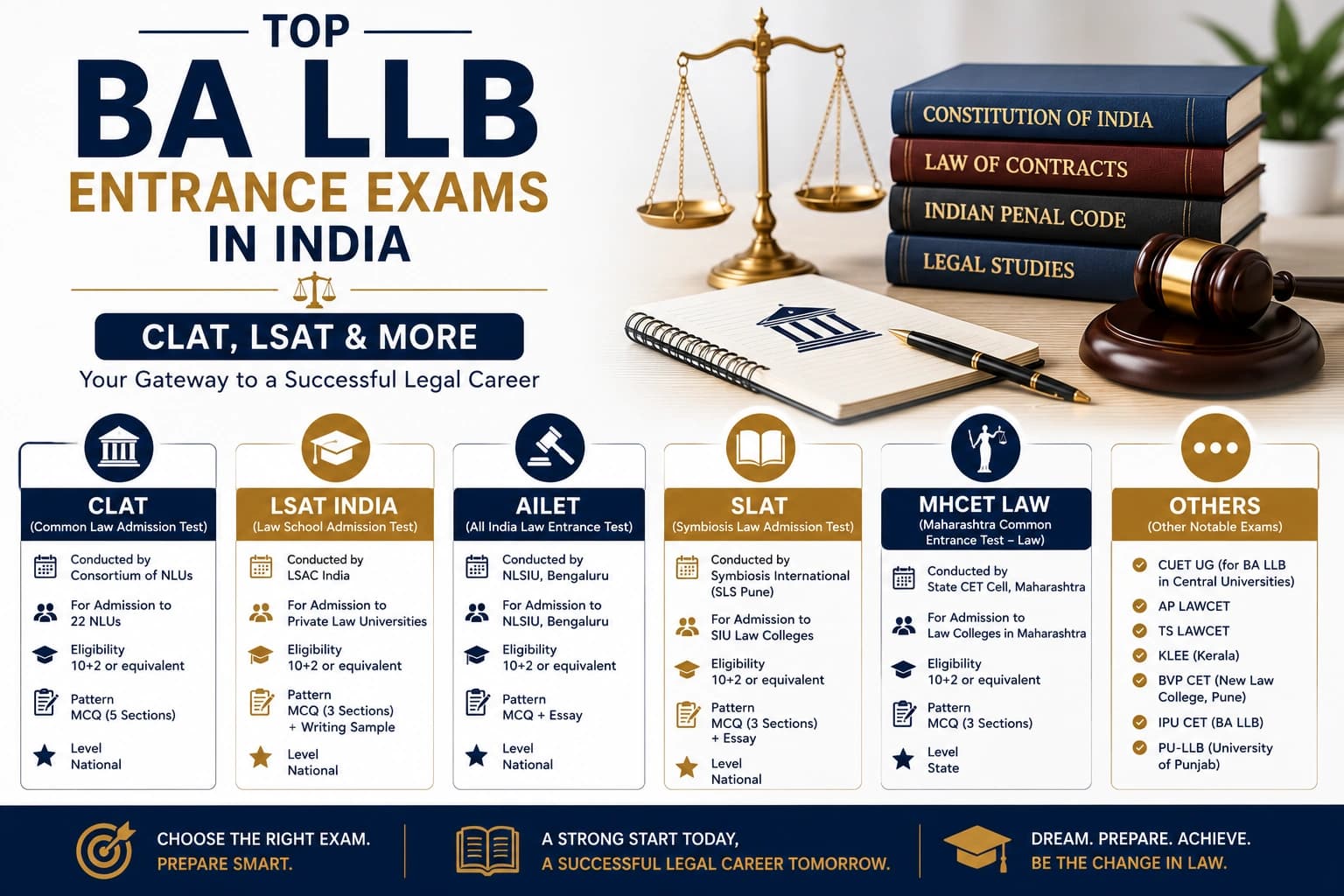
Deciding to pursue BA LLB is the easy part. The harder question is which entrance exam to prepare for — because unlike engineering or medicine, law admissions in India don't run on a single national test. Depending on which universities you're targeting, you could need CLAT, AILET, LSAT India, a state-level exam, or a university's own entrance test, and each has a different pattern, timeline, and difficulty level.
Spreading your preparation thin across every exam you've heard of rarely works well — most serious aspirants pick one or two exams that unlock the widest set of colleges on their shortlist, and prepare for those in depth. This guide walks through the major BA LLB entrance exams in India, what each one tests, which universities accept them, roughly how competitive each one is, and how to decide where to focus your preparation.
Why the Right Entrance Exam Choice Matters for BA LLB
Choosing your entrance exam isn't just a formality — it shapes months of your preparation and directly determines which colleges are even open to you. Preparing for the wrong exam, or missing an application window because you assumed one exam covered every college you wanted, is one of the most common and avoidable mistakes students make. It's also worth remembering that these exams differ not just in syllabus but in overall competitiveness and applicant pool, which can affect how you pace your preparation timeline.
Before committing your preparation time, it helps to shortlist the universities you're actually interested in and check which exam(s) each one accepts. Some universities accept multiple exam scores, while others are strict about a single test — knowing this early lets you build a realistic, focused preparation plan instead of spreading yourself across every exam you've heard of. A good rule of thumb: pick one primary national exam that covers most of your shortlist, add a state exam if domicile reservation genuinely helps you, and only add a third exam if a specific university on your list requires it.
CLAT: India's Most Widely Accepted Law Entrance Exam
The Common Law Admission Test (CLAT) is the most recognized and widely used entrance exam for BA LLB admissions in India, accepted by the National Law Universities (NLUs) and a large number of other law schools, both government and private.
CLAT Exam Pattern Overview
CLAT is a comparative reasoning-heavy test, covering areas like English Language, Current Affairs and General Knowledge, Legal Reasoning, Logical Reasoning, and Quantitative Techniques. The exam has moved toward a more passage-based, comprehension-driven format in recent years rather than testing rote legal knowledge, which means strong reading speed and reasoning ability matter as much as subject preparation. Because CLAT is attempted by a very large number of candidates every year for a comparatively limited number of NLU seats, it's widely regarded as one of the more competitive law entrance exams in the country — which is exactly why sustained, structured preparation over several months tends to outperform last-minute cramming. Because the exact pattern, marking scheme, and syllabus emphasis can shift slightly year to year, always cross-check the current year's official CLAT information bulletin rather than relying on older prep material alone.
Which Universities Accept CLAT
Beyond the NLUs, a significant number of private and deemed universities also accept CLAT scores for their own BA LLB programs, either directly or through their own counselling process. If CLAT is your primary exam, it's worth checking the full list of participating institutions for the current admission cycle, since it changes slightly from year to year as new universities join. Many aspirants treat CLAT as their anchor exam precisely because a single test opens the door to both NLUs (through the main CLAT counselling) and a wide range of private universities that separately accept CLAT scores.
AILET: NLU Delhi's Standalone Entrance Exam
While most NLUs come together under CLAT, the National Law University, Delhi (NLU Delhi) conducts its own separate entrance exam — the All India Law Entrance Test (AILET).
How AILET Differs from CLAT
AILET tests similar broad areas to CLAT — English, General Knowledge and Current Affairs, Legal Aptitude, Logical Reasoning, and Elementary Mathematics — but it's a separate exam with its own application process, exam date, and pattern. Clearing CLAT does not automatically grant admission to NLU Delhi; you need to apply for and take AILET separately if NLU Delhi is on your list.
Who Should Consider AILET
If NLU Delhi specifically is a priority for you, preparing for AILET alongside CLAT makes sense, since the overlap in syllabus areas means the additional preparation burden is manageable. Just be mindful of separate application deadlines and fees, and don't assume your CLAT application covers this exam as well.
LSAT India: An Alternative National-Level Option
The Law School Admission Test (LSAT) India is a separate national-level entrance exam, distinct from CLAT, accepted by a range of private and deemed law universities across the country.
LSAT India Exam Format
LSAT India focuses heavily on reading comprehension, analytical reasoning, and logical reasoning, with less emphasis on static general knowledge compared to CLAT. Some students find this format more predictable to prepare for, since it leans more on skill-building (reasoning and comprehension) than on memorizing current affairs. LSAT India is also conducted multiple times in some years, which can offer more flexibility than a single-attempt national exam, and a multi-attempt structure can reduce the pressure of a single high-stakes exam day.
Universities Accepting LSAT India Scores
A number of well-known private universities accept LSAT India scores as part of their admission process, sometimes alongside their own interview or group discussion rounds. If your shortlist leans toward private universities rather than NLUs specifically, it's worth checking how many of them accept LSAT India, since preparing for one well-structured exam can sometimes cover more ground than juggling several different state-level tests. Because the LSAT India syllabus overlaps significantly with CLAT's reasoning and comprehension sections, many students prepare for both simultaneously without a large additional time cost.
State-Level Law Entrance Exams
Beyond the national exams, many Indian states conduct their own law entrance tests, generally referred to as state CETs (Common Entrance Tests), which are often the primary route into government and state-affiliated law colleges within that state.
Popular State CETs
Examples include Maharashtra's MH CET Law, Telangana's TS LAWCET, Andhra Pradesh's AP LAWCET, and Kerala's KLEE, among others conducted by different states. These exams typically test similar broad areas — English, general knowledge, legal aptitude, logical and analytical reasoning — but with their own specific pattern, difficulty level, and, often, a preference (or reservation) for domicile students of that state. Each state exam also runs on its own application timeline, so if two states you're interested in have overlapping exam dates, you may need to choose between them.
Should You Prepare for a State Exam Too?
If you're open to studying in a specific state, or if your home state offers strong law colleges through its own CET, preparing for that state exam alongside a national one can meaningfully widen your options — particularly because domicile reservations in state colleges can make admission more achievable than competing purely on a national merit list. Many aspirants underestimate how much this domicile advantage matters: a rank that wouldn't secure a national-level seat can comfortably secure a strong state college seat within your home state's quota. Just factor in the extra preparation time and separate application deadlines when planning your year.
University-Specific and Merit-Based Entrance Tests
Not every path into BA LLB runs through a shared, multi-university exam. A number of institutions — particularly private universities — conduct their own standalone entrance tests or admit students without any written test at all.
Private University Entrance Tests
Several private universities run their own law entrance exams, sometimes followed by a personal interview or group discussion, as part of their admission process. These are usually less competitive in terms of applicant volume than CLAT but still worth preparing for seriously, since they often test similar reasoning and comprehension skills. Some universities also weigh your Class 12 performance and interview alongside your entrance score, so how you present yourself in an interview can matter as much as your raw test result. Check each university's official admission page for their specific exam pattern and dates rather than assuming it mirrors CLAT.
Merit-Based Admission Without an Exam
A meaningful number of private and deemed universities offer BA LLB admission purely on Class 12 merit, without requiring any entrance exam. This can be a good option if you'd rather avoid an additional exam altogether, though it's worth weighing the trade-off — merit-based private admission often comes with a different fee structure and, at some institutions, a different peer and placement profile compared to exam-based, more selective programs. It's not a lesser path by default, but it is a different one, and it's worth researching a university's outcomes (placements, faculty, infrastructure) just as carefully as you would an exam-based college. Our detailed guide on BA LLB admission without entrance exam covers this route in more depth.
Quick Comparison: Which Exam Should You Prepare For?
| Exam | Who Conducts It | Best If You Want | Key Focus Areas |
| CLAT | CLAT Consortium | Access to NLUs + many private universities | Reading comprehension, legal & logical reasoning, GK |
| AILET | NLU Delhi | A shot specifically at NLU Delhi | Similar to CLAT, but a separate application |
| LSAT India | Law School Admission Council | A reasoning-heavy alternative, flexible test dates in some years | Analytical & logical reasoning, comprehension |
| State CETs | Respective state governments | Domicile advantage in state law colleges | English, GK, legal aptitude, reasoning |
| University Tests | Individual private universities | A specific private university, sometimes lower competition | Varies by institution |
Use this as a starting filter, then verify current-year details — pattern, dates, and participating colleges — directly from each exam's official website before finalizing your preparation plan.
Frequently Asked Questions
1. Which is the best entrance exam for BA LLB? There's no single "best" exam — it depends on which universities you're targeting. CLAT covers the widest range of institutions including NLUs, while AILET, LSAT India, and state CETs each open different sets of colleges.
2. Can I give both CLAT and LSAT India? Yes. There's no restriction preventing you from appearing for multiple law entrance exams, and many serious aspirants do prepare for more than one to widen their options, as long as the exam dates don't clash.
3. Is AILET the same as CLAT? No. AILET is a separate exam conducted specifically for NLU Delhi. Clearing CLAT does not grant admission to NLU Delhi — you need to apply for and take AILET separately.
4. Do state CETs give preference to local students? Many state-level law entrance exams do reserve a portion of seats for domicile (in-state) candidates, though the exact reservation policy varies by state. Check your specific state's official notification for details.
5. Can I get into a good BA LLB program without any entrance exam? Yes, several private and deemed universities offer merit-based BA LLB admission using Class 12 marks alone, without a separate entrance test. Availability and selectivity vary by institution.
6. How many attempts do I get for these entrance exams? Most law entrance exams, including CLAT and AILET, are conducted once a year, though there's generally no cap on how many years you can attempt them as long as you meet the eligibility criteria for that admission cycle. LSAT India has, in some years, offered multiple test windows — check the current year's schedule.
Once you've picked your exam route, the next step is understanding the full admission timeline — our BA LLB admission process guide walks through application, counselling, and verification in detail. Before you commit to an exam, it's also worth double-checking you meet the BA LLB eligibility criteria for your target universities, and if you're still deciding between degree types altogether, this BA LLB vs LLB comparison can help.
Not sure how your profile stacks up for a specific exam or college? Use Vidyapun's Admission Chances Predictor for an instant, data-based estimate, or explore full course details on the BA LLB course page.
Still have questions about which entrance exam is right for you? Reach out to our counsellors directly.
🌐 Website: www.vidyapun.com 📞 Call / WhatsApp: +91 96438 02216