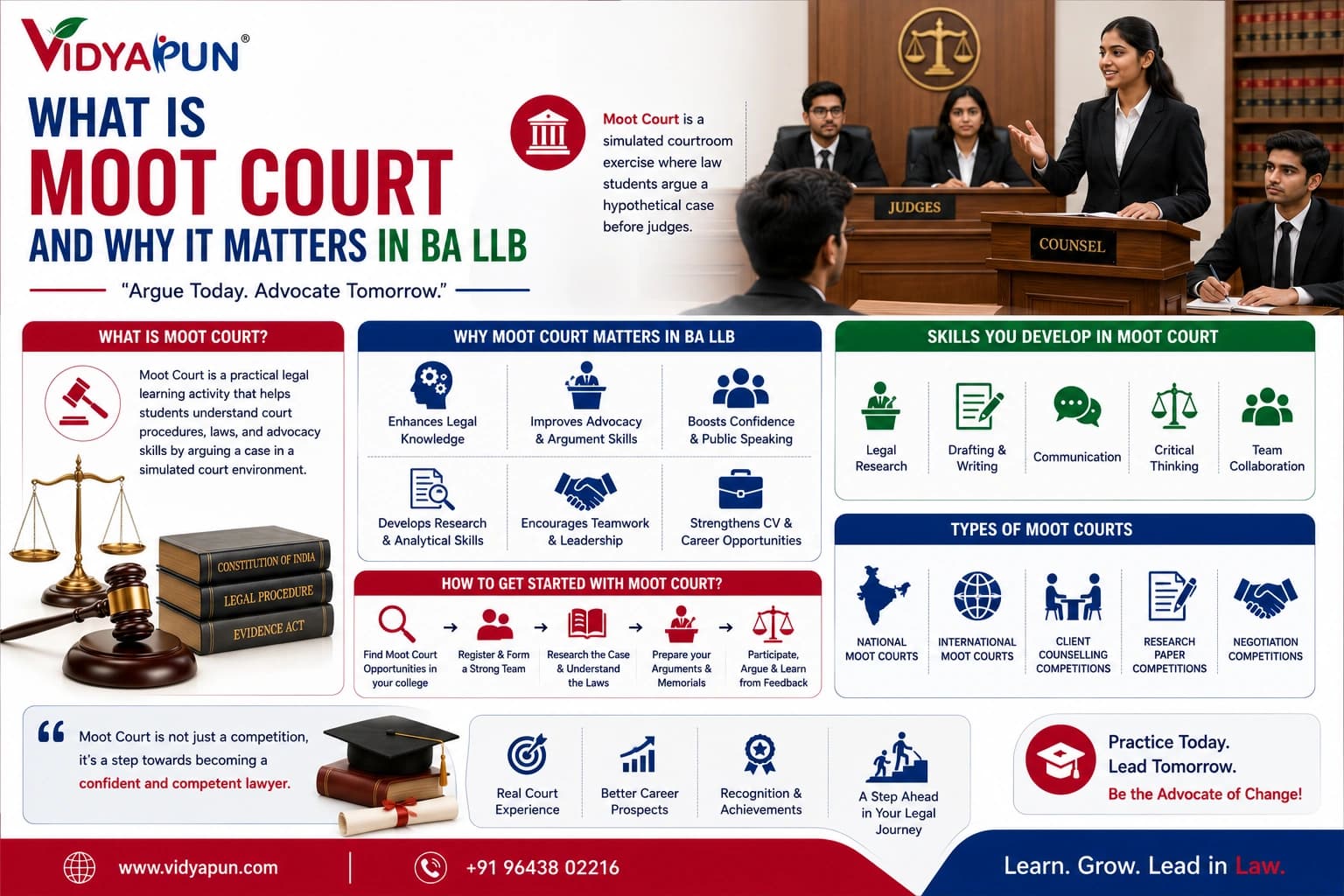
If you're in your 1st or 2nd year of BA LLB and keep hearing seniors talk about "mooting" like it's the most important thing you'll do this year, this is what it actually means — and why they're not exaggerating.
What Is Moot Court, Exactly?
Moot court is a simulated legal proceeding, usually modelled on an appellate court, arbitral tribunal, or international dispute resolution body, where students argue a hypothetical case in front of judges (often faculty, senior lawyers, or actual judges). It typically involves two stages: written submissions (called memorials or memoranda) and oral arguments, where you present and defend your side's position in person.
Moot Court vs. Mock Trial: They're Not the Same Thing
This distinction trips up a lot of first-year students. A mock trial simulates a jury or bench trial — including witness examination and evidence presentation, closer to what you'd see in a courtroom drama. Moot court, by contrast, is almost entirely about legal argument on a point of law, argued before an appellate-style bench, without witnesses or evidence in the traditional sense. Your BA LLB program almost certainly focuses on moot court, not mock trials, since it builds a different and more foundational skill set.
Why Moot Court Matters So Much in BA LLB
It's Often Your First Real Exposure to Legal Argument
Classroom learning teaches you what the law says. Moot court teaches you how to use it — building an argument, anticipating the opposing side's position, and responding to tough questions from the bench in real time.
It Builds Research Skills You'll Use for the Rest of Your Career
Preparing a moot memorial means digging through case law, statutes, and legal commentary to construct a defensible position — a research muscle that transfers directly into internships, litigation, and even corporate legal work.
It's a Genuine Differentiator on Your Resume
Recruiters, whether at law firms or for judiciary preparation, generally view strong moot court participation and results as a credible signal of practical readiness — arguably more so than grades alone, since it demonstrates applied skill rather than memorisation.
It Builds Comfort With Public Speaking and Pressure
Being questioned by a bench mid-argument, and having to think on your feet, is uncomfortable the first few times — and that discomfort is exactly the point. It's controlled exposure to a pressure you'll face for real later, whether in court or a boardroom negotiation.
How Moot Court Typically Progresses Through BA LLB
1st and 2nd Year: Introductory Exposure
Most universities introduce a lighter, often optional moot court exercise in this phase — sometimes ungraded, designed purely to familiarise you with the format before the stakes rise.
3rd and 4th Year: Structured, Credit-Bearing Participation
Moot court typically becomes a formal, graded component from here, often with internal college-level competitions feeding into external national and international ones.
5th Year: Competitive and Career-Relevant
By final year, strong mooters are often competing in prestigious national or international moot court competitions, which can meaningfully shape internship and placement conversations.
How to Prepare for Your First Moot Court
Understand the Problem Thoroughly Before Researching
Read the moot problem multiple times before diving into research — misunderstanding the factual scenario is one of the most common (and avoidable) early mistakes.
Build Your Memorial Around a Clear Structure
A strong memorial states your position clearly, supports each argument with relevant authority (case law, statute, or established legal principle), and anticipates counterarguments rather than ignoring them.
Practice Oral Arguments Out Loud, Not Just on Paper
Reading your argument silently feels very different from saying it aloud under a bench's questioning — rehearse with a friend or senior playing the judge, asking you tough follow-up questions.
Don't Memorise a Script
Judges will interrupt and question you, and a memorised script falls apart the moment you're asked something unexpected. Know your argument's logic well enough to adapt, not recite.
Learn From Feedback, Even When It Stings
Moot court judges give direct, sometimes blunt feedback. Treat it as the fastest way to improve rather than something to be defensive about — most successful mooters improve dramatically between their first and second attempts specifically because of this feedback loop.
Common First-Timer Mistakes
- Skipping the factual reading and jumping straight to legal research
- Building a memorial that ignores likely counterarguments
- Over-rehearsing a fixed script instead of understanding the argument's underlying logic
- Freezing when a judge interrupts, instead of pausing, thinking, and responding calmly
- Underestimating how much time proper legal research actually takes
Frequently Asked Questions
1. What is moot court in simple terms? A simulated legal proceeding where students argue a hypothetical case before judges, usually involving written memorials and oral arguments, modelled on appellate-level legal argument.
2. Is moot court the same as a mock trial? No. Mock trials simulate jury or bench trials with witnesses and evidence; moot court focuses on legal argument before an appellate-style bench, without witness examination.
3. Do 1st year BA LLB students participate in moot court? Many universities introduce a lighter, often ungraded moot court exercise in the 1st or 2nd year, with formal, credit-bearing participation typically starting later in the program.
4. Why is moot court considered important for a legal career? It builds legal research, argumentation, and public speaking skills that directly transfer to litigation, corporate legal work, and judiciary preparation, and is often viewed by recruiters as a credible signal of practical readiness.
5. What is a moot court memorial? A written submission that lays out your side's legal argument, supported by case law and statutory authority, prepared before the oral argument stage of a moot court competition.
6. How can a first-year student start preparing for moot court? Start by reading the problem thoroughly, building a clearly structured memorial with anticipated counterarguments, and practicing oral arguments out loud under simulated questioning rather than memorising a script.
Related Reading
Explore the full BA LLB Course page for program details, or check your Admission Chances before applying.
🌐 Website: www.vidyapun.com 📞 Call / WhatsApp: +91 96438 02216