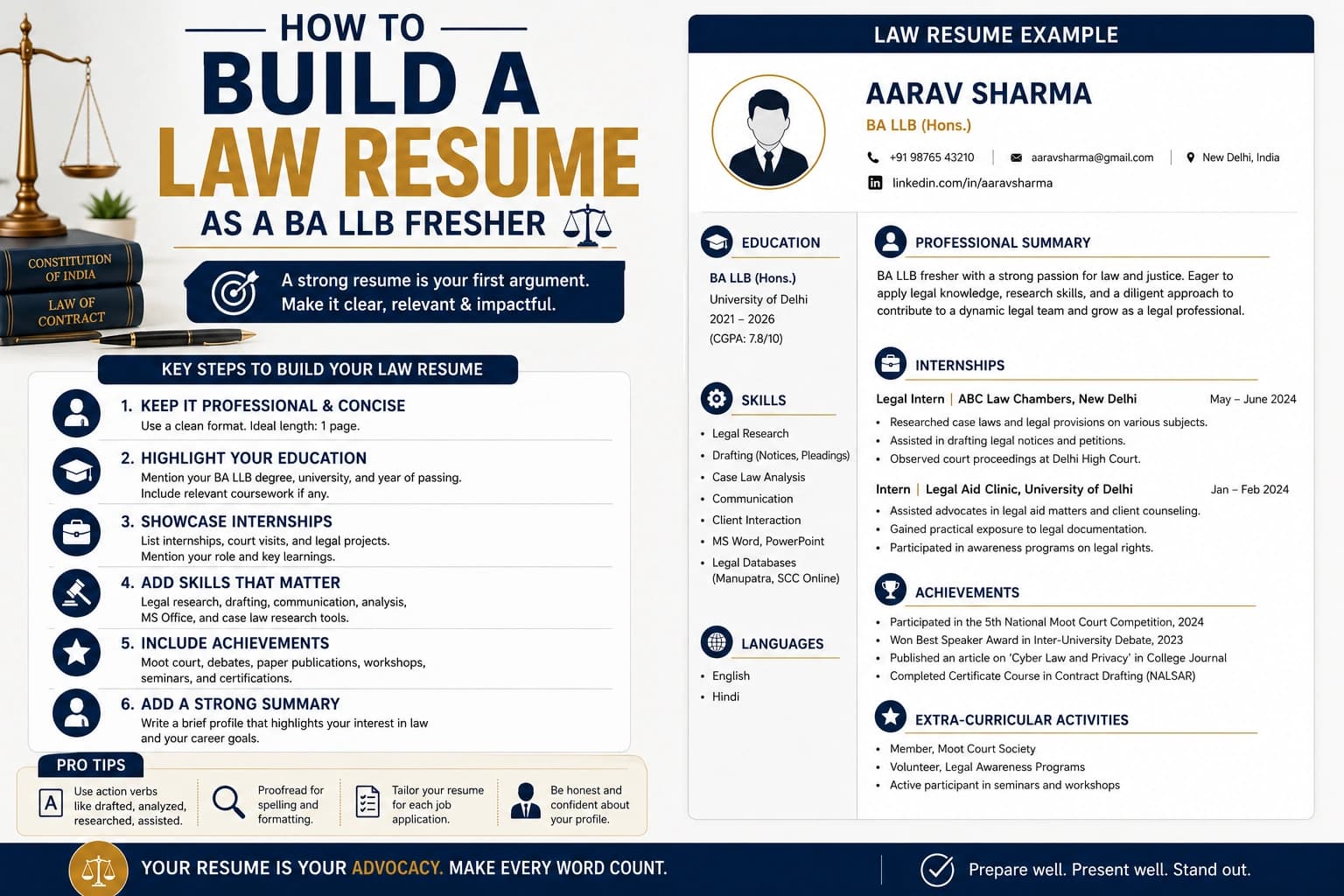
A law resume isn't a shorter version of a general CV — it follows its own conventions, and getting them wrong is one of the fastest ways to get filtered out before you're even considered for an interview. If you're a final-year BA LLB student preparing to apply for law firm roles, judicial clerkships, or corporate legal positions, this guide walks through exactly how to structure, write, and format a resume that actually gets read.
Why a Law Resume Is Different from a Standard CV
Legal recruiters read resumes differently from recruiters in most other fields, for a few specific reasons:
- Internships carry disproportionate weight – unlike many fields where a single strong internship suffices, law firms scrutinize the range, relevance, and depth of your internship history closely
- Moot court and publications signal specific skills – these aren't just extracurriculars; they're direct evidence of research, writing, and advocacy ability
- Precision matters as much as content – a resume with inconsistent formatting or unclear writing raises immediate doubts about your drafting ability, which is central to legal work
- Firms often skim quickly, then verify deeply – shortlisted candidates are frequently asked detailed follow-up questions about specific resume entries during interviews, so nothing on your resume should be exaggerated or vague
Keeping these differences in mind while building your resume will shape nearly every decision below — from what to include to how to phrase it. If you haven't yet built up the internship experience this resume will lean on, our guides on how to find law internships during BA LLB and how to get a law firm internship during LLB are worth reviewing first.
Structuring Your Law Resume: Section by Section
A strong law resume typically follows this order, though some sections can be reordered based on your strongest material:
- Contact information – name, phone, email, LinkedIn (if maintained professionally); keep this compact at the top
- Education – law school, expected graduation date, CGPA/percentage (include unless genuinely weak), relevant coursework or specializations if space allows
- Internships – reverse chronological order, with firm/organization name, practice area, duration, and 2–3 specific bullet points per entry describing actual work done
- Moot court and mock trial experience – competition name, your role, and notable achievement (best speaker, finals appearance, etc.)
- Publications and research – articles, papers, or blog contributions, with publication name and date
- Extracurriculars and leadership – student body roles, debate societies, legal aid clinics, or other relevant activities
- Skills – languages, relevant software (legal research databases, drafting tools), and any certifications
Not every section needs equal space — internships and moot court experience typically deserve the most detail, since they're what recruiters scrutinize most closely.
How to Present Internships Effectively
This is usually the single most important section on a fresher's law resume, and also where students most commonly undersell their experience.
What to include for each internship:
- Organization name and practice area (e.g., "Litigation team" or "M&A/Corporate practice")
- Duration (be honest — don't inflate short internships)
- 2–3 specific bullet points describing what you actually did — not generic descriptions like "assisted with research"
Weak vs. strong examples:
- Weak: "Assisted senior associates with case research and drafting"
- Strong: "Drafted a 12-page legal memorandum analyzing precedent on [specific issue] for an ongoing arbitration matter; conducted case law research for a shareholder dispute involving [specific area]"
Specificity does two things: it makes your experience genuinely more credible, and it gives interviewers concrete material to ask follow-up questions about — which works in your favor if you actually did the work described. Our guides on legal research skills every BA LLB student needs and building a legal research portfolio are useful for identifying which parts of your internship work are worth highlighting most prominently.
Showcasing Moot Court, Publications & Extracurriculars
Moot court: List the competition name, your role (speaker, researcher, drafter of memorials), and any notable results — reaching semi-finals, best memorial, or best speaker awards are all worth highlighting specifically. Even without an award, participation in national or well-regarded moots is valuable evidence of advocacy and research skill. Our guides on moot court in LLB: meaning, importance, and how to prepare and what moot court is and why it matters in BA LLB cover how to make the most of these experiences before you graduate.
Publications: Blog posts, journal articles, or research papers all count, provided they're genuinely legal or policy-related. Include the publication name, date, and a one-line description if the title itself isn't self-explanatory.
Extracurriculars: Student body positions, legal aid clinic involvement, and debate society participation are worth including, particularly if they demonstrate leadership or communication skills. Keep this section brief relative to internships and moot court, since recruiters weigh those more heavily.
Formatting, Length & Design Best Practices
- Keep it to one page as a fresher — recruiters reviewing hundreds of applications rarely read past the first page, and a padded two-page resume often reads as an inability to prioritize
- Use a clean, professional format – avoid excessive colors, graphics, or unconventional fonts; legal recruiting still leans conservative on design
- Be consistent – matching date formats, bullet styles, and spacing throughout signals the same attention to detail firms expect in legal drafting
- Use strong action verbs – "drafted," "analyzed," "negotiated," "researched" read more credibly than passive phrasing like "was responsible for"
- Proofread meticulously – a single typo on a law resume carries more weight than it would elsewhere, since it directly undermines your claimed attention to detail
Strong resume writing draws on the same underlying skill as strong legal drafting — precision, clarity, and cutting unnecessary words. Our guides on legal writing skills for BA LLB students and how to improve legal writing skills in law school are worth revisiting with your resume specifically in mind — the same discipline that makes a legal memo effective makes a resume bullet effective too.
Common Resume Mistakes That Cost You Interviews
Watch out for these frequently repeated errors:
- Generic, vague bullet points – "assisted with various legal matters" tells a recruiter nothing; always be specific
- Exaggerating responsibilities – interviewers often ask detailed follow-up questions specifically to test whether your resume claims hold up
- Inconsistent formatting – mismatched fonts, spacing, or date formats signal carelessness
- Burying your strongest material – if your best internship or moot achievement is at the bottom of a long list, reorder to lead with strength
- Ignoring the specific firm or role – a generic, one-size-fits-all resume performs worse than one lightly tailored to emphasize the most relevant experience for each application
- Including irrelevant personal details – hobbies unrelated to the role, excessive personal information, or an unprofessional email address all weaken an otherwise strong resume
- No cover letter when one is expected – for firms that request one, treat it with the same precision as the resume itself; a rushed cover letter undercuts a strong resume
Tailoring Your Resume for Different Roles
Your resume shouldn't be entirely identical for every application. Small adjustments matter:
- For litigation-focused firms – emphasize moot court, drafting pleadings, and any court observation or shadowing experience
- For corporate/transactional roles – emphasize contract drafting, due diligence work, and any relevant coursework or certifications
- For judicial clerkships – emphasize legal writing, research depth, and academic performance specifically
- For in-house or policy roles – emphasize any research publications, policy-adjacent internships, or cross-functional collaboration experience
This doesn't mean rewriting your resume from scratch each time — it means reordering bullet points and lightly adjusting emphasis based on what each specific role values most. If you're still deciding which direction to specialize in, our guides on career after BA LLB, top job roles for BA LLB graduates, and corporate law career path for BA LLB graduates can help you figure out where to focus your resume's strongest material. And since your resume is only the first step, our guide on how to crack law firm interviews after BA LLB picks up exactly where this one leaves off, alongside essential soft skills for aspiring lawyers for the interpersonal skills interviewers will be assessing once your resume gets you in the room. Building your professional network alongside your resume also matters — see our guide on professional networking for LLB students for how the two work together. For context on what different roles typically pay once you land them, our guide on BA LLB graduate salary in India: fresher to experienced is a useful reference.
Curious how your profile stacks up for programs with strong internship and placement support? Explore verified BA LLB programs on the Vidyapun BA LLB course page.
Frequently Asked Questions
How long should a fresher's law resume be?
One page. As a fresher, recruiters expect a concise, well-prioritized resume — a padded two-page version often signals an inability to identify your strongest, most relevant material.
What should I include if I don't have many internships yet?
Emphasize moot court experience, publications, academic performance, and relevant extracurriculars like legal aid clinic involvement. Even limited internship experience described specifically and credibly is stronger than padding with irrelevant activities.
Should I use a resume template or design my own?
A clean, simple, professional template works best. Legal recruiting tends to favor conservative formatting over creative design — the content and precision of your bullet points matter far more than visual flair.
Do I need a different resume for every law firm I apply to?
Not entirely different, but light tailoring helps — reordering or adjusting emphasis based on whether a role is litigation-focused, corporate/transactional, or research-heavy makes your application feel more targeted.
What's the biggest resume mistake law students make?
Vague, generic bullet points that don't specify what was actually done. "Assisted with legal research" tells a recruiter almost nothing — describing the specific matter, issue, or output is far more effective.
Final Thoughts
A strong law resume isn't about listing everything you've ever done — it's about presenting your most relevant internships, moot court experience, and skills with enough specificity that a recruiter can immediately see the depth behind each line. Keep it to one page, be precise rather than exaggerated, and proofread it as carefully as you would a legal document, because that's exactly how it will be judged.
Wondering which BA LLB programs offer the strongest internship pipeline to build a standout resume? Check Your Admission Chances for personalized guidance.
🌐 Website: www.vidyapun.com 📞 Call / WhatsApp: +91 96438 02216