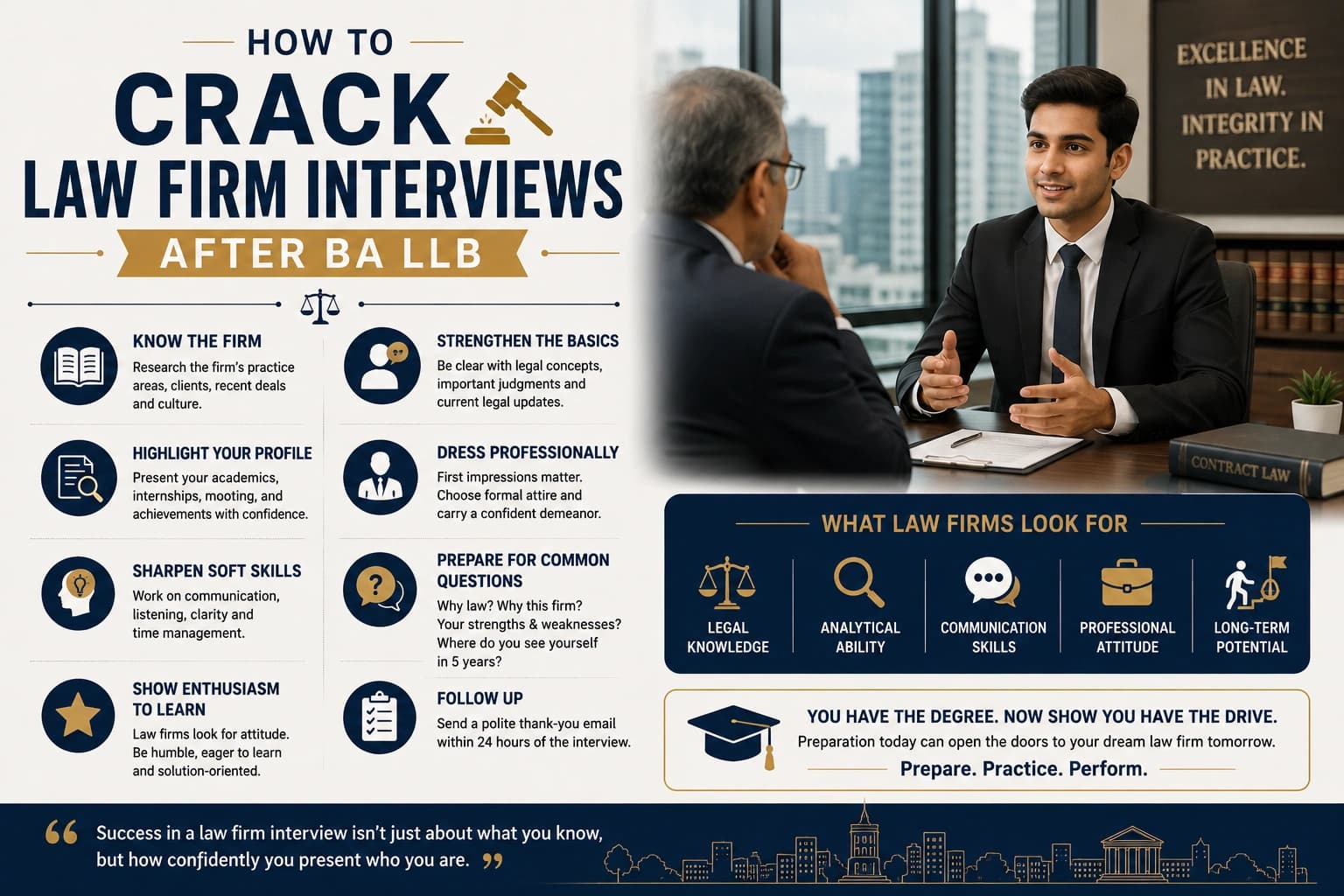
Law firm interviews test something different from your semester exams — not how much law you've memorized, but whether you can think on your feet, communicate clearly under pressure, and demonstrate genuine interest in the specific firm and practice area you're applying to. If you're a final-year BA LLB student preparing for placements, this guide walks through exactly what to expect and how to prepare, step by step.
Understanding the Law Firm Hiring Process
Most law firm hiring in India follows a fairly consistent structure, though specifics vary by firm size and tier:
- Application/CV shortlisting – firms filter candidates based on academic record, internship experience, moot court participation, and sometimes a cover letter
- Written test (at some firms) – testing legal knowledge, drafting ability, or case analysis, particularly common at larger firms
- First-round interview – often with a mid-level associate or HR, focused on background, motivation, and basic legal knowledge
- Final-round interview – typically with a partner or senior associate, going deeper into technical knowledge, case discussions, and fit
- Offer and negotiation – compensation and practice area confirmation, though junior associate offers at most firms have limited negotiation room
Understanding this sequence matters because different rounds test different things — treating every round the same is a common mistake. If you haven't already built strong internship experience to draw on during these interviews, our guides on how to find law internships during BA LLB and how to get a law firm internship during LLB are worth reviewing before you start applying for full-time roles.
Researching the Firm and Practice Area Before You Apply
Generic applications are one of the easiest ways to get filtered out early. Before any interview, you should be able to answer:
- What is this firm actually known for? Corporate/M&A, litigation, arbitration, IP, tax — most firms have a clear specialization or a few strong practice groups
- Who are their marquee clients or recent notable deals/cases? A quick search of recent firm news signals genuine interest
- What does the specific practice group you're interviewing for actually do day to day? Vague enthusiasm for "corporate law" reads very differently from specific knowledge of the practice area
- How does this firm compare to others you might be considering? Interviewers can tell when you have no real basis for choosing them over competitors
This research directly shapes how convincingly you can answer "why this firm" — one of the most commonly asked and most commonly answered poorly questions in law firm interviews.
Common Law Firm Interview Questions (and How to Approach Them)
While exact questions vary, most law firm interviews draw from a fairly predictable pool:
"Walk me through your CV / Tell me about yourself" Keep this focused on your legal journey — relevant internships, moot court, publications, and what drew you to law or this specific practice area. Avoid a generic life story.
"Why this firm?" Answer with specifics from your research — practice area strength, a particular deal or case, firm culture, or growth trajectory — not just "your reputation" or "your ranking."
"Why this practice area (corporate, litigation, IP, etc.)?" Connect this to concrete experience — an internship, a moot problem, a specific subject you excelled in — rather than a purely abstract interest.
"Tell me about a challenging legal problem you worked on" This is where internship experience matters most. Have 2–3 specific examples ready, with enough detail to discuss the issue, your role, and the outcome or learning.
"How do you handle pressure/tight deadlines?" Use a real example rather than a generic answer — law firm work is deadline-heavy, and interviewers are specifically probing for evidence you can handle that reality.
Technical/legal knowledge questions Covered in more detail in the next section, but expect at least some direct testing of your legal fundamentals, especially in areas relevant to the practice group you're interviewing for.
Technical and Legal Knowledge Rounds: What to Expect
Depending on the firm and seniority of interviewer, expect some combination of:
- Core subject questions – Contract Law, Company Law, Constitutional Law, or Civil Procedure fundamentals, depending on the practice area
- Case-based hypotheticals – being given a fact pattern and asked to identify issues or reason through a legal position on the spot
- Current affairs and recent legal developments – especially relevant recent judgments, amendments, or regulatory changes in the firm's core practice areas
- Drafting exercises – some firms include a short written component testing clause drafting, legal opinion writing, or issue-spotting
You won't be expected to have instant, perfect answers to every question — interviewers are often more interested in how you reason through a problem than whether you land on the exact right answer immediately. Staying composed and thinking out loud methodically usually scores better than freezing or guessing randomly. Our guide on how to improve courtroom communication skills covers composure-under-pressure techniques that transfer directly to interview settings, and our guides on legal research skills every BA LLB student needs and legal writing skills for BA LLB students are worth revisiting if drafting exercises are part of your target firm's process.
Behavioral and Fit Questions
Beyond legal knowledge, firms are evaluating whether you'll fit their team and work style:
- Teamwork and collaboration examples – be ready to discuss a group project, moot court team, or internship experience involving collaboration
- Handling disagreement or feedback – a specific example of receiving tough feedback and how you responded shows maturity
- Long-term career goals – firms want some sense you're thinking beyond just the first job, though it's fine to be honest that plans may evolve
- Questions you ask them – always have thoughtful questions prepared; asking nothing signals limited genuine interest
Moot court experience is a particularly strong source of behavioral examples, since it naturally involves teamwork, pressure, and handling setbacks — our guide on moot court in LLB: meaning, importance, and how to prepare is worth revisiting to identify strong stories from your own moot experience, and what moot court is and why it matters in BA LLB if you're earlier in your degree and building this experience now.
Common Mistakes That Cost Candidates Offers
Watch out for these frequently repeated mistakes:
- Generic answers with no specific detail – vague enthusiasm without concrete examples signals unpreparedness
- Not knowing basic facts about the firm – this is one of the fastest ways to be filtered out, and it's entirely avoidable with 30 minutes of research
- Overselling or exaggerating internship experience – interviewers often ask detailed follow-up questions specifically to test the depth of what you claim to have worked on
- Poor communication under pressure – freezing, rambling, or getting visibly flustered when challenged tends to weigh more heavily than an imperfect technical answer
- Neglecting soft skills entirely – firms hire people they'll work closely with for years; technical competence alone rarely closes the gap if interpersonal skills seem weak. Our guide on essential soft skills for aspiring lawyers covers the communication, negotiation, and client-handling skills that interviewers are implicitly assessing throughout the process
- Not preparing questions to ask – this is an easy, low-effort way to demonstrate genuine engagement that many candidates skip
- Ignoring professional networking – many opportunities, especially at boutique and mid-size firms, come through referrals and networking rather than cold applications; our guide on professional networking for LLB students covers how to build this before you need it
Final Preparation Checklist
In the days before your interview:
- Review your own CV thoroughly – be ready to discuss every internship, project, and publication listed, in detail
- Research the firm's recent work – at least 2–3 recent deals, cases, or notable developments
- Prepare 2–3 strong examples for common behavioral questions (challenge, teamwork, pressure)
- Revise core legal fundamentals relevant to the practice area you're interviewing for
- Prepare thoughtful questions to ask your interviewers
- Practice out loud, ideally with a mock interview, since articulating answers verbally is a different skill from having them clear in your head
For a broader look at what different practice areas and firm tiers actually pay, our guides on corporate lawyer salary in India: law firm-wise pay breakdown and BA LLB graduate salary in India: fresher to experienced are useful for setting realistic expectations before you negotiate an offer. If corporate law is your specific target, our guide on how to become a corporate lawyer in India and corporate law career path for BA LLB graduates cover the fuller career picture beyond just the interview itself. For a wider view of where a BA LLB can lead, see our guides on career after BA LLB and top job roles for BA LLB graduates.
Curious how your profile stacks up for programs with strong placement support and firm connections? Explore verified BA LLB programs on the Vidyapun BA LLB course page.
Frequently Asked Questions
What questions are commonly asked in law firm interviews?
Common questions include "walk me through your CV," "why this firm," "why this practice area," behavioral questions about handling pressure or challenging problems, and technical questions on core legal subjects relevant to the practice area.
How should I prepare for the technical/legal knowledge round?
Revise core subjects relevant to your target practice area, practice reasoning through hypothetical fact patterns out loud, and stay current on recent judgments or regulatory developments in that field — interviewers often care more about how you reason than whether you know every answer instantly.
What's the biggest mistake candidates make in law firm interviews?
Giving generic, unresearched answers — particularly around "why this firm" — and failing to demonstrate concrete, specific examples from internships or moot court experience when asked behavioral questions.
How important is internship experience for law firm interview success?
Very important. Internship experience gives you specific, credible examples to draw on throughout the interview, and interviewers frequently ask detailed follow-up questions to test how substantively you engaged with your past internships.
Should I ask questions at the end of a law firm interview?
Yes. Coming prepared with thoughtful questions about the firm, practice group, or role signals genuine interest and engagement — not asking anything is a missed opportunity that many candidates overlook.
Final Thoughts
Cracking a law firm interview comes down to specific preparation, not generic confidence — genuine firm research, concrete examples from your internships and moot court experience, and composure when your answers are challenged. Start preparing well before placement season begins, since the depth of your answers is usually what separates strong candidates from the rest.
Wondering which BA LLB programs offer the strongest placement support for law firm roles? Check Your Admission Chances for personalized guidance.
🌐 Website: www.vidyapun.com 📞 Call / WhatsApp: +91 96438 02216