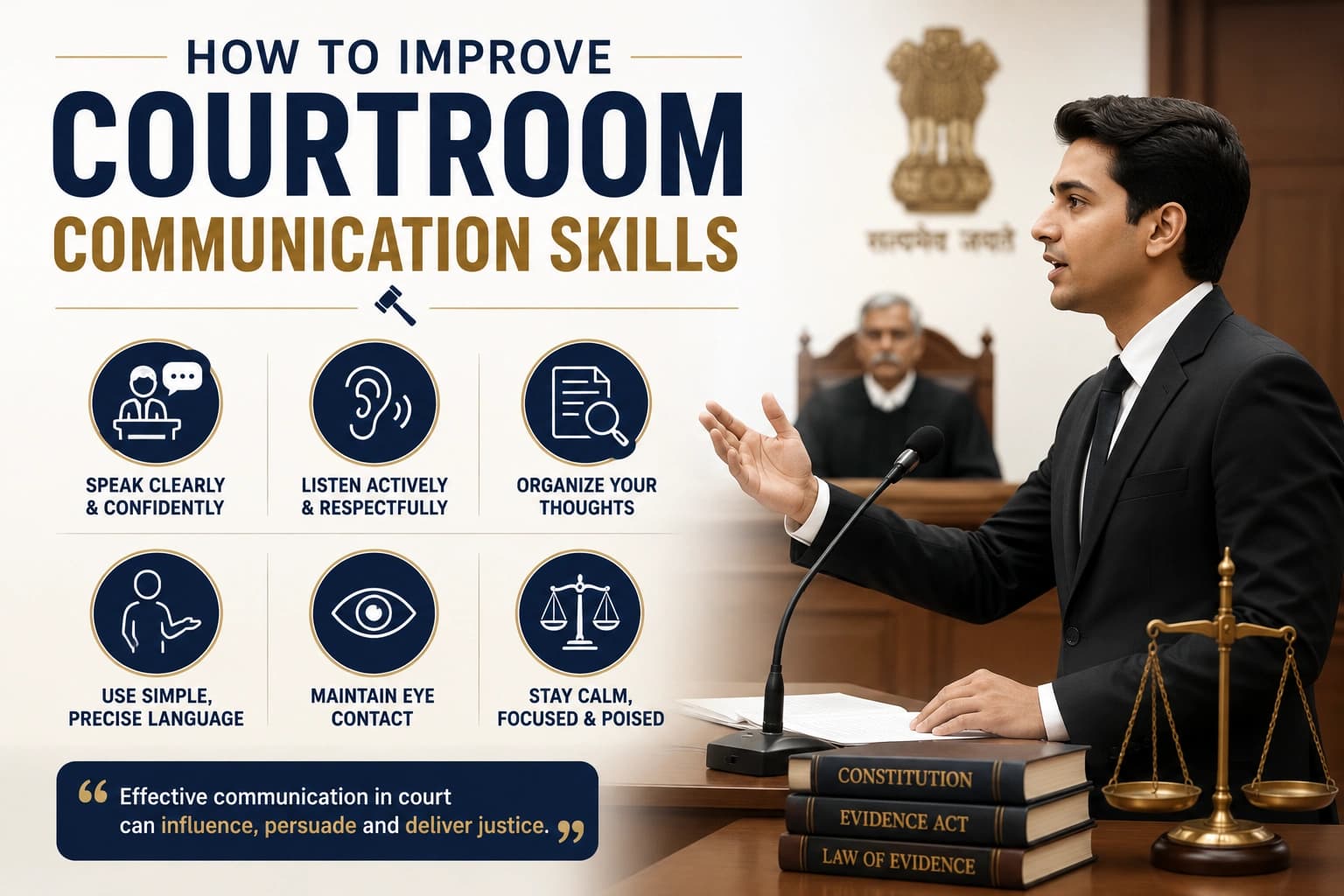
Courtroom communication isn't the same skill as general public speaking, and treating it that way is one of the most common mistakes law students make when they first step into moot court or a real courtroom. A judge isn't an audience to entertain — they're a decision-maker you need to persuade under strict procedural constraints, often while being interrupted, questioned, and pushed on the weakest parts of your argument. This guide breaks down what courtroom communication actually involves and how to build it deliberately, well before you're arguing in front of a real bench.
Why Courtroom Communication Is a Distinct Skill
Courtroom communication differs from general public speaking or even classroom presentation in a few specific ways:
- You're persuading a specific, informed audience – a judge already knows the law; your job is to frame the facts and arguments in the way most favorable to your client, not to explain the law from scratch
- It's interactive, not a monologue – judges interrupt, ask pointed questions, and expect you to adapt your argument in real time
- Procedural discipline matters – how you address the court, respond to objections, and structure your submissions all follow conventions that affect how credible you appear
- Composure under pressure is non-negotiable – losing your footing when challenged undermines your argument regardless of its underlying merit
This is exactly why moot court exists as a structured training ground — it recreates these specific pressures in a lower-stakes environment. Our guides on what moot court is and why it matters in BA LLB and moot court in LLB: meaning, importance, and how to prepare are worth reading alongside this guide.
Structuring Persuasive Legal Arguments
Strong courtroom communication starts well before you open your mouth — it starts with how you structure your argument:
- Lead with your strongest point – judges form impressions quickly; don't bury your best argument in the middle of a long submission
- Signpost clearly – explicitly tell the court what you're about to argue and how many points you'll make, so your structure is easy to follow under time pressure
- Anticipate the counterargument – address the weakest part of your position proactively rather than waiting for opposing counsel or the bench to expose it
- Use precedent precisely – cite cases that are genuinely on point, and be ready to distinguish cases the other side is likely to raise
- Know when to concede a minor point – conceding something small to protect credibility on your core argument is often more persuasive than contesting everything
For the underlying research and writing skills that feed into strong argument structure, our guides on legal research skills every BA LLB student needs and legal writing skills for BA LLB students are useful companion reads — a well-structured written argument is usually the foundation of a well-delivered oral one.
Voice, Body Language & Courtroom Presence
How you say something in a courtroom often matters as much as what you say:
- Pace and pausing – speaking too quickly signals nervousness and makes complex arguments harder to follow; deliberate pauses give weight to key points
- Vocal projection and clarity – you need to be heard clearly without shouting, which takes practice to calibrate in an unfamiliar room
- Eye contact with the bench – maintaining appropriate eye contact conveys confidence and respect, though this should be balanced with looking at your notes when needed
- Controlled body language – avoid distracting movements or gestures; stillness and controlled gestures generally read as more authoritative than restless movement
- Appropriate courtroom etiquette – how you address the judge, when you stand, and how you respond to rulings all form part of your overall presence, and getting these conventions wrong undercuts an otherwise strong argument
These are physical, repetition-based skills — they improve through practice far more than through reading about them, which is part of why moot court and mock trials are so heavily emphasized in legal education.
Handling Cross-Examination and Thinking on Your Feet
Whether you're being cross-examined as a witness advocate or fielding tough questions from the bench, this is where courtroom communication is tested most directly:
- Listen to the full question before responding – interrupting or answering before a question is complete often leads to answering the wrong thing
- Stay composed when challenged – a hostile or skeptical question isn't a personal attack; treat it as an opportunity to strengthen your position, not a threat to react defensively to
- Buy yourself thinking time when needed – a brief, deliberate pause before answering a tough question reads as thoughtful, not weak
- Know your case cold – the ability to think on your feet depends heavily on how thoroughly you've prepared; genuine improvisation without preparation rarely works well in a courtroom
- Don't overreach – if you don't know an answer or a point genuinely isn't in your favor, acknowledging it briefly and moving on is usually stronger than stretching to defend an indefensible position
Repeated moot court rounds are the most realistic way to build this skill before you're in front of a real judge, since they specifically simulate being challenged and having to adapt mid-argument.
How to Build This Skill During BA LLB
A few concrete, sequential steps to develop courtroom communication before you graduate:
- Start with moot court early, not just in your final year – repetition matters more than any single high-stakes competition
- Record yourself practicing arguments – watching your own pacing, filler words, and body language is one of the fastest ways to spot and fix weaknesses
- Seek out internships with active litigation exposure – observing real courtroom proceedings teaches conventions and pacing that no classroom simulation fully replicates; our guides on how to find law internships during BA LLB and how to get a law firm internship during LLB cover how to secure this kind of exposure
- Ask for specific, honest feedback after every moot round – vague praise doesn't help you improve; ask judges and coaches what specifically weakened your delivery or argument
- Study experienced advocates in action – watching senior lawyers argue, whether in person during internships or through recorded proceedings, builds an intuitive sense of pacing and structure
If courtroom advocacy is a career priority for you specifically, our guides on judiciary exams after LLB: eligibility, syllabus, and preparation and how to prepare for judiciary exams after BA LLB are worth reading, since strong oral advocacy is heavily weighted in judiciary interviews. For a broader look at the interpersonal skills that complement courtroom communication, our guide on essential soft skills for aspiring lawyers covers negotiation, critical thinking, and client handling in more depth.
Curious how your profile stacks up for programs with strong moot court and litigation exposure? Explore verified BA LLB programs on the Vidyapun BA LLB course page.
Frequently Asked Questions
How can I improve my courtroom communication skills as a law student?
Practice consistently through moot court, record and review your own arguments, seek internships with litigation exposure, and ask for specific feedback after every practice round rather than relying on classroom theory alone.
Is courtroom communication the same as general public speaking?
Not quite. Courtroom communication involves persuading a legally informed decision-maker under procedural constraints, handling real-time interruptions and questions, and following specific etiquette — skills that go beyond general public speaking confidence.
How important is body language in courtroom advocacy?
Very important. Controlled body language, appropriate eye contact, and confident vocal delivery all affect how persuasive and credible your argument appears, often as much as the legal content itself.
What's the best way to prepare for cross-examination or tough questions from a judge?
Thorough preparation is the foundation — genuine improvisation without deep case knowledge rarely works well. Beyond that, practice staying composed under pressure, listening fully before responding, and using brief pauses to think rather than rushing an answer.
Does moot court actually help with real courtroom skills later in a legal career?
Yes. Moot court closely simulates the pressures of real courtroom advocacy — persuasive argument structure, handling interruptions, and composure under questioning — making it one of the most effective ways to build these skills before entering practice.
Final Thoughts
Strong courtroom communication is built through repetition, honest feedback, and deliberate practice — not through natural talent alone. Start early with moot court, record and critique your own delivery, and seek out real litigation exposure through internships wherever possible, so that by the time you're arguing in front of an actual judge, the fundamentals are already second nature.
Wondering which BA LLB program offers the strongest moot court and litigation exposure? Check Your Admission Chances for personalized guidance.
🌐 Website: www.vidyapun.com 📞 Call / WhatsApp: +91 96438 02216