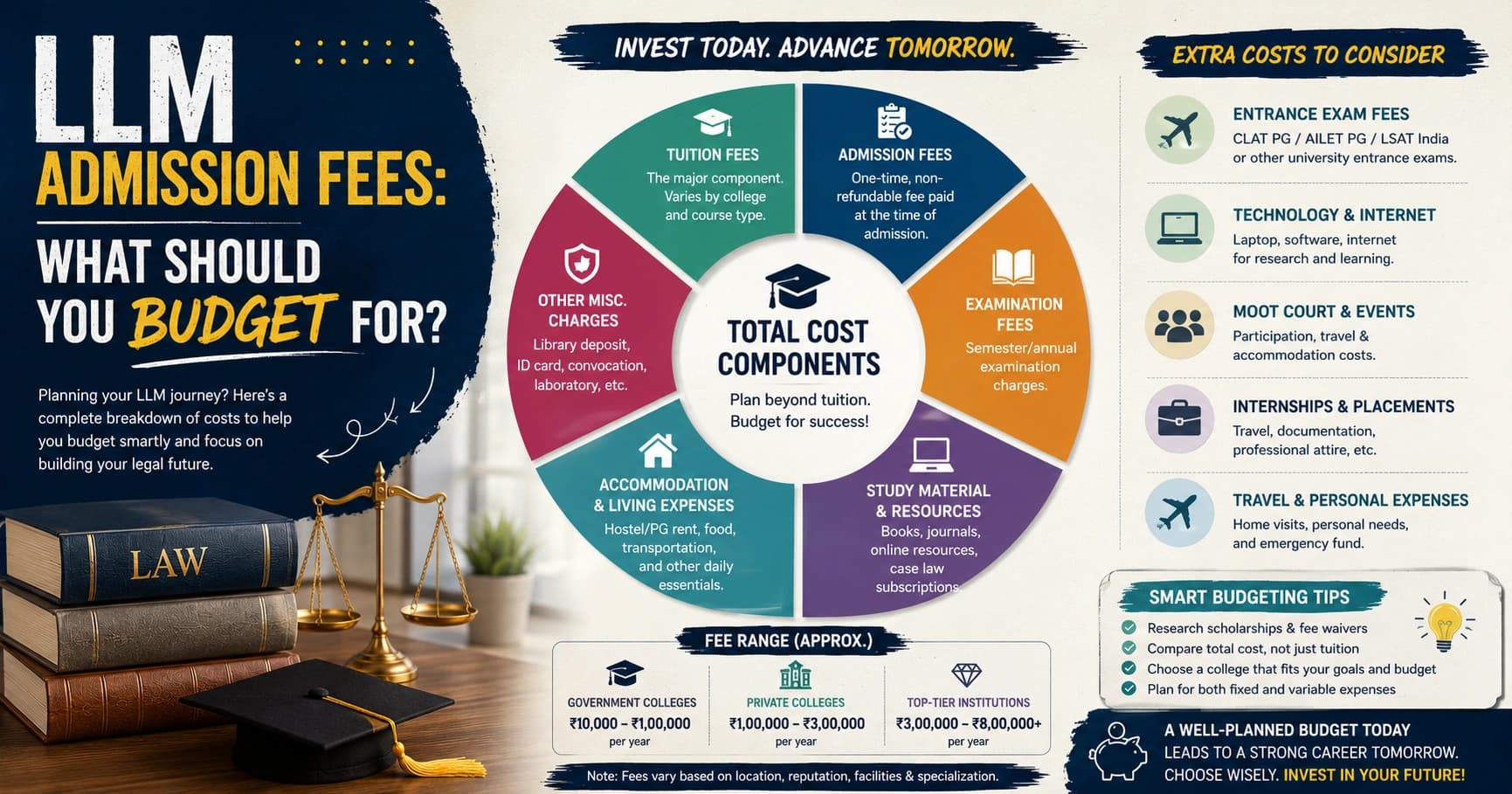
One of the trickiest parts of planning an LLM is that fees vary so widely across institutions that a single "average cost" figure is nearly meaningless. A government or NLU program can cost a fraction of what a private university charges for the same degree, and tuition itself is only one line item in your total budget.
This guide walks through every category of cost you should actually plan for, without pretending there's one universal number — because there genuinely isn't one, and the right approach is understanding the categories so you can request accurate figures from your specific shortlisted universities.
Why LLM Fees Vary So Much in India
Understanding the drivers behind the variation helps you interpret any fee figure you come across with the right context.
Institution Type as the Biggest Factor
Government and National Law University programs are typically funded and regulated differently than private institutions, generally resulting in significantly lower tuition. Private and deemed universities set their own fee structures independently, which can range widely based on infrastructure, faculty, and market positioning.
Specialization and Program Format Differences
Some specializations (particularly those with smaller cohorts or specialized faculty) can carry different fee levels than more common specializations at the same institution. Program format — full-time, part-time, or executive — also affects cost, which we'll cover in more detail further down.
Tuition Fees: What to Expect by Institution Type
Rather than quoting a single figure, it helps to understand the general pattern across institution types.
Government and NLU Programs
Government and National Law University LLM programs are generally the most affordable option in India, though exact fees differ between institutions and are revised periodically. These programs remain highly competitive to get into precisely because of this combination of quality and affordability.
Private and Deemed Universities
Private and deemed university LLM programs typically charge meaningfully higher tuition than government institutions, with a wide range depending on the specific university's reputation, infrastructure, and location. Always request the current year's exact fee structure directly from each university rather than relying on outdated or third-party figures.
Beyond Tuition: Other Costs to Budget For
Tuition is rarely the full picture — several other costs add up over the course of your program.
Hostel and Living Expenses
If you're relocating for your LLM, hostel or accommodation costs, along with food and daily living expenses, form a significant part of your total budget — often comparable to or exceeding tuition itself at some institutions. Costs vary significantly by city, with metro locations generally costing more than smaller cities.
Exam, Library, and One-Time Charges
Beyond tuition, expect exam fees, library and lab charges, a one-time admission or caution deposit (often partially refundable), and miscellaneous administrative fees. Always ask for a complete, itemized fee breakdown rather than just the headline tuition figure, since these additions can meaningfully change your total cost.
Entrance Exam and Application Costs
Before you even secure a seat, there are costs associated with applying itself.
Application Fees Across Multiple Universities
Each university or entrance exam typically charges its own application fee, and if you're applying to multiple institutions (a sensible strategy given how spread out LLM admission timelines are), these fees add up. Budget for this as a separate line item, particularly if you're applying broadly.
Coaching and Preparation Costs, If Any
If you choose to use coaching or preparation resources for CLAT PG or a university-specific entrance exam, factor this into your overall budget as well, though it's entirely optional — many candidates prepare independently using official study material and past papers.
Cost Differences: Full-Time vs Part-Time/Executive LLM
Program format is a genuine cost variable, not just a scheduling one.
Full-Time Program Costs
Full-time programs typically follow a standard fee structure for the institution, spread across the program's duration, with the added consideration that you may be forgoing income during this period if you're a working professional.
Part-Time and Executive Program Costs
Part-time and executive LLM programs, designed for working professionals, sometimes carry a different (occasionally higher) fee structure than standard full-time programs, reflecting the flexible format and professional cohort. Always confirm this directly, since it isn't a universal rule and varies by institution.
Scholarships and Ways to Reduce Costs
Several legitimate options exist to reduce your overall LLM cost, worth researching before you finalize your budget.
Merit and Category-Based Scholarships
Government scholarships (including category-based schemes for SC/ST/OBC/EWS candidates), university merit-based fee waivers, and entrance exam rank-based scholarships can meaningfully reduce your total cost. Research these early, since scholarship application timelines often run separately from admission deadlines.
Employer Sponsorship and Assistantships
If you're a working professional, some employers sponsor LLM fees in exchange for a service commitment, or offer study leave for part-time programs. Research-oriented universities occasionally offer assistantships involving some teaching or research work in exchange for a stipend or fee reduction.
Studying LLM Abroad: A Different Cost Picture
If you're considering an LLM outside India, the cost structure shifts substantially.
Why International Costs Are Harder to Estimate
International LLM programs involve tuition (often significantly higher than Indian institutions when converted to INR), living costs specific to that country, visa fees, travel, and health insurance — all of which vary enormously by country and city. Research each specific target university and country's current cost of living and tuition directly, since broad estimates rarely hold up across different national contexts.
How to Build a Realistic LLM Budget
Bringing all these pieces together into an actual plan is the practical final step.
A Simple Budgeting Checklist
List each shortlisted university's tuition, hostel/living costs, one-time fees, and application costs separately, request current-year figures directly from each institution's admission office rather than relying on older data, and factor in scholarship or sponsorship possibilities before finalizing your decision. Building this out as a spreadsheet, university by university, tends to reveal cost differences that aren't obvious from headline tuition figures alone.
Frequently Asked Questions
1. How much does an LLM cost in India? This varies enormously by institution type — government and NLU programs are generally significantly more affordable than private universities. There's no single reliable "average" figure; always request current fees directly from your specific shortlisted institutions.
2. Are government LLM programs cheaper than private ones? Generally yes, government and National Law University programs tend to have lower tuition than private and deemed universities, though private institutions vary widely among themselves too.
3. What costs besides tuition should I budget for? Hostel and living expenses, exam and library fees, one-time admission deposits, and application fees across multiple universities are all worth budgeting for separately from tuition.
4. Are part-time LLM programs more expensive than full-time ones? Not always, but they can be at some institutions, given the different format and professional cohort. Always confirm the exact fee structure directly with each university.
5. Can scholarships significantly reduce LLM costs? Yes, government category-based schemes, university merit scholarships, and entrance exam rank-based fee waivers can meaningfully lower your total cost. Research these early, since deadlines often run separately from admission timelines.
6. Is studying LLM abroad significantly more expensive than in India? Generally yes, when factoring in tuition, living costs, visa fees, and travel, though this varies enormously by country and specific university. Research your specific target country and institution directly rather than relying on general assumptions.
Ready to plan your LLM budget properly? Review full details on the Master of Laws (LLM) page, explore Best LLM Specializations, or check our LLM Entrance Exam Guide if you're budgeting for exam preparation too. Already thinking about your final project? See our LLM Dissertation Guide, or revisit your BA LLB Course foundation.
Check your eligibility and get a personalized cost estimate:
🌐 Website: www.vidyapun.com 📞 Call / WhatsApp: +91 96438 02216