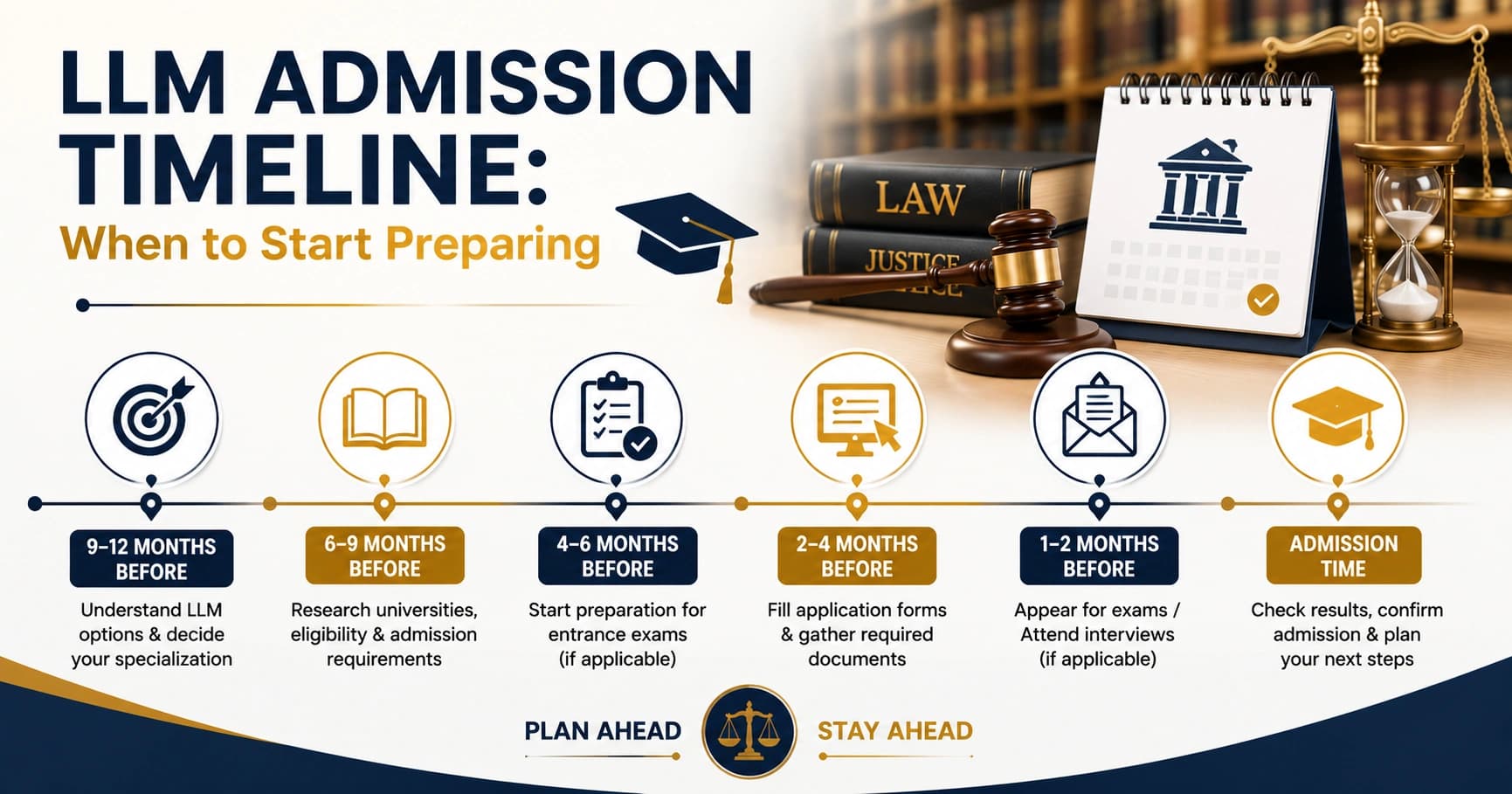
Most students underestimate how early LLM preparation actually needs to begin, mainly because there's no single, universally publicized exam calendar the way CLAT dominates LLB admission conversations. By the time many students start researching seriously, several university application windows have already opened — or closed — forcing an unplanned gap year that could easily have been avoided.
This guide lays out a realistic month-by-month LLM admission timeline, working backward from your intended start date, so you know exactly when to start each stage instead of discovering deadlines after they've passed. For the full eligibility and process details behind each stage, pair this with our LLM Admission 2026 guide.
Why the LLM Admission Timeline Catches Students Off Guard
Understanding why this timeline is trickier than LLB's helps explain why starting early matters so much.
No Single Centralized Calendar
LLB admission (particularly the 5-year integrated route) is shaped heavily by a few large, centralized exams like CLAT, with a widely publicized calendar. LLM admission runs across many more independent university timelines, entrance exams, and merit-based processes — each with its own dates, meaning there's no single calendar you can rely on for every option.
How Timeline Awareness Prevents a Lost Year
Missing a specific university's application window doesn't just mean missing that one college — it often means waiting a full year for the next intake cycle, since most LLM programs admit once annually. Building timeline awareness early is the single most effective way to avoid this outcome.
12+ Months Before: Research and Specialization Decisions
The earliest phase is about direction-setting, not applications.
Exploring Specialization Options Early
Start exploring specialization areas — Corporate Law, Constitutional Law, Criminal Law, International Law, and others — at least a year before you intend to start LLM. Our Best LLM Specializations guide is a useful starting point for understanding which areas align with different career directions. This is also a good time to reflect honestly on which LLB subjects, internships, or moot court experiences genuinely engaged you, rather than choosing based on what sounds prestigious.
Building Your Initial University List
Once you have a rough specialization direction, start building a broad initial list of universities known for strength in that area. This doesn't need to be final yet — the goal at this stage is simply to have a working list to narrow down later, so aim for breadth over precision at this early point.
8-10 Months Before: Shortlisting and Eligibility Checks
This is when your broad research starts turning into a concrete, workable shortlist.
Narrowing Your University Shortlist
Narrow your initial list down to a realistic set of universities — typically eight to twelve — based on specialization strength, location, cost, and admission route. Trying to apply everywhere isn't practical; a focused shortlist lets you prepare more thoroughly for each option.
Confirming Eligibility for Each Option
Confirm the exact eligibility criteria (minimum LLB percentage, category relaxations, any additional conditions) for each university on your shortlist at this stage, well before applications open. This avoids the disappointment of discovering you don't meet a specific university's bar after you've already invested preparation time.
6-8 Months Before: Entrance Exam Preparation Begins
If your shortlist includes exam-based universities, this is when focused preparation should start.
CLAT PG Preparation Timeline
If CLAT PG covers a meaningful portion of your shortlist, begin structured preparation six to eight months ahead — revisiting core LLB subjects like Constitutional Law, Jurisprudence, and Contract Law, since CLAT PG tests postgraduate-level legal knowledge built on this foundation rather than entirely new material. Past papers and official mock tests, where available, tend to be more useful at this stage than generic prep material.
Preparing for University-Specific Tests
If specific universities on your shortlist run their own entrance tests, research each one's pattern and syllabus separately, since these can differ meaningfully from CLAT PG. Don't assume preparation for one automatically covers another — some university-specific tests weight practical or research-oriented questions more heavily than a standardized national exam would.
3-5 Months Before: Applications Open
This is typically when the bulk of actual application activity happens.
Tracking Multiple Application Windows
Most LLM application windows open three to five months before the academic session begins, though exact timing varies significantly by university. Because these windows don't align to one shared calendar, maintain a personal tracker listing each university's specific opening and closing dates.
Document Preparation Checklist
Have your LLB mark sheets, provisional or final degree certificate, Class 10 and 12 certificates, and category documents (if applicable) ready well before this stage, since gathering them under deadline pressure is one of the most common causes of last-minute stress.
1-3 Months Before: Exams, Results and Counselling
This stage compresses several important milestones into a relatively short window.
Entrance Exam Dates and Results
Entrance exams (where applicable) are typically conducted one to three months before the academic session, with results following shortly after. Keep a close eye on official exam body communications during this period, since result and counselling dates can sometimes shift.
Counselling and Preference Filling
Once results are out, counselling typically begins quickly — filling university and specialization preferences within a limited window. Have your preferences thought through in advance, since counselling windows are often short and don't leave much room for last-minute research.
Final Weeks: Verification, Fees and Enrolment
The final stretch is largely administrative, but no less important to get right.
Document Verification Timeline
Once a seat is allotted, document verification usually needs to be completed within a short window — often just a few days to a couple of weeks. Having your originals and photocopies organized in advance (as covered in the earlier document preparation step) makes this stage move quickly.
Fee Payment Deadlines
Fee payment deadlines to confirm your seat are typically strict, with seats reallotted to waitlisted candidates if you miss the window. Understand the full fee structure and payment schedule before this stage arrives, so there are no surprises when the deadline is close.
Building Your Own Personal LLM Timeline
With so many moving pieces across different universities, a simple personal tracker is often more useful than trying to remember every date.
A Simple Tracking Template
For each shortlisted university, track: application opening and closing dates, entrance exam date (if applicable), expected result date, counselling window, and fee payment deadline. Reviewing this tracker monthly, starting from around 12 months out, is a practical way to stay ahead of a process that otherwise has no single shared calendar to rely on.
Frequently Asked Questions
1. When should I start preparing for LLM admission? Ideally at least 12 months before you intend to start the program — beginning with specialization research and a broad university shortlist, well before application windows open.
2. Is there a single LLM admission calendar for all of India? No. Unlike LLB's centralized exams like CLAT, LLM admission runs across many independent university timelines, entrance exams, and merit-based processes, each with its own schedule.
3. When do LLM application windows typically open? Most open three to five months before the academic session begins, though exact timing varies significantly by university — always check each institution's current-year notification directly.
4. How long does the LLM counselling process take? It varies by university, but counselling windows are often short, sometimes just a few days to a couple of weeks, so having your preferences and documents ready in advance is important.
5. What happens if I miss a university's LLM application deadline? You would typically need to wait for the next year's intake cycle at that specific institution, since most LLM programs admit only once annually. Some universities occasionally offer spot admission if seats remain vacant, but this isn't guaranteed.
6. How far in advance should I prepare my documents for LLM admission? Start gathering mark sheets, certificates, and category documents at least a few months before application windows open, since some documents take time to procure from your university's administrative office.
Ready to build your own timeline? Review full details on the Master of Laws (LLM) page, revisit your Bachelor of Laws (LLB) foundation, or explore Best LLM Specializations and what comes after in our Career After LLM guide. Considering studying abroad instead? See our LLM Abroad Guide.
Start Your Application with guidance from our counsellors:
🌐 Website: www.vidyapun.com 📞 Call / WhatsApp: +91 96438 02216