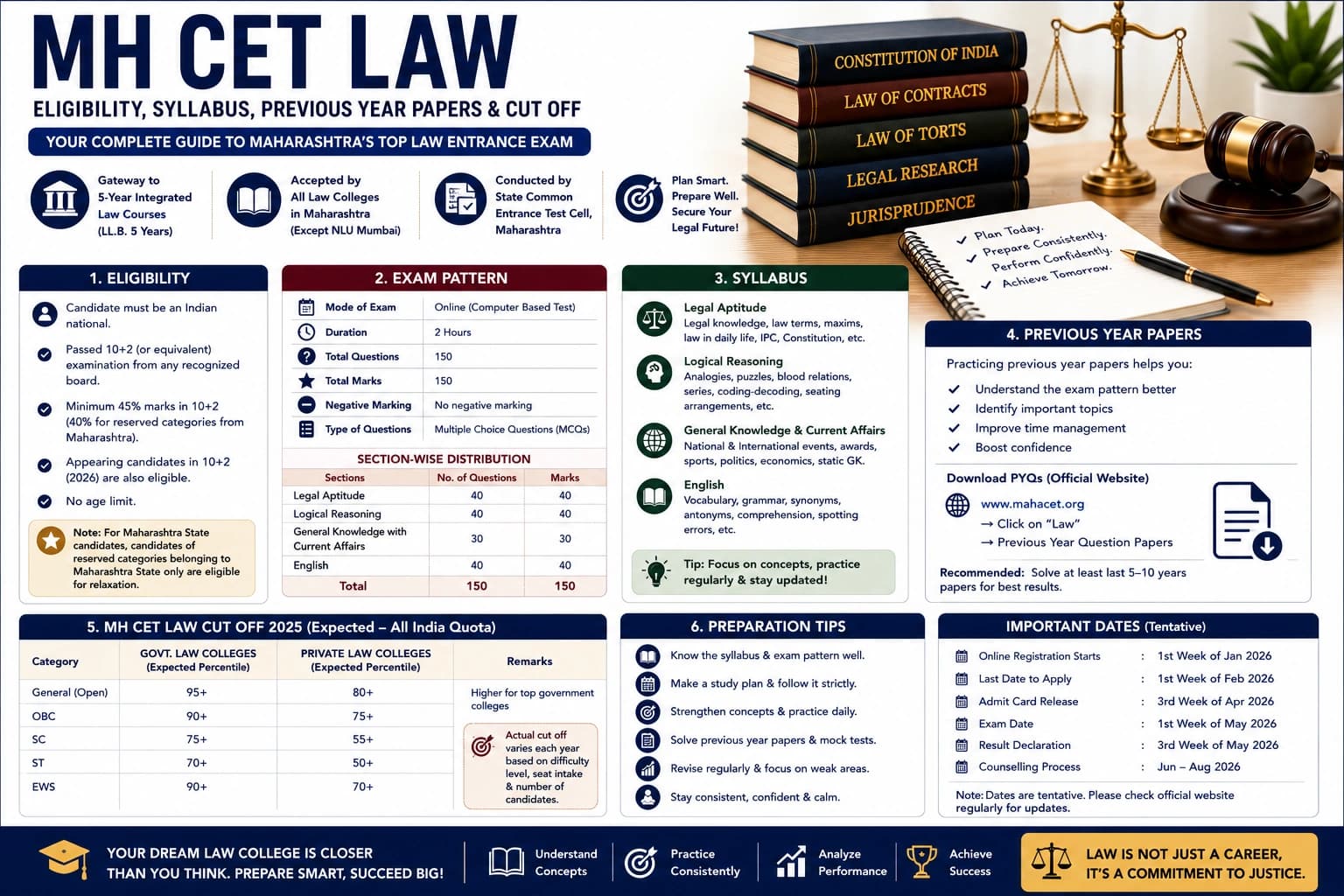
MH CET Law is Maharashtra's own state-level law entrance exam, conducted by the State Common Entrance Test Cell (CET Cell), and it's the primary route into 3-year and 5-year LLB programs at law colleges across the state. The 5-year LLB edition of MH CET Law 2026 was held on May 8, 2026. This guide covers eligibility, syllabus, exam pattern, and preparation strategy for both course types.
What Is MH CET Law, and Who Conducts It
MH CET Law is administered by the Maharashtra State CET Cell, separately for the 3-year LLB (for graduates) and 5-year LLB (for 12th pass students, generally BA LLB or BBA LLB). It's a state-level alternative to national exams like CLAT and AILET, primarily feeding into Maharashtra's law colleges and universities.
MH CET Law Eligibility
For 5-Year LLB
Candidates must have passed 12th grade (any stream) from a recognised board, generally with a minimum aggregate percentage set by the CET Cell each year (with relaxation for reserved categories) — always check the current year's information brochure for the exact figure, since it can be revised.
For 3-Year LLB
Candidates must hold a graduate degree in any discipline from a recognised university, meeting the minimum aggregate percentage specified in that year's brochure.
MH CET Law Exam Pattern
The exam is conducted in online mode, with the question paper available in both English and Marathi.
- Total questions: 120 multiple-choice questions
- Duration: 120 minutes
- Marking: 1 mark per correct answer
- Negative marking: None — this is a key difference from CLAT and AILET, both of which deduct marks for wrong answers
5-Year LLB Paper Structure (5 Sections)
- Legal Aptitude and Legal Reasoning
- General Knowledge and Current Affairs
- Logical and Analytical Reasoning
- English Language
- Basic Mathematics
3-Year LLB Paper Structure (4 Sections)
The 3-year LLB paper covers the same four core areas but excludes Basic Mathematics:
- English Language (typically the highest-weightage section)
- General Knowledge and Current Affairs
- Legal Aptitude and Legal Reasoning
- Logical and Analytical Reasoning
MH CET Law Syllabus: Section by Section
Legal Aptitude and Legal Reasoning
Questions are generally based on a legal proposition or principle, followed by a factual scenario — you're expected to take the given proposition as true and apply logical reasoning to reach the correct inference, similar in spirit to CLAT's Legal Reasoning section.
General Knowledge and Current Affairs
Covers recent national and international events, along with static GK. Because the exam is Maharashtra-specific, it's worth being comfortable with basic state-related facts and current developments as well.
Logical and Analytical Reasoning
Tests pattern recognition, drawing conclusions, completing arguments, and applying logical rules to different scenarios — puzzles, statement-conclusion questions, and analogy-based items are common.
English Language
Comprehension, grammar, and vocabulary, generally carrying meaningful weightage, especially in the 3-year LLB paper.
Basic Mathematics (5-Year LLB Only)
Typically includes ratios, percentages, basic geometry, and simple arithmetic — this section doesn't appear in the 3-year LLB paper at all.
MH CET Law Cut-Off Trends
Cut-offs are published as part of the merit list and vary by:
- Course type (3-year vs 5-year LLB)
- Category (General, OBC, SC, ST, EWS)
- College and its location — cut-offs at colleges in Mumbai and Pune tend to run higher than in smaller cities, given demand
Because the exam has no negative marking, score distributions tend to cluster more tightly than in CLAT or AILET, which can make cut-offs shift more with small changes in difficulty level year to year. Always check the current year's official merit list from the CET Cell rather than relying on a previous year's figure.
Preparation Strategy for MH CET Law
Prioritise English if You're Attempting the 3-Year LLB Paper
Since English typically carries the highest weightage in the 3-year LLB pattern, strong comprehension and grammar fundamentals pay off disproportionately here.
Don't Skip Basic Mathematics If You're Attempting the 5-Year LLB Paper
It's a smaller section, but since no negative marking applies, every attempted question is a free opportunity — there's no downside to attempting questions you're unsure about, unlike in CLAT or AILET.
Use Previous Year MH CET Law Papers
Previous year papers are the most reliable way to understand the actual difficulty level and question style for each section, since state-level exam patterns can differ meaningfully from national exams even when section names look similar.
Build a Maharashtra-Aware Current Affairs Habit
Beyond national and international events, being comfortable with Maharashtra-specific developments can give you an edge in the GK section.
Take Full Timed Mocks Without Guessing Anxiety
Since there's no negative marking, your mock test strategy should differ from CLAT/AILET prep — attempt every question rather than leaving weaker ones blank, and use mocks to build the speed needed for 120 questions in 120 minutes.
Frequently Asked Questions
1. What is the eligibility for MH CET Law? 12th pass (any stream) for the 5-year LLB, and a graduate degree in any discipline for the 3-year LLB, both subject to a minimum aggregate percentage set in the current year's information brochure.
2. Is there negative marking in MH CET Law? No. Each correct answer gets 1 mark, and there's no penalty for incorrect answers — unlike CLAT and AILET.
3. What is the difference between the 3-year and 5-year LLB syllabus for MH CET Law? The 5-year LLB paper includes a Basic Mathematics section that the 3-year LLB paper does not; both share Legal Aptitude, GK & Current Affairs, Logical Reasoning, and English.
4. Is MH CET Law harder than CLAT? Difficulty is generally considered comparable to slightly more accessible than CLAT for many candidates, partly because there's no negative marking, though competition for top colleges remains high.
5. Which colleges accept MH CET Law scores? Law colleges and universities across Maharashtra that offer 3-year or 5-year LLB programs generally accept MH CET Law scores — check the specific college's admission notification to confirm.
6. Is the MH CET Law exam conducted in Marathi as well as English? Yes, the question paper is available in both English and Marathi.
7. How is the MH CET Law cut-off decided? It emerges from the merit list process based on category, course type, and college-wise demand — it isn't a single fixed number, so always check the current year's official release.
8. Can students from outside Maharashtra appear for MH CET Law? Yes, but domicile-based reservation at many Maharashtra colleges means non-domicile candidates typically compete for a smaller share of seats — check specific college eligibility rules.
Related Reading
For a national-exam alternative, see our guides on CLAT 2026: Syllabus, Exam Pattern, Preparation Strategy & Cut Off and the AILET Exam Guide. Explore the full LLB Course page or Best Colleges in India for broader admission planning.
🌐 Website: www.vidyapun.com 📞 Call / WhatsApp: +91 96438 02216