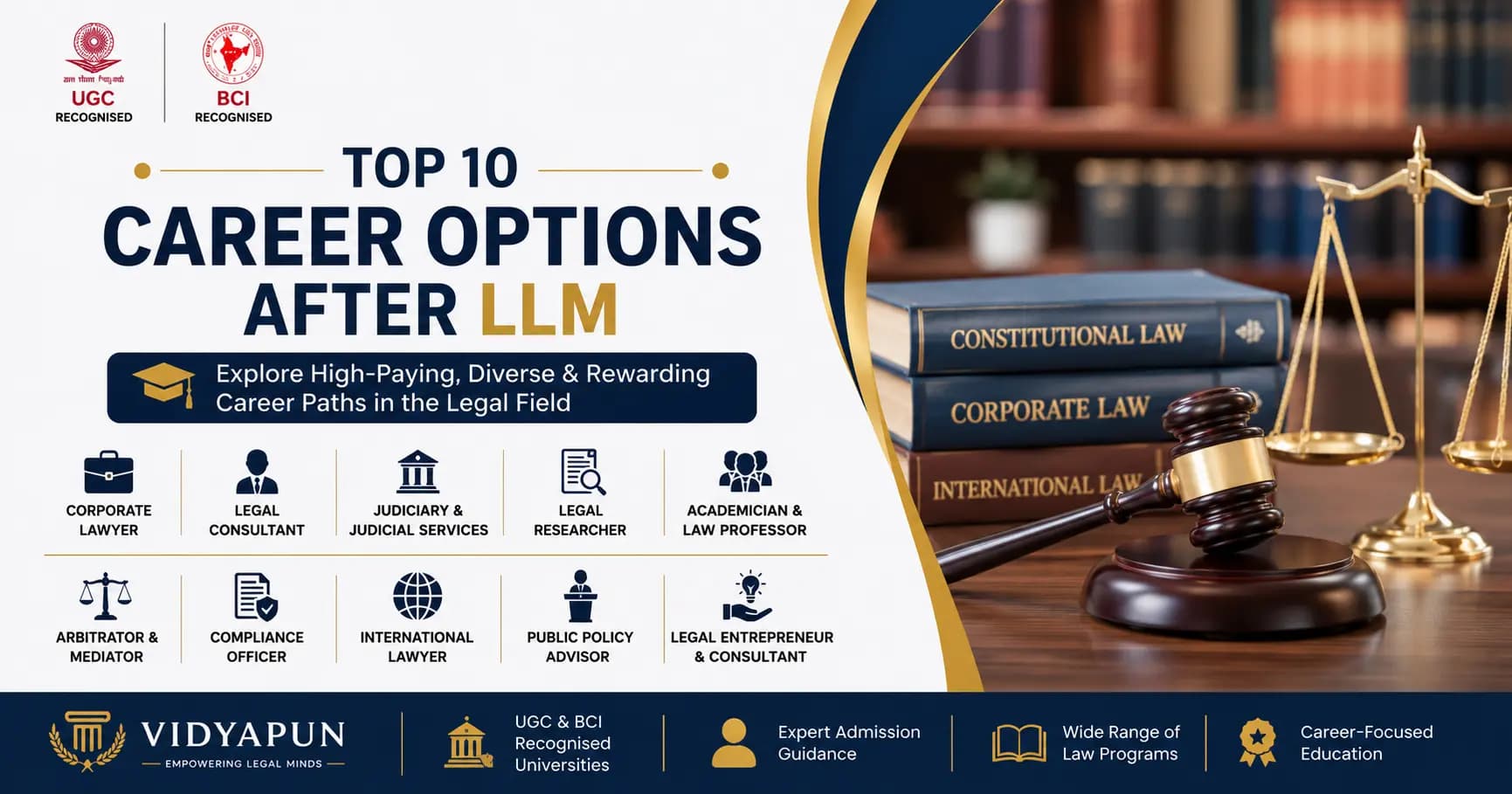
Top 10 Career Options After LLM
An LLM (Master of Laws) is one of the most valuable postgraduate degrees for law graduates looking to build expertise in a specialized area of law. Beyond strengthening legal knowledge, an LLM opens doors to diverse career opportunities across corporate organizations, law firms, government departments, research institutions, international organizations, and academia.
As industries continue to evolve, employers increasingly seek legal professionals with advanced qualifications, analytical thinking, and specialization in areas such as Corporate Law, Cyber Law, Constitutional Law, Intellectual Property Rights, and International Law.
Below are ten rewarding career options that students can consider after completing an LLM.
1. Corporate Lawyer
Corporate Lawyers advise businesses on legal matters related to contracts, mergers, acquisitions, corporate governance, compliance, and commercial transactions.
Responsibilities
- Draft commercial agreements
- Handle mergers and acquisitions
- Ensure regulatory compliance
- Provide legal opinions
- Manage corporate disputes
Skills Required
- Legal Drafting
- Contract Management
- Business Knowledge
- Negotiation
- Communication
2. Legal Consultant
Legal Consultants provide legal advice to businesses, startups, NGOs, and individuals without representing clients in court.
Responsibilities
- Legal Documentation
- Compliance Advice
- Risk Assessment
- Policy Review
- Business Advisory
Best For
Professionals who enjoy advisory and consulting roles.
3. Judiciary & Judicial Services
Students interested in serving the justice system may prepare for Judicial Service Examinations, subject to the applicable eligibility criteria.
Career Scope
- Civil Judge
- Judicial Magistrate
- District Judiciary
- Tribunal Services
Judicial careers require strong legal knowledge, ethical judgment, and continuous preparation.
4. Legal Researcher
Research plays a vital role in legal reforms, policy development, and academic advancement.
Employment Areas
- Universities
- Research Institutions
- Think Tanks
- Policy Organisations
- Legal Publishing
This role is suitable for professionals interested in analytical and academic work.
5. Law Professor or Academician
Many LLM graduates pursue teaching and academic careers.
Responsibilities may include:
- Teaching law subjects
- Conducting legal research
- Publishing research papers
- Guiding students
- Curriculum development
Teaching provides opportunities to contribute to legal education and scholarship.
6. Compliance Officer
Every large organisation needs professionals who understand laws, regulations, and industry standards.
Responsibilities
- Monitor compliance
- Develop compliance policies
- Risk Management
- Regulatory Reporting
- Internal Audits
Compliance professionals are in demand across banking, finance, healthcare, manufacturing, and technology sectors.
7. International Lawyer
International Lawyers advise on legal matters involving multiple countries and jurisdictions.
They may work in areas such as:
- International Trade
- Human Rights
- Diplomatic Relations
- International Arbitration
- Cross-border Transactions
Knowledge of international regulations and treaties is essential for this career path.
8. Public Policy Advisor
Legal professionals often contribute to policy formulation and legislative reforms.
Responsibilities
- Policy Research
- Legislative Analysis
- Government Advisory
- Public Administration
- Legal Reform
This career combines legal expertise with governance and public service.
9. Arbitrator & Mediator
Alternative Dispute Resolution (ADR) has become an increasingly important part of the legal system.
Professionals in this field help resolve disputes efficiently through:
- Arbitration
- Mediation
- Negotiation
- Settlement Discussions
ADR offers opportunities outside traditional courtroom litigation.
10. Legal Entrepreneur or Independent Consultant
Experienced legal professionals may establish independent consulting practices or legal service firms.
Services may include:
- Corporate Advisory
- Legal Documentation
- Startup Consultancy
- Compliance Support
- Contract Drafting
Entrepreneurship offers flexibility and opportunities to develop niche legal expertise.
Why Pursue an LLM?
An LLM helps professionals:
- Gain advanced legal knowledge
- Develop specialization
- Improve research capabilities
- Expand career opportunities
- Strengthen professional credibility
- Prepare for leadership roles
Advanced legal education can support long-term career growth across multiple industries.
Popular LLM Specializations
Students can specialize in areas including:
- Corporate Law
- Cyber Law
- Constitutional Law
- Criminal Law
- Intellectual Property Rights
- International Law
- Human Rights Law
- Environmental Law
- Banking & Finance Law
- Labour & Employment Law
Selecting a specialization should align with your interests and long-term career goals.
Essential Skills for LLM Graduates
Successful legal professionals continuously develop:
- Legal Research
- Legal Drafting
- Critical Thinking
- Communication Skills
- Negotiation
- Problem Solving
- Leadership
- Ethics & Professional Responsibility
- Technology Awareness
These skills are valuable across both traditional and emerging legal careers.
Why Choose Vidyapun?
Choosing the right university and specialization is an important step in building a successful legal career.
Vidyapun provides:
- LLM Admission Guidance
- University Comparison
- Course Selection Support
- Career Counselling
- Eligibility Assessment
- Documentation Assistance
- Admission Support
Our experienced counsellors help students make informed educational and career decisions.
Frequently Asked Questions
Is an LLM worth pursuing?
An LLM can help graduates develop specialized legal knowledge, strengthen research skills, and explore advanced career opportunities.
Which specialization offers strong career prospects?
Corporate Law, Cyber Law, Intellectual Property Rights, International Law, and Banking & Finance Law are among the popular specializations. Career outcomes depend on individual interests, qualifications, and market demand.
Can I become a professor after an LLM?
Many universities consider LLM graduates for academic roles, subject to institutional requirements and applicable regulations.
Is Corporate Law a good career?
Corporate law offers opportunities in businesses, multinational companies, consulting firms, and legal practices. Career growth depends on expertise, experience, and professional development.
How can Vidyapun help?
Vidyapun assists students with university selection, admission guidance, documentation, specialization counselling, and career planning.
Conclusion
An LLM degree offers far more than academic advancement—it opens the door to specialized legal careers in corporate organizations, the judiciary, academia, research, compliance, public policy, and international law. By choosing the right specialization, continuously developing practical skills, and staying informed about legal and technological developments, graduates can build rewarding and future-ready careers.
Whether your ambition is to become a corporate lawyer, legal consultant, researcher, compliance officer, or educator, careful planning and the right guidance can help you achieve your professional goals.
Website: www.vidyapun.com
Call / WhatsApp: +91 96438 02216
Connect with Vidyapun today to explore LLM programmes, compare recognised universities, and take the next step toward a successful legal career.