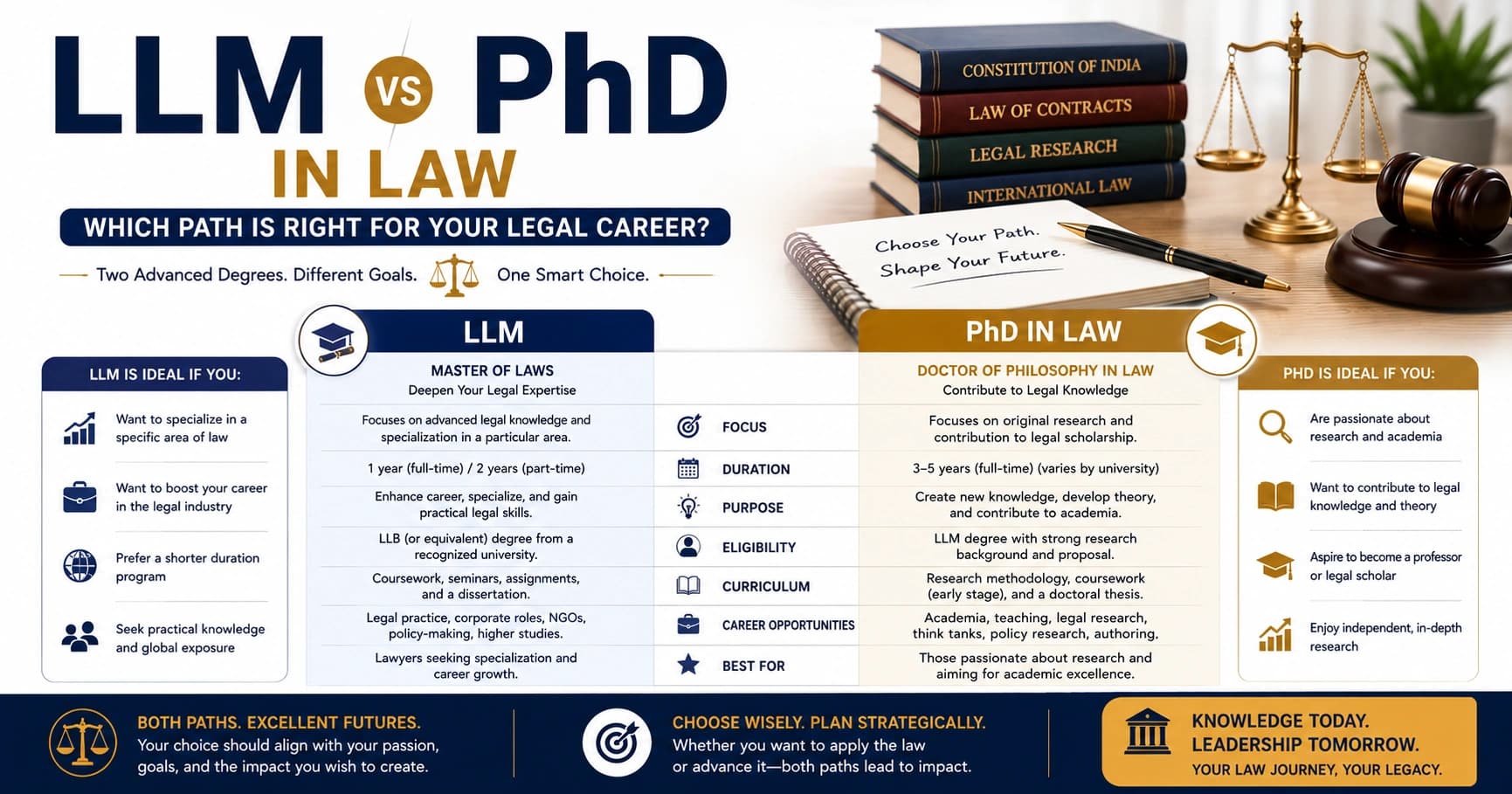
After completing a Bachelor of Laws (LLB) or an integrated BA LLB Course, many aspiring legal professionals wonder whether they should pursue a Master of Laws (LLM) Course or continue toward a PhD in Law. Both qualifications offer unique advantages, but the right choice depends on your career aspirations, interests, and long-term professional goals.
An LLM helps you develop specialized legal expertise and practical knowledge in a chosen field of law, while a PhD focuses on advanced legal research and academic contributions. Understanding the differences between these two programs can help you make an informed decision.
What Is an LLM?
A Master of Laws (LLM) Course is a postgraduate degree designed for law graduates who wish to specialize in a particular area of law.
Common specializations include:
- Corporate Law
- Criminal Law
- Cyber Law
- Intellectual Property Rights
- Constitutional Law
- International Law
- Human Rights Law
- Environmental Law
- Taxation Law
An LLM combines advanced coursework, legal research, seminars, and dissertation writing to prepare students for specialized legal careers.
What Is a PhD in Law?
A PhD in Law is the highest academic qualification in the legal field. It emphasizes original legal research, critical analysis, and contributions to legal scholarship.
Students pursuing a PhD spend several years conducting independent research under faculty supervision and produce a comprehensive thesis.
A PhD is ideal for individuals interested in teaching, policy research, judicial studies, and academic leadership.
LLM vs PhD in Law: Key Differences
| Feature | LLM | PhD in Law |
| Course Level | Postgraduate | Doctoral |
| Duration | 1–2 Years | 3–6 Years |
| Focus | Legal specialization | Original research |
| Research | Moderate | Extensive |
| Dissertation | Yes | Full doctoral thesis |
| Best For | Lawyers & legal professionals | Researchers & academics |
Eligibility Criteria
LLM
To pursue an LLM, candidates generally need:
- An LLB or BA LLB degree
- Minimum qualifying marks as required by the university
- Entrance examination or merit-based admission (depending on the institution)
PhD in Law
For a PhD, candidates typically require:
- An LLM degree (or equivalent, depending on institutional regulations)
- Research proposal
- Entrance examination and interview (where applicable)
Who Should Choose an LLM?
An LLM is suitable for students who want to:
- Specialize in a legal field
- Work in law firms
- Join multinational companies
- Become legal consultants
- Practice corporate law
- Build expertise in emerging legal areas
Who Should Pursue a PhD?
A PhD is ideal for individuals who want to:
- Become university professors
- Conduct legal research
- Publish academic papers
- Influence legal policy
- Work with think tanks
- Lead research institutions
Career Opportunities After an LLM
Graduates can explore careers such as:
- Corporate Lawyer
- Legal Advisor
- Compliance Officer
- Intellectual Property Lawyer
- Cyber Law Specialist
- Arbitration Consultant
- Legal Consultant
- International Law Expert
Career Opportunities After a PhD
Doctoral graduates may work as:
- Law Professor
- Legal Researcher
- Policy Analyst
- Research Fellow
- Academic Consultant
- Legal Scholar
- Think Tank Researcher
- Judicial Research Officer
Salary Prospects
Salary varies based on experience, specialization, employer, and location.
After an LLM
Career opportunities may be available in:
- Law firms
- Corporate legal departments
- Government organizations
- International institutions
- Consulting firms
After a PhD
Professionals may find opportunities in:
- Universities
- Research institutions
- Public policy organizations
- Government research bodies
- International organizations
Skills Developed During an LLM
An LLM helps students improve:
- Legal drafting
- Research methodology
- Contract analysis
- Legal writing
- Case analysis
- Negotiation
- Compliance
- Client advisory
Skills Developed During a PhD
Doctoral research develops:
- Advanced legal research
- Critical analysis
- Academic writing
- Independent research
- Policy evaluation
- Data interpretation
- Scholarly publication
- Research leadership
Which Degree Has Better Career Opportunities?
Neither degree is universally "better." The right choice depends on your career goals.
Choose an LLM if you want to:
- Practice law
- Specialize in a legal domain
- Work in corporate legal departments
- Advance your legal career quickly
Choose a PhD if you want to:
- Build an academic career
- Conduct long-term legal research
- Teach at universities
- Influence legal policy and scholarship
Future Trends in Legal Education
The legal profession continues to evolve with technology and globalization.
High-demand areas include:
- Artificial Intelligence & Law
- Cybersecurity Law
- Data Privacy
- ESG Compliance
- Digital Governance
- International Arbitration
- Financial Technology Law
- Healthcare Law
Professionals with advanced specialization or research expertise in these fields are expected to remain in demand.
Conclusion
Choosing between an LLM and a PhD in Law depends on where you see your future. If your goal is to become a specialized legal practitioner, consultant, or corporate lawyer, an LLM offers excellent opportunities for professional growth. If you're passionate about legal research, teaching, and contributing to legal scholarship, a PhD in Law may be the right path.
Explore the Master of Laws (LLM) Course, Bachelor of Laws (LLB), and BA LLB Course to understand your legal education options and choose the program that aligns with your career aspirations.
🌐 Website: www.vidyapun.com
📞 Call / WhatsApp: +91 96438 02216
Take the next step toward a successful legal career with expert admission guidance from Vidyapun.
Frequently Asked Questions
1. Is an LLM necessary before pursuing a PhD in Law?
Many universities require an LLM for PhD admission, though eligibility criteria vary by institution.
2. Which degree is better for corporate law?
An LLM with a specialization in Corporate Law is generally well suited for corporate legal careers.
3. Can I teach after completing an LLM?
Teaching opportunities depend on institutional requirements and applicable regulations. Some positions may require additional qualifications, including a PhD.
4. Does a PhD improve career opportunities?
A PhD can strengthen opportunities in academia, legal research, public policy, and research institutions.
5. Which is better for legal research?
A PhD is specifically designed for advanced legal research and original scholarly contributions.