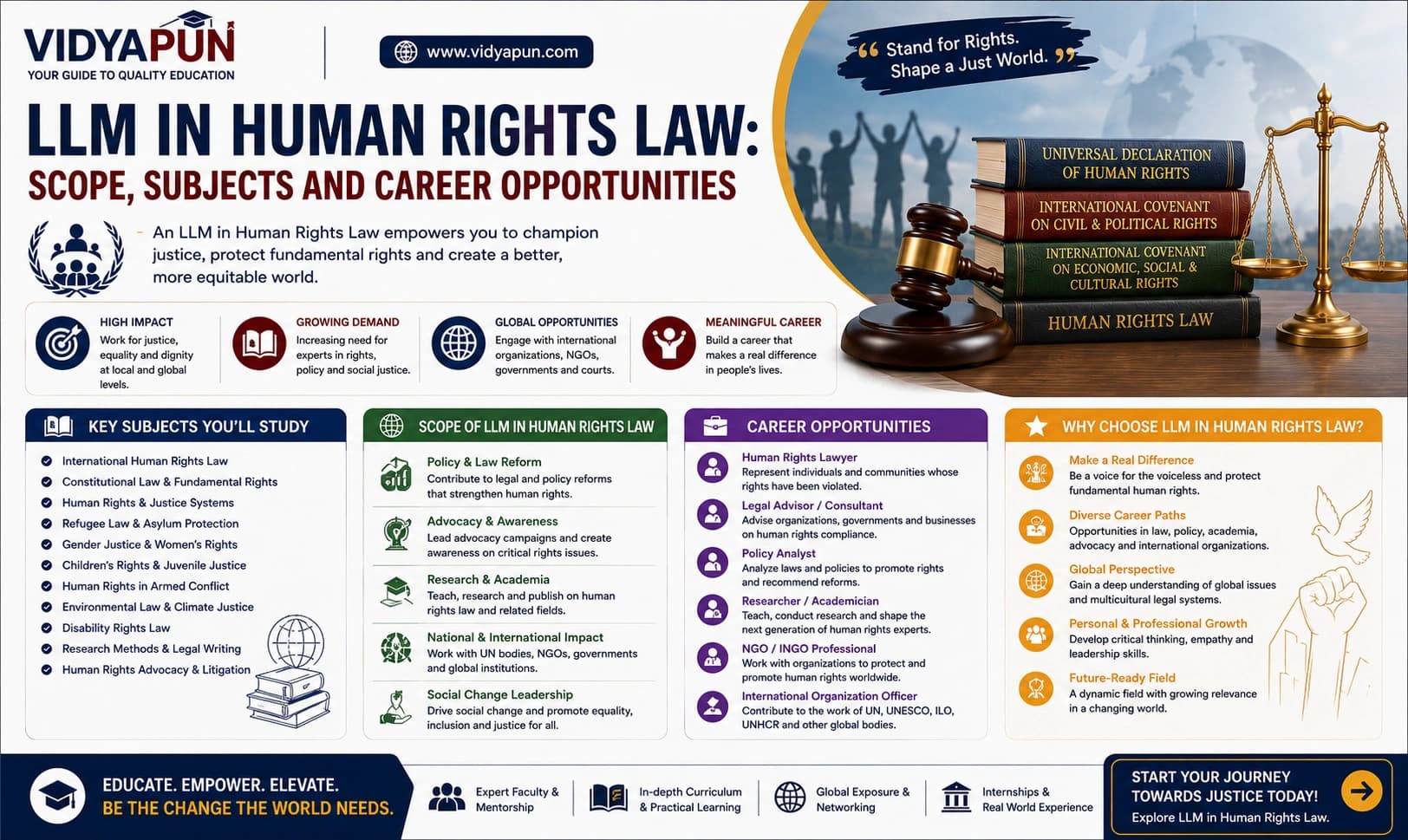
A meaningful share of LLM in Human Rights Law applicants aren't fresh LLB graduates — they're lawyers already a few years into corporate practice, litigation, or government roles who want a genuine pivot toward public interest work. If that's you, the honest questions aren't just "what does the syllabus cover" but "will my current experience count for anything" and "is this actually a realistic career move at this stage."
This guide covers what an LLM in Human Rights Law actually involves, and answers those switching-specific questions directly.
Why Lawyers Switch Into Human Rights Law
The pivot toward human rights law tends to come from a specific place — lawyers who've built solid legal fundamentals in another practice area but want their work to connect more directly to social impact. Common starting points include:
- Corporate lawyers – seeking a shift from commercial practice toward public interest litigation or policy work
- Litigators – wanting to specialize in constitutional and civil rights cases specifically
- Government and PSU lawyers – moving toward international human rights bodies or NGO legal roles
- Journalists and policy professionals with a law degree – formalizing existing human rights interest with specialized credentials
An LLM doesn't erase your prior specialization — it adds credibility and network access for the switch, without requiring you to start from zero. Our guide on why choose an LLM after LLB and LLM degree benefits covers how an LLM functions as a career pivot tool more broadly, not just for fresh graduates.
Core Subjects in an LLM in Human Rights Law
A typical LLM in Human Rights Law curriculum covers:
- International Human Rights Law – core treaties, conventions, and enforcement mechanisms
- Constitutional Law and Fundamental Rights – Indian constitutional protections and judicial interpretation
- Refugee and Migration Law – legal frameworks governing displacement and asylum
- Gender and the Law – legal protections and jurisprudence around gender-based rights
- Criminal Justice and Human Rights – custodial rights, due process, and criminal justice reform
- International Humanitarian Law – law governing armed conflict and civilian protection
- Economic, Social, and Cultural Rights – legal frameworks around housing, health, education, and labor rights
- Human Rights Litigation and Advocacy – practical skills for public interest litigation and advocacy work
For a broader sense of how LLM electives are typically structured, our LLM entrance exam syllabus subject-wise breakdown is a useful reference, and our guide on human rights law as a growing career path after BA LLB is worth reading for additional context on where this specialization is headed.
Top Universities Offering LLM in Human Rights Law
Several Indian law schools offer strong human rights law specializations within their LLM programs:
- National Law School of India University (NLSIU), Bengaluru – established human rights and constitutional law faculty
- NALSAR University of Law, Hyderabad – dedicated human rights law electives and clinical legal education programs
- National Law University, Delhi – strong ties to Delhi-based human rights organizations and policy bodies
- Jindal Global Law School – broad international human rights and humanitarian law elective range
- Tata Institute of Social Sciences (TISS), Mumbai – for candidates interested in a more interdisciplinary human rights and social justice program
If you're weighing this pivot against staying in your current specialization, our guide on international law careers for BA LLB graduates offers related context on adjacent global-facing legal careers.
Eligibility: Does Your Current Experience Count?
Eligibility for an LLM in Human Rights Law follows the standard LLM admission criteria — your prior specialization doesn't disqualify you, and in many cases it strengthens your application:
- A recognized LLB / BA LLB / BBA LLB degree from a BCI-approved university (any specialization background is accepted)
- Minimum qualifying marks (varies by university and category)
- Entrance exam score and/or interview, depending on the university's admission route
- Work experience in a related field (litigation, policy, NGO work, journalism) is often viewed favorably, even if not formally required
See our detailed guides on LLM eligibility criteria and the full LLM admission process explained step by step. If you're applying with a few years of unrelated practice behind you, our guide on how LLM admission changes for working professionals is directly relevant, and our guide on writing an LLM statement of purpose that works is especially useful for framing a career-switch narrative convincingly.
Entrance Exams You'll Need
Admission to most reputed human rights law LLM programs goes through a standard LLM entrance route:
- CLAT PG – the most widely accepted route into NLUs; see our CLAT PG registration step-by-step guide and CLAT PG syllabus and preparation strategy
- AILET PG – NLU Delhi's own exam; see our AILET PG complete exam guide
- University-level exams – many private and state universities run independent entrance tests; see our full list of university-level LLM entrance exams in India
- Entrance-free routes – some universities admit based on merit or interview alone; see merit-based vs entrance-based LLM admission
If you've been out of academic study for a few years, revisiting exam prep can feel like the biggest hurdle — our guide to LLM entrance exams other than CLAT PG covers routes that may better suit a working-professional timeline.
Career Paths After an LLM in Human Rights Law
An LLM in Human Rights Law opens several distinct career tracks — realistically, some pay considerably less than corporate practice, which is worth planning for honestly:
- NGOs and civil society organizations – legal and advocacy roles at human rights organizations
- International bodies – roles with UN agencies, international human rights commissions, or related organizations
- Public interest litigation – specialized litigation practice focused on constitutional and human rights cases
- Policy and research roles – working with think tanks or research institutions on human rights policy
- Academia – teaching or research roles in human rights and constitutional law
- Government and quasi-judicial bodies – roles with human rights commissions at state or national level
For a broader look at post-LLM career outcomes and realistic compensation expectations, see our guide on top career options after LLM, and our overview of career after LLB: 15 high-paying career options for law graduates if you want a clear-eyed comparison against your current corporate or litigation earnings before committing to the switch.
Frequently Asked Questions
Can a corporate lawyer switch to human rights law after an LLM?
Yes. Many LLM in Human Rights Law candidates come from corporate, litigation, or government backgrounds. Prior legal experience is generally viewed as an asset, not a barrier, and doesn't need to be human-rights-specific.
Is an LLM in Human Rights Law a financially viable career switch?
It depends on the specific role. NGO and civil society roles typically pay less than corporate practice, while positions with international bodies, government human rights commissions, or specialized public interest litigation can offer more competitive compensation. It's worth researching target roles and realistic salary ranges before committing to the switch.
Do I need prior human rights experience to apply for this LLM?
No. While relevant experience (NGO work, journalism, policy roles) can strengthen your application and statement of purpose, it isn't a formal eligibility requirement — a valid LLB and qualifying entrance exam score or interview are what matters most.
What subjects are covered in an LLM in Human Rights Law?
Core subjects typically include International Human Rights Law, Constitutional Law and Fundamental Rights, Refugee and Migration Law, Gender and the Law, Criminal Justice and Human Rights, and International Humanitarian Law.
Which universities are best for an LLM in Human Rights Law in India?
NLSIU Bengaluru, NALSAR Hyderabad, NLU Delhi, Jindal Global Law School, and TISS Mumbai are among the most recognized institutions for human rights law specializations in India.
Final Thoughts
Switching into human rights law after building a career elsewhere isn't a step backward — it's a specialization that specifically values the practical legal grounding you've already built, whatever area it came from. Go in with a clear-eyed view of the compensation trade-offs, but don't assume your current experience doesn't count; in most cases, it's exactly what makes your application stand out.
Not sure if you meet the eligibility criteria for an LLM in Human Rights Law given your background? Check Your Eligibility for a personalized assessment.
(Note: swap the "Check Eligibility" CTA link above for your dedicated eligibility-check page if it differs from the admission-chances URL — used as the closest confirmed equivalent.)
🌐 Website: www.vidyapun.com 📞 Call / WhatsApp: +91 96438 02216