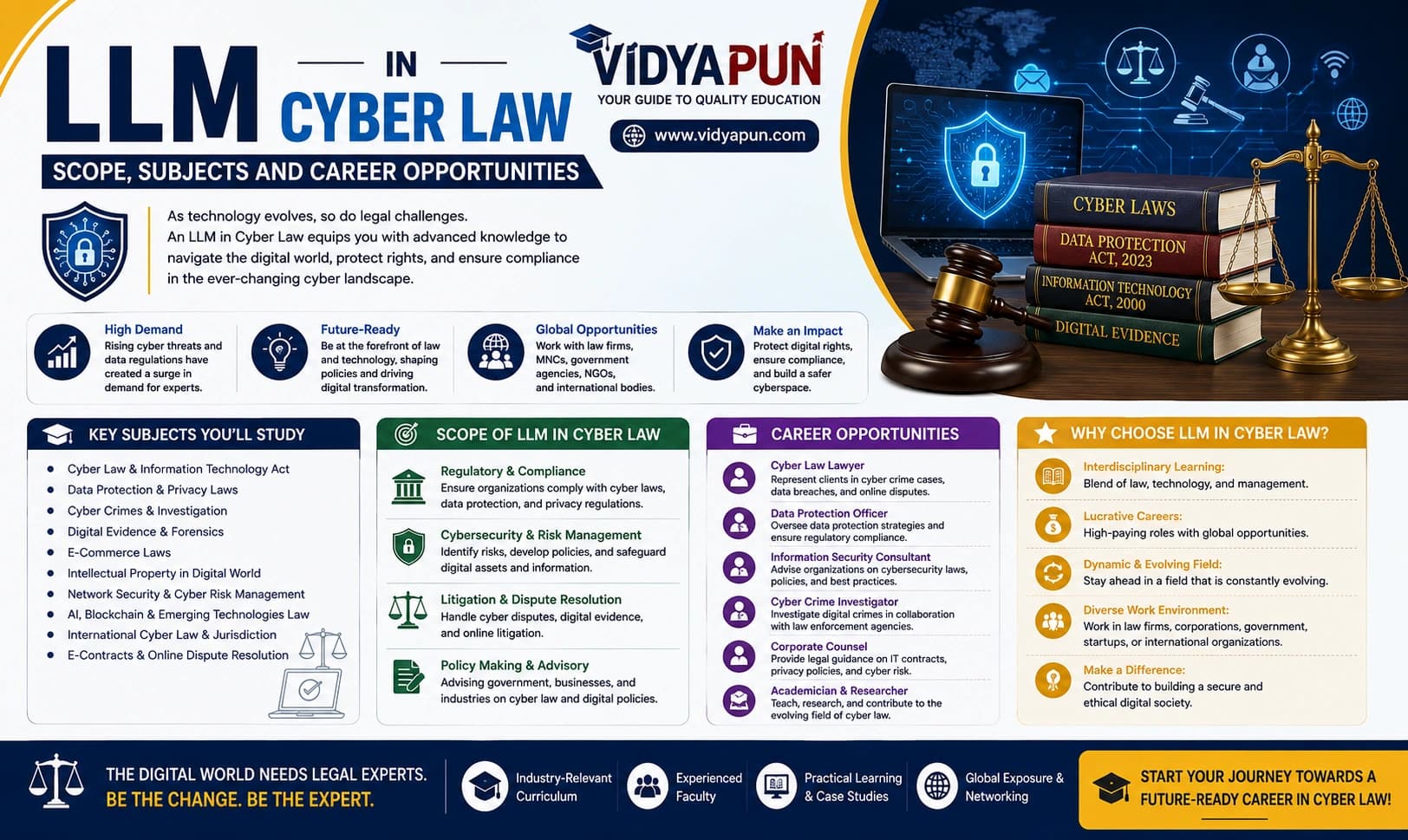
Cyber law has moved from a niche elective to one of the fastest-growing LLM specializations in India, driven by expanding data protection regulation, rising cybercrime litigation, and a genuine shortage of legal scholars with deep technical-legal expertise. For research scholars in particular, it's also one of the most fertile areas for original, publishable legal scholarship — the law here is still actively being written.
This guide covers what an LLM in Cyber Law actually involves — the curriculum, emerging research areas, top universities, and the career and academic paths it opens up.
Why Cyber Law Is a High-Growth Specialization
Unlike more settled areas of law, cyber law sits at a genuinely unresolved intersection of technology, criminal procedure, and constitutional rights — which is exactly what makes it attractive for research-oriented students:
- Regulatory expansion – ongoing developments under the Information Technology Act, 2000 and India's evolving data protection framework are generating fresh legal questions faster than case law can settle them
- Cross-disciplinary demand – courts, regulators, and companies increasingly need legal scholars who understand both law and technology
- Under-researched terrain – compared to corporate or constitutional law, published Indian scholarship on cyber law is still relatively thin, leaving real room for original contribution
- Growing litigation volume – cybercrime, data breach liability, and platform regulation disputes are rising steadily, creating both academic and practical demand
If you're deciding between specializations altogether, our guide on best LLM specializations for a successful legal career and top emerging legal specializations after LLM are useful companion reads, alongside how to choose the right LLM specialization before applying.
Core Subjects in an LLM in Cyber Law
A typical LLM in Cyber Law curriculum covers:
- Information Technology Law – the Information Technology Act, 2000 and its amendments, covering electronic contracts, digital signatures, and cyber offenses
- Data Protection and Privacy Law – India's evolving data protection framework and comparative approaches like the EU's GDPR
- Cyber Crime and Digital Forensics – offenses, investigation procedure, and admissibility of digital evidence
- E-Commerce and Platform Regulation – intermediary liability, consumer protection, and competition issues arising from digital platforms, tying into the role of the Competition Commission of India
- Intellectual Property in Cyberspace – copyright, trademark, and patent issues specific to digital content and software, relevant to work with the Intellectual Property Office
- Cyber Security Law and Policy – legal frameworks governing critical infrastructure protection and incident response
- International and Comparative Cyber Law – cross-border jurisdiction issues and international cooperation frameworks
For a broader sense of how LLM electives are typically structured, our LLM entrance exam syllabus subject-wise breakdown is a useful reference, and our primer on introduction to cyber law for BA LLB students is worth reading if you're building foundational knowledge before you specialize further.
Research Areas Worth Exploring
For research scholars specifically, cyber law offers several genuinely under-explored areas for dissertation or publication work:
- Algorithmic accountability and AI regulation – how existing legal frameworks apply (or fail to apply) to automated decision-making
- Cross-border data flows and jurisdiction – conflict-of-law questions in an increasingly borderless digital economy
- Platform liability and content regulation – the evolving balance between free expression and intermediary responsibility
- Cyber warfare and international humanitarian law – an emerging and still largely unsettled area of international legal scholarship
- Data protection enforcement gaps – comparative study of how regulatory bodies are (or aren't) enforcing data protection provisions in practice
If you're weighing an LLM against a full research degree, our comparison of LLM vs PhD in law as a career path walks through how each route supports long-term academic and research goals differently.
Top Universities Offering LLM in Cyber Law
Several Indian law schools have built genuine research strength in technology and cyber law:
- National Law School of India University (NLSIU), Bengaluru – strong interdisciplinary research culture and technology law faculty
- National Law University, Delhi – active research output on data protection and digital rights
- NALSAR University of Law, Hyderabad – established technology law program with dedicated electives
- Gujarat National Law University (GNLU), Gandhinagar – growing focus on cyber law and IP-adjacent research
- Jindal Global Law School – broad elective range covering technology, data, and platform regulation
When shortlisting, look closely at each university's ongoing research output, faculty publications, and any dedicated technology law research centers — these matter more here than general rankings, especially if you're pursuing the LLM with research or eventual PhD ambitions in mind.
Eligibility and Admission Process
Eligibility for an LLM in Cyber Law follows the standard LLM admission criteria:
- A recognized LLB / BA LLB / BBA LLB degree from a BCI-approved university
- Minimum qualifying marks (varies by university and category)
- Entrance exam score and/or interview, depending on the university's admission route
See our detailed guides on LLM eligibility criteria and the full LLM admission process explained step by step. Since research-focused applicants are often evaluated partly on their proposed area of study, our guide on writing an LLM statement of purpose that works is especially useful for framing a cyber law research interest convincingly.
Entrance Exams You'll Need
Admission to most reputed cyber law LLM programs goes through a standard LLM entrance route:
- CLAT PG – the most widely accepted route into NLUs; see our CLAT PG registration step-by-step guide and CLAT PG syllabus and preparation strategy
- AILET PG – NLU Delhi's own exam; see our AILET PG complete exam guide
- University-level exams – many private and state universities run independent entrance tests; see our full list of university-level LLM entrance exams in India
If you've missed CLAT PG or want to keep other options open, our guide to LLM entrance exams other than CLAT PG covers the full range of alternatives, including merit-based routes.
Career and Research Paths After an LLM in Cyber Law
An LLM in Cyber Law opens both practice-oriented and research-oriented tracks:
- Academia and research – teaching or research roles focused on technology and cyber law, often a stepping stone toward a PhD
- Policy and regulatory bodies – working with government bodies and regulators shaping data protection and cyber security policy
- Law firm practice – advising companies on data protection compliance, cyber incident response, and platform regulation
- In-house counsel – handling data privacy and cyber security compliance for technology companies
- International organizations – roles focused on cross-border cyber law, digital rights, and internet governance
For a broader look at post-LLM outcomes generally, see our guide on top career options after LLM, and our overview of LLM degree benefits and why choose an LLM after LLB if you're still confirming the LLM route is right for you before specializing further.
Frequently Asked Questions
Is an LLM in Cyber Law a good choice for research scholars?
Yes. Cyber law is one of the least-settled and least-researched areas of Indian law, offering genuine opportunities for original dissertation work and publishable scholarship, particularly around data protection enforcement, platform regulation, and AI accountability.
What subjects are covered in an LLM in Cyber Law?
Core subjects typically include Information Technology Law, Data Protection and Privacy Law, Cyber Crime and Digital Forensics, E-Commerce and Platform Regulation, and Intellectual Property in Cyberspace.
Which universities are best for an LLM in Cyber Law in India?
NLSIU Bengaluru, NLU Delhi, NALSAR Hyderabad, GNLU Gandhinagar, and Jindal Global Law School are among the universities with the strongest technology and cyber law research programs.
Can an LLM in Cyber Law lead to a PhD?
Yes, many students use an LLM in Cyber Law as a foundation before pursuing a PhD, particularly given how much unsettled legal terrain remains in this field for doctoral-level research.
Do I need CLAT PG to pursue an LLM in Cyber Law?
CLAT PG is the most common route into NLUs offering this specialization, but AILET PG, university-level entrance exams, and merit-based admissions are all valid alternatives depending on your target university.
Final Thoughts
Cyber law offers a rare combination for LLM students — strong and growing practical demand alongside genuinely under-researched academic terrain. For research scholars especially, it's one of the few specializations where the foundational legal questions are still being actively debated, making it fertile ground for meaningful, original scholarship.
🌐 Website: www.vidyapun.com 📞 Call / WhatsApp: +91 96438 02216