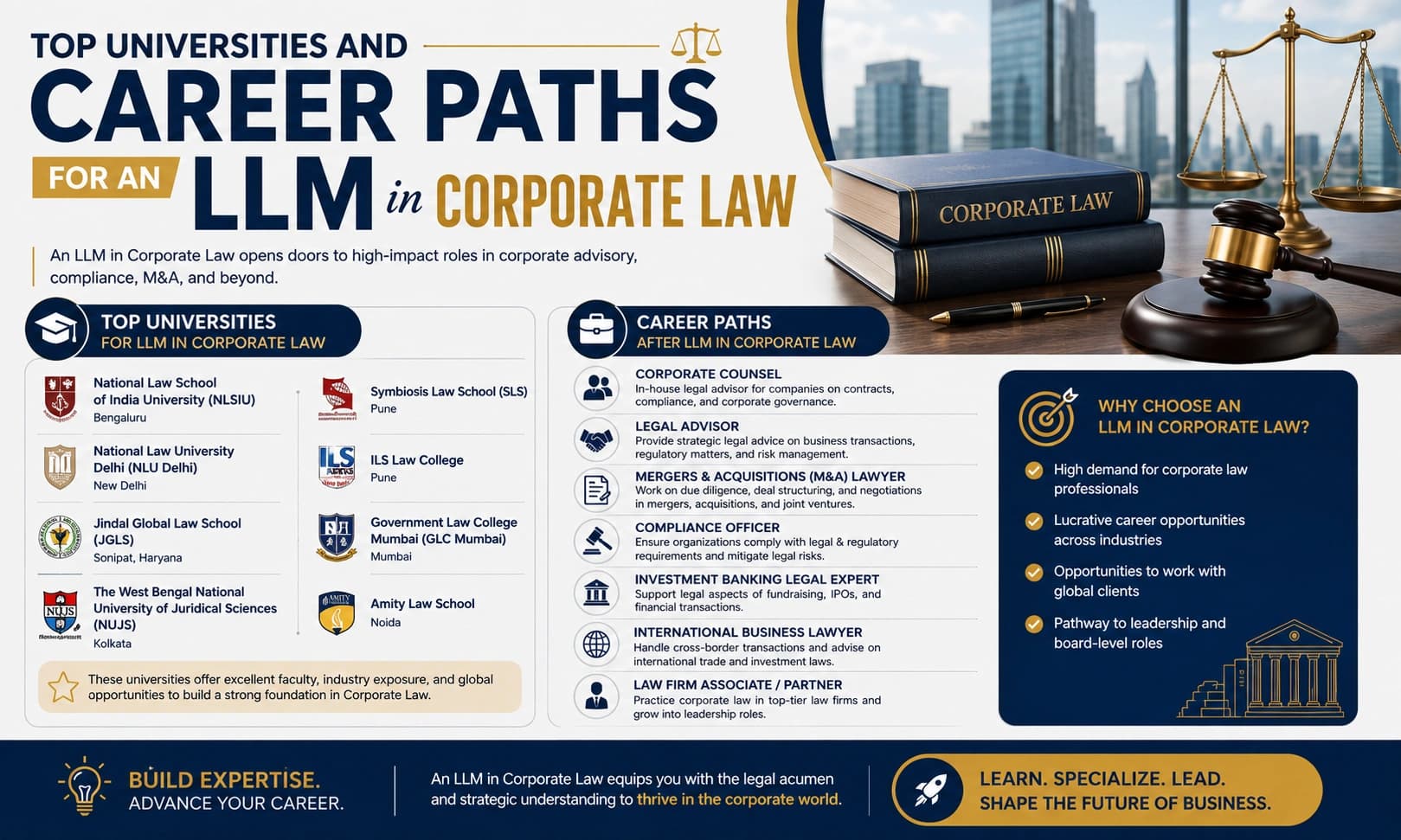
Corporate law is consistently one of the highest-demand LLM specializations in India, driven by a growing economy, an active M&A market, and evolving regulation under the Companies Act, 2013, the Competition Commission of India, and India's expanding IT and data protection framework. But not every university teaches corporate law the same way — curriculum depth, faculty expertise, and recruiter access vary widely.
This guide covers the top universities offering an LLM in Corporate Law, what the program actually involves, and the career paths it opens up.
Why Choose an LLM in Corporate Law
An LLM in Corporate Law builds specialized expertise in company law, mergers and acquisitions, securities regulation, competition law, and corporate governance — areas that generalist LLB training only touches on. If you're deciding between specializations altogether, our guide on best LLM specializations for a successful legal career is worth reading first, alongside how to choose the right LLM specialization before applying.
Corporate law also pairs well with several emerging practice areas — see our roundup of top emerging legal specializations after LLM if you're weighing corporate law against adjacent fields like fintech or competition law.
Top Universities Offering LLM in Corporate Law
While rankings shift slightly year to year, these institutions are consistently recognized for strong corporate law LLM programs in India:
| University | City | Known For |
| National Law School of India University (NLSIU) | Bengaluru | Business law faculty, strong corporate law research output |
| NALSAR University of Law | Hyderabad | Well-regarded corporate and securities law electives |
| National Law University | Delhi | Strong faculty in company law and competition law |
| Jindal Global Law School | Sonipat | Extensive corporate law elective range, international faculty |
| Gujarat National Law University (GNLU) | Gandhinagar | Strong ties to corporate law firms and industry |
| Symbiosis Law School | Pune | Well-established corporate law LLM with placement support |
Beyond reputation, look closely at faculty specialization, moot court and negotiation opportunities, and — critically — recruiter access during placements, since corporate law hiring is heavily relationship-driven.
Corporate Law LLM Curriculum: What You'll Actually Study
A typical LLM in Corporate Law covers:
- Company Law – incorporation, governance, directors' duties, and compliance under the Companies Act, 2013
- Mergers & Acquisitions – deal structuring, due diligence, and regulatory approvals
- Securities Law – SEBI regulations, capital markets, and disclosure requirements
- Competition Law – covering the role of the Competition Commission of India in mergers and anti-trust matters
- Corporate Governance – board structures, shareholder rights, and compliance frameworks
- Technology and Data Law electives – increasingly common given the Information Technology Act, 2000 and data protection developments
- Intellectual Property basics – especially relevant for corporate transactions involving the Intellectual Property Office
For a broader sense of how LLM subjects and electives are typically structured across specializations, our LLM entrance exam syllabus subject-wise breakdown is a useful reference, even though it focuses on entrance exams rather than the LLM curriculum itself.
Eligibility and Admission Process
Most corporate law LLM programs follow the same baseline eligibility as other LLM specializations:
- A recognized LLB / BA LLB / BBA LLB degree from a BCI-approved university
- Minimum qualifying marks (varies by university and category)
- Entrance exam score and/or interview, depending on the university's admission route
See our detailed guides on LLM eligibility criteria and the full LLM admission process explained step by step. If you're applying to a university requiring a statement of purpose specifically for a corporate law track, our guide on writing an LLM statement of purpose that works can help you frame your interest convincingly.
Entrance Exams You'll Need
Admission to most reputed corporate law LLM programs goes through a standard LLM entrance route:
- CLAT PG – the most widely accepted route into NLUs offering corporate law specializations; see our CLAT PG registration step-by-step guide and CLAT PG syllabus and preparation strategy
- AILET PG – NLU Delhi's own exam; see our AILET PG complete exam guide
- University-level exams – many private and state universities run independent entrance tests; see our full list of university-level LLM entrance exams in India
- Entrance-free routes – some universities admit based on merit alone; see merit-based vs entrance-based LLM admission
If you've missed CLAT PG or want to keep other options open, our guide to LLM entrance exams other than CLAT PG covers the full range of alternatives.
Fees Comparison Across Top Universities
Corporate law LLM fees vary significantly based on institution type:
- Government NLUs – generally range from ₹1.5 lakh to ₹3 lakh for the full program
- Private universities (e.g., Jindal, Symbiosis) – can range from ₹3 lakh to ₹8 lakh or more, depending on the institution
- Additional costs – hostel, application fees, and study material should be budgeted separately
Our guide on LLM admission fees and what to budget for breaks this down further, and our complete LLM admission checklist is worth reviewing before you start applying, alongside the documents required for LLM admission.
Career Paths After an LLM in Corporate Law
A corporate law LLM opens several distinct career tracks:
- Corporate law firms – working on M&A, private equity, and regulatory advisory for top-tier and boutique firms
- In-house counsel – joining a company's legal department to handle contracts, compliance, and governance
- Regulatory bodies – roles with SEBI, the Competition Commission of India, or similar bodies
- Consulting and advisory – compliance and risk advisory roles at consulting firms
- Academia and research – teaching or research roles focused on corporate and commercial law
For a broader look at where a corporate-focused legal career can lead, see our guides on how to become a corporate lawyer in India, corporate law career path for BA LLB graduates, and top career options after LLM more generally.
Salary Expectations in Corporate Law
Corporate law is among the higher-paying legal specializations in India, particularly at top-tier firms and MNCs. Compensation varies widely by firm tier, city, and experience level. For detailed, firm-wise and experience-wise figures, see our guides on corporate lawyer salary in India: law firm-wise pay breakdown and lawyer salary in India from fresher to senior advocate.
Skills That Make You Competitive
Beyond the LLM curriculum itself, recruiters in corporate law tend to look for:
- Strong drafting and negotiation skills
- Commercial awareness — understanding how legal decisions affect business outcomes
- Familiarity with regulatory frameworks like the Companies Act and competition law
- Comfort working under deadline pressure on live transactions
If you're still building this foundation during your LLB, our guide on corporate law for LLB students is a useful starting point before you specialize further at the LLM level.
How to Choose the Right University For You
With reputation being only one factor, weigh these before shortlisting:
- Faculty expertise in corporate, securities, and competition law specifically
- Recruiter relationships — ask for placement data broken down by practice area, not just overall numbers
- Elective depth — how many corporate-law-specific electives are actually offered
- Location — proximity to Delhi, Mumbai, or Bengaluru can meaningfully affect internship access during your LLM
- Cost vs. outcomes — a more expensive private university isn't automatically the better ROI; compare fees against realistic placement outcomes
If you're still deciding between an LLM and a research-focused path altogether, our comparison of LLM vs PhD in law as a career path and general breakdown of why choose an LLM after LLB and LLM degree benefits can help you confirm the LLM route is right for you before you commit to a specialization.
Frequently Asked Questions
Which is the best university for an LLM in Corporate Law in India?
NLSIU Bengaluru, NALSAR Hyderabad, NLU Delhi, and Jindal Global Law School are among the most consistently recognized universities for corporate law LLM programs, though the "best" choice depends on your budget, location preference, and career goals.
Do I need CLAT PG to pursue an LLM in Corporate Law?
Not necessarily. While CLAT PG is the most common route into NLUs, AILET PG, university-level entrance exams, and merit-based admissions are all valid alternatives depending on your target university.
What jobs can I get after an LLM in Corporate Law?
Common paths include corporate law firms, in-house counsel roles at companies, regulatory bodies like SEBI or the Competition Commission of India, consulting and compliance advisory, and academia.
Is an LLM in Corporate Law worth the fees at private universities?
It depends on the specific university's placement outcomes and your career goals. Compare fee structure against real placement data broken down by practice area rather than relying on general reputation alone.
What subjects are covered in an LLM in Corporate Law?
Core subjects typically include Company Law, Mergers & Acquisitions, Securities Law, Competition Law, and Corporate Governance, often alongside electives in technology, data, and intellectual property law.
Final Thoughts
An LLM in Corporate Law can open some of the most competitive and well-compensated roles in the legal profession, but the university you choose matters as much as the degree itself — faculty depth, recruiter access, and elective breadth vary more than rankings alone suggest. Shortlist based on your target career path first, then match it to the university that gives you the strongest route there.
Ready to explore corporate law LLM programs that fit your profile? Apply Now and get personalized university recommendations.
(Note: swap the "Apply Now" CTA link above for your dedicated application page if it differs from the admission-chances URL — used as the closest confirmed equivalent.)
🌐 Website: www.vidyapun.com 📞 Call / WhatsApp: +91 96438 02216